

There’s a number that keeps coming up in conversations about AI investment right now, and it’s so large it barely sounds real.
In the first quarter of 2026 alone, investors poured $300 billion into roughly 6,000 startups globally (Crunchbase, April 2026). That’s not a typo. A single quarter. One 90-day window. And it eclipses the total venture capital deployed in any full year before 2018.
If you’ve been paying attention to the funding headlines, you’ll have noticed something: the sheer scale of the money flowing into artificial intelligence has started to feel less like a venture trend and more like a geological event. Something that reshapes the landscape rather than just adding to it.
So where is it all actually going — and what does it mean if you’re building, investing, or simply trying to understand the industry?
The Numbers Are Genuinely Extraordinary
To understand the 2026 AI funding landscape, you first need to sit with a few data points.
Q1 2026 set an all-time record for global venture investment, with AI accounting for roughly 80% of the total — a figure that would have been unthinkable even two years ago (Crunchbase). For context, AI startups captured around half of global venture funding in Q4 2024. That percentage hovered around 50% through most of 2025. Then Q1 2026 arrived and blew straight past it.
What drove that jump? Four deals, almost entirely.
OpenAI closed a $122 billion round, the single largest private venture raise in history, pushing its valuation to $852 billion and putting the company within striking distance of a $1 trillion IPO it has reportedly been targeting for Q4 2026 (Crescendo AI). Anthropic followed with a $30.6 billion raise. xAI secured $20 billion. Self-driving company Waymo pulled in $16 billion. Together, those four deals accounted for nearly two-thirds of all global venture capital in the quarter.
Then in April, Anthropic came back to the table and raised another $15 billion, with Jeff Bezos’s Project Prometheus — focused on AI-enabled manufacturing — raising $10 billion in the same month. Those two deals alone represented 45% of all venture capital deployed globally in April (Crunchbase, May 2026).
The velocity is staggering. Global venture investment through April is up 139% year over year.
More Money, Fewer Winners
Here’s the thing that gets lost when you read those headline numbers: the concentration is extraordinary even by the standards of an already concentrated market.
According to PitchBook’s Q1 2026 AI VC Trends report, just three companies: OpenAI, Anthropic, and xAI, accounted for 67% of all AI funding in the quarter (PitchBook). The remaining $83.5 billion was split across 1,543 deals. So while more money than ever is entering the ecosystem, it’s going to fewer companies, and deal count has actually been falling even as dollar volume surges.
Median pre-money valuations nearly doubled in a single quarter, jumping from $30 million in Q4 2025 to $69.9 million. The venture-growth stage saw an even sharper leap — up more than 165% to $868.4 million (Crowdfund Insider / PitchBook). The Crunchbase Unicorn Board added $900 billion in value in a single quarter, the largest valuation bump on record.
What this means practically: the AI funding market is not uniformly hot. It’s extremely hot at the top and noticeably cooler everywhere else. Capital is overheating in frontier AI and cooling in much of the rest of the startup world. For founders outside the favored categories, the funding environment is tighter than the headline numbers suggest.
Sovereign Wealth Funds Have Become the New Power Brokers
One of the most significant structural shifts in AI funding is who’s writing the big cheques.
Traditional venture capital firms, even the largest, don’t have the balance sheet to write $30 billion or $122 billion rounds. The firms that do are sovereign wealth funds and they’ve become arguably the most important investors in the AI ecosystem.
Temasek (Singapore) participated in OpenAI’s record raise. The Qatar Investment Authority backed Anthropic. Saudi Arabia’s Public Investment Fund and Abu Dhabi’s Mubadala Investment Company have both substantially increased their AI allocations through 2025 and into 2026 (tech-insider.org). Combined, sovereign wealth funds globally manage assets exceeding $12 trillion, giving them a deployment capacity that dwarfs any traditional VC firm.
The strategic logic is straightforward: these funds want equity pre-IPO in companies they believe will become foundational infrastructure for the global economy. As one analyst put it, investors now treat frontier AI infrastructure as a sovereign wealth-class asset, not traditional venture capital.
The implication is that frontier AI development has effectively moved into a different financing category. When the capital demands of a single company outgrow what venture can provide, governments and sovereign funds step in to fill the gap.
Where the Rest of the Money Is Going
Strip away the frontier lab megarounds and what you’re left with is a picture of where the broader investment thesis is heading. A few categories stand out.
AI Infrastructure
The picks-and-shovels bet is alive and well. GPU cloud providers, data platforms, and semiconductor companies absorbed a significant share of funding outside the frontier labs. Databricks raised a major round. Infrastructure companies like Nscale and CoreWeave continue attracting capital from investors who believe the real returns are in enabling AI rather than building the models themselves. The logic: whoever owns the compute owns the category.
In April’s funding data, 145 deals went to AI infrastructure, the software and hardware that makes AI run, compared to 280 for general-purpose LLM and generative AI tools (Infor Capital, April 2026). Investors are increasingly betting on the plumbing, not just the applications.
Physical AI and Robotics
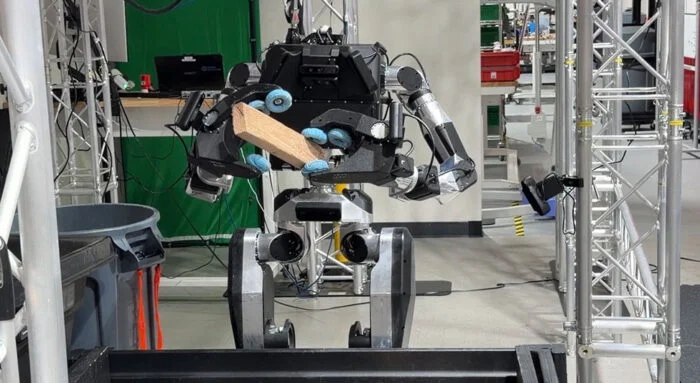
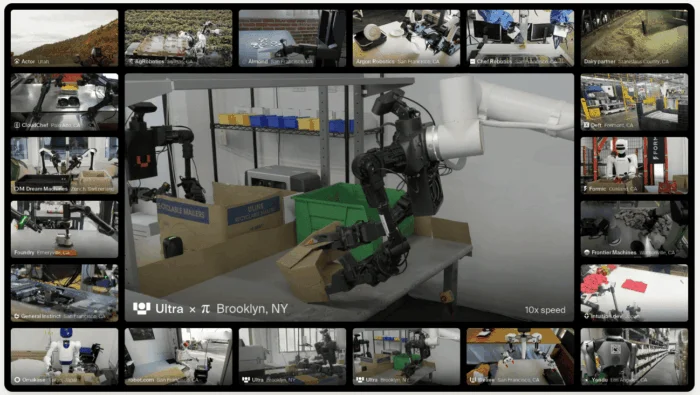
Unlike the cloud and mobile era, the 2026 AI investment cycle is being built in the physical world. Massive capital is flowing into autonomous vehicles, robotics, and manufacturing — not just software.
General-purpose robotics company Figure raised $1 billion in Series C funding. Humanoid robotics company Apptronik secured $935 million. FieldAI raised $405 million to develop foundational “robot brain” models for humanoids, drones, and autonomous vehicles. Reliable Robotics, focused on autonomous aircraft, pulled in $160 million (Crunchbase; Crescendo AI; Crunchbase weekly).
The thesis here is that physical AI: systems that can understand and operate in real environments, represents the next frontier after software intelligence. Investors who missed the LLM wave aren’t making the same mistake with robotics.
Defense Technology
Defense tech saw record funding in 2025, with overall sector investment reaching $8.5 billion — more than double the prior year. That momentum has carried into 2026. Shield AI secured $1.5 billion in a Series G round, valuing the company at $12.7 billion (up 140% in a year). Anduril Industries continues to raise at scale (Crunchbase; Crescendo AI).
The geopolitical backdrop is doing the work here. Investors who were previously cautious about defense exposure have largely set those reservations aside, and the dual-use nature of much AI technology makes the line between commercial and defense increasingly blurry anyway.
Vertical AI Applications
While horizontal AI platforms captured $197 billion in Q1, the more interesting story for most founders may be in vertical applications: AI built specifically for healthcare, legal, finance, construction, and other industries where domain expertise creates defensible moats.
Legal tech is a strong example. Venture funding to the sector totaled more than $4 billion in 2025, driven by tools that can analyse case transcripts, draft patents, and automate litigation workflows (Crunchbase). Steno raised $150 million total on the back of its legal AI platform. Ankar, a patent intelligence company, secured $20 million to help law firms navigate a database of 150 million patent applications (Crescendo AI).
Healthcare AI is attracting similar attention, though at longer investment timescales. Investors willing to navigate regulatory complexity are finding less competition and more durable competitive advantage than in faster-moving software categories.
The Geography of AI Capital
The geographic concentration in AI funding is as striking as the sectoral concentration.
US-based companies raised 83% of global venture capital in Q1 2026: up from 71% in Q1 2025, which was already well above historical averages (Crunchbase). Silicon Valley and San Francisco remain the dominant centres for frontier AI, developer platforms, and autonomous systems.
China pulled in $16.1 billion, the second-largest market globally, but a distant second. Ongoing export controls on advanced AI chips and geopolitical tensions continue to constrain the Chinese AI ecosystem relative to its size and talent base.
The UK attracted $7.4 billion, boosted by Wayve’s autonomous driving round and London’s continued strength in fintech. Europe as a whole saw $17.6 billion in Q1 — up nearly 30% year over year (Crunchbase), with new frontier model companies emerging in London, Paris, and Stockholm. Ineffable Intelligence, founded by former DeepMind researchers, raised a significant round. Legora and Wayve showed that European startups can attract global capital when they operate in large markets with genuine technical depth.
Still, the gap between the US and everywhere else is widening, not narrowing. Europe’s regulatory environment has created stability, but the risk appetite that produces $100 billion funding rounds hasn’t developed there the way it has in America.
What Investors Are Actually Looking For Now
The days of funding AI wrappers: products that are essentially thin interfaces sitting on top of someone else’s foundation model, are largely over. That shift happened through 2025 and the direction of travel in 2026 is clear.
Investors in 2026 are prioritising companies with genuine defensibility: proprietary data, novel architectures, deep workflow integration, or domain expertise that can’t easily be replicated. Proprietary data, novel architectures, and deep workflow integration now separate credible pitches from thin wrappers on foundation models (Sky9 Capital, May 2026). The cleaner way to put it: if your product would stop working (or become a commodity) the moment a frontier lab adds a similar feature natively, you probably won’t raise at the valuations that were available two years ago.
What is attracting capital: companies with enterprise-ready AI agents that can operate inside organisations with proper oversight and audit trails; physical AI systems with real-world deployment; vertical applications in regulated industries where buyer trust takes years to build; and infrastructure that serves AI builders rather than competing with them (Startup Insides, May 2026).
The Series A market in particular has sharpened. Investors are increasingly seeking companies that can demonstrate revenue, not just impressive demos. The barbell structure of the market — concentrated bets at the growth end, active seed funding at the early end — has squeezed the middle. If you’re raising a Series A, you need to look more like a growth company than you did two years ago (Crunchbase VC forecast).
The Question Nobody Can Quite Answer
There is an obvious question hovering over all of this: is it sustainable?
When a single company raises $122 billion in a private round, and when one quarter’s AI investment exceeds the entire prior year’s total, you’re in territory where historical precedent offers limited guidance.
The optimistic case: frontier AI models are genuinely foundational infrastructure for the next phase of the global economy, in the same way that cloud computing was in the 2010s. The capital requirements reflect that scale, and the returns — pre-IPO equity in companies targeting trillion-dollar valuations — will justify the concentration.
The cautious case: capital this concentrated creates fragility. When most of the venture market’s dollar volume depends on five companies and four or five investors, the ecosystem becomes brittle in ways that don’t show up in the quarterly numbers. And the AI application layer — where most companies actually live — is experiencing something much more sober than the headlines suggest.
Both things can be true simultaneously. The macro story of AI funding in 2026 is extraordinary by any measure. The micro story, for most founders and most investors operating outside the frontier lab category, is considerably more grounded.
The Honest Summary
The AI funding cycle of 2026 is unlike anything venture capital has seen. The numbers are real, the concentration is real, and the structural shift — from traditional VC to sovereign wealth, from software to physical AI, from horizontal platforms to defensible verticals — is real.
But so is this: the vast majority of that capital is going to a very small number of companies. The AI investment story that matters for most people in the ecosystem isn’t the $122 billion OpenAI round. It’s the Series A market, where investors are demanding revenue; the infrastructure layer, where the competition to build the picks and shovels is genuinely fierce; and the vertical application market, where the companies that survive will be the ones that actually solve industry-specific problems rather than ride the wave of general AI enthusiasm.
The money is there. More of it than ever. The question, as always, is whether the work behind it is worth it.
Data in this article is current as of May 2026, drawing on reports from Crunchbase, PitchBook, and KPMG Venture Pulse Q1 2026.