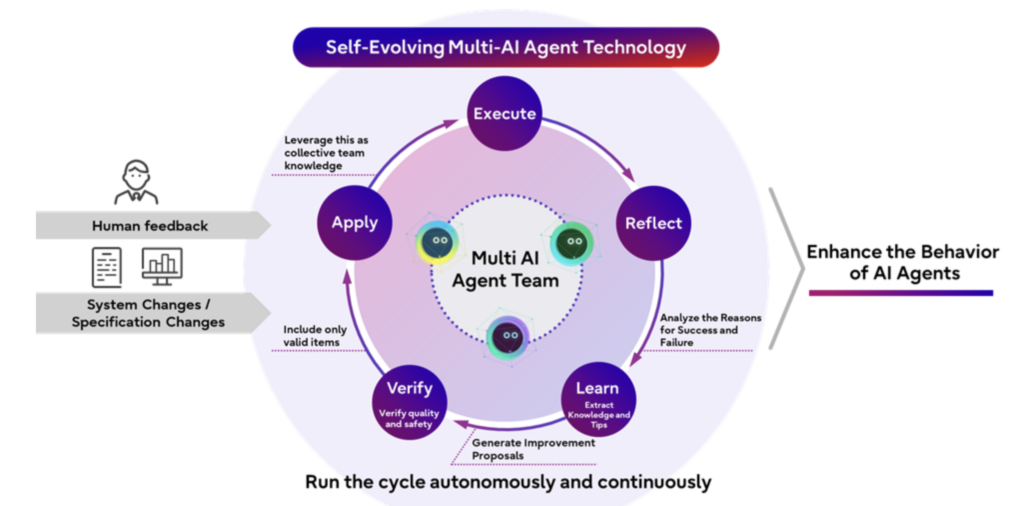
Fujitsu has announced a self-evolving multi-AI agent system in which teams of AI agents continuously improve their own performance by learning from operational results, human feedback, regulatory changes, and specification updates — without requiring constant intervention from human experts.
The core innovation is the agents’ ability to identify the reasons behind both successes and failures, extract actionable insights, and autonomously update their own prompts, search strategies, and evaluation criteria. Tasks that previously demanded ongoing adjustment by specialists are now handled by the AI system itself.
Fujitsu tested the technology across two areas. Applied to its proprietary large language model Takane, the multi-agent system autonomously managed data selection, training, evaluation, and improvement across sectors including manufacturing, healthcare, finance, and public administration, delivering an average accuracy gain of 28 points over pre-specialisation performance. The technology was also deployed on design specification search for Fujitsu’s electronic health record and local government business systems, where agents learned from past failures and human corrections to independently refine their document retrieval strategies.
Fujitsu plans to integrate the technology into its Kozuchi AI platform and, in collaboration with researchers at Carnegie Mellon University, develop lower-memory versions capable of running in on-premises and edge environments — extending self-evolving AI into highly confidential, sovereign infrastructure settings.