

Insider Brief
- Nvidia and Foxconn are expanding healthcare AI deployments in Taiwan through the government-backed Healthy Taiwan initiative, which includes $1.5 billion in investment to build an AI-enabled healthcare system spanning hospitals, universities and technology companies.
- Foxconn introduced new AI-powered clinical tools, including its CoDoctor platform with specialized agents for cardiac screening, coronary artery analysis and colonoscopy support, as well as the CoDoClaw system for coordinating multiple healthcare AI agents through a single interface.
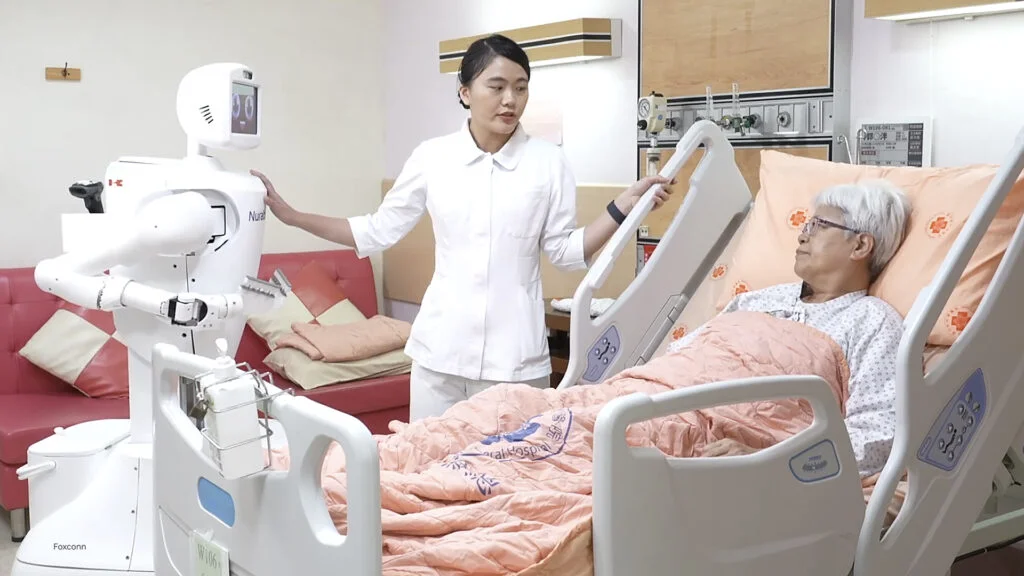
- The effort also includes healthcare robots such as the Scrub Bot surgical assistant and Nurabot nursing robot, which Foxconn said can perform 75 to 80 tasks per day and reduce nursing workloads by about 30%.
Nvidia and Foxconn are expanding their healthcare AI efforts in Taiwan, where hospitals are deploying teams of AI agents and healthcare robots as part of a government-backed effort modernize clinical operations and address growing workforce pressures.
“The next era of healthcare is being powered by agentic AI — teams of digital and physical AI agents working alongside clinicians,” Nvidia VP of healthccare Kimberly Powell noted in the announcement. “Together with Foxconn and Taiwan’s leading medical centers, Nvidia is accelerating the deployment of AI infrastructure that helps clinical teams, improves hospital efficiency and creates a model for health systems around the world.”
According to Nvidia, the initiative is part of Taiwan’s “Healthy Taiwan” program that includes $1.5 billion in investment aimed at building an AI-enabled healthcare system spanning hospitals, universities and technology companies. Foxconn is serving as a systems integrator, connecting healthcare providers, government agencies and technology partners to deploy AI tools across clinical environments. The companies unveiled their AI healthcare vision at COMPUTEX 2026 and NVIDIA GTC Taipei 2026 this week.
AI Agents for Clinical Workflows
At the center of the initiative is Foxconn’s CoDoctor platform, which uses specialized AI agents to assist clinicians with diagnosis, documentation and care coordination. According to the company, the system includes:
- ECG AI Agent for cardiac screening and patient triage.
- Corovia AI Agent for automated 3D reconstruction of the heart and coronary arteries.
- Endovia AI Agent for real-time lesion detection and workflow support during colonoscopy procedures.
Foxconn also introduced CoDoClaw, a multi-agent orchestration platform designed to coordinate AI systems across applications including breast cancer screening, ECG analysis, fundus imaging and coronary artery analysis through a single clinical interface. According to the company, the platform is built using Nvidia’s healthcare AI software stack.
Physical AI and Healthcare Robotics
The partnership also includes deployment of AI-powered robots in hospital environments and includes:
- Scrub Bot, a robotic surgical assistant designed to support operating room teams and respond to voice commands.
- Nurabot, a collaborative nursing robot that handles transportation and logistics tasks within hospitals.
Foxconn noted the Nurabot nursing robot has moved beyond pilot testing and is being deployed in hospitals and long-term care facilities. According to the company, the robot can perform 75 to 80 tasks per day, including medication delivery and specimen transport, helping reduce nursing workloads by roughly 30%.
Another deployment highlighted by Foxconn was an automated chemotherapy workflow developed with Taipei Veterans General Hospital and industry partners, combining robotic drug preparation, autonomous hospital transport and robotic delivery into a single end-to-end system designed to improve efficiency, traceability and medication safety.
To support deployment, Foxconn creates digital twins of hospital facilities using Nvidia Omniverse software, allowing robots and AI systems to be tested and validated before entering clinical environments. According to the company, this simulation-first approach has reduced deployment times and improved navigation accuracy.
“Foxconn is building the AI infrastructure and clinical platforms to connect hospitals, medical devices and software innovators across Taiwan,” added Barry Chiang, president of B group and Digital Health at Foxconn. “With Nvidia technologies across accelerated computing, simulation, edge AI and robotics, we are helping healthcare providers move from proof of concept to scalable, safe deployments that can improve care delivery.”
Credit: Nvidia