Insider Brief
- TARS unveiled its DexHand robotic hand at ICRA 2026, showcasing a 21-degree-of-freedom system modeled on human hand anatomy and designed to improve dexterity and manipulation for humanoid robots.
- The company said DexHand is intended to help bridge the gap between simulation and real-world operation through its SenseHub platform, which captures and maps human motion data for robotics training and embodied AI development.
- According to TARS, DexHand combines fingertip-mounted cameras with its AWE 3.0 foundation model to interpret physical characteristics such as texture, hardness and slip risk during manipulation tasks, while a simplified motor and reducer architecture is designed to support automated manufacturing.
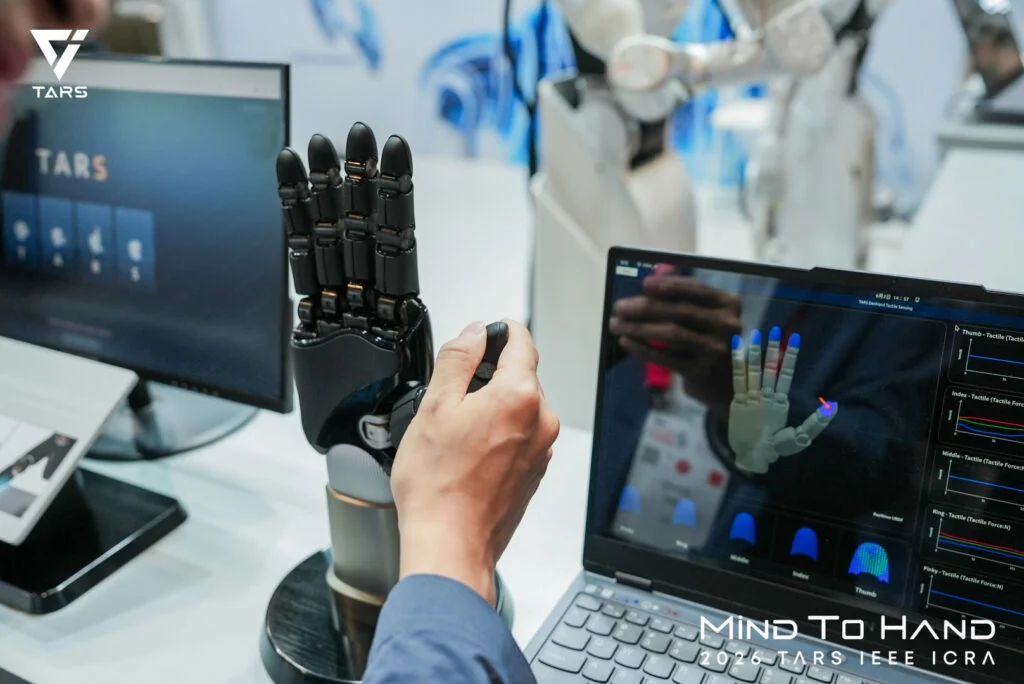
TARS has debuted its DexHand robotic hand, a system the company said is designed to more closely replicate the structure and movement of the human hand.
The Chinese humanoid robotics company’s demonstration at last week’s ICRA 2026 in Vienna featured real-time sign-language gestures and mirror-control interactions intended to highlight the platform’s dexterity and responsiveness. According to the company, DexHand is built around a 21-degree-of-freedom architecture modeled on human hand anatomy, including the thumb’s complex joint structure, with the goal of improving manipulation capabilities compared with more conventional robotic hand designs.
“IEEE’s ICRA 2026 was the ideal stage to showcase TARS’ embodied AI solutions in practice,” said TARS co-founder and chief scientist Dr. Ding Wenchao. “TARS’ DexHand is the optimized interface between human intelligence and robotic action.”
TARS also said the system is designed to help address the challenge of transferring skills learned in simulation to real-world environments. Its SenseHub platform captures and maps human motion data for use in training robotic systems, allowing the company to incorporate real-world movements into its embodied AI development process.
According to TARS, DexHand uses fingertip-mounted cameras paired with TARS’ AWE 3.0 foundation model, which the company said helps robots interpret physical characteristics of objects, such as texture and hardness, and make more informed decisions during manipulation tasks. TARS said DexHand uses a quasi-direct-drive design built around three motor types and three reducer types, a structure intended to support automated assembly.
Image credit: TARS