
Insider Brief
- Researchers at Penn State found that people trust AI-powered fact-checkers about as much as human fact-checkers, though users view each as having different strengths and weaknesses.
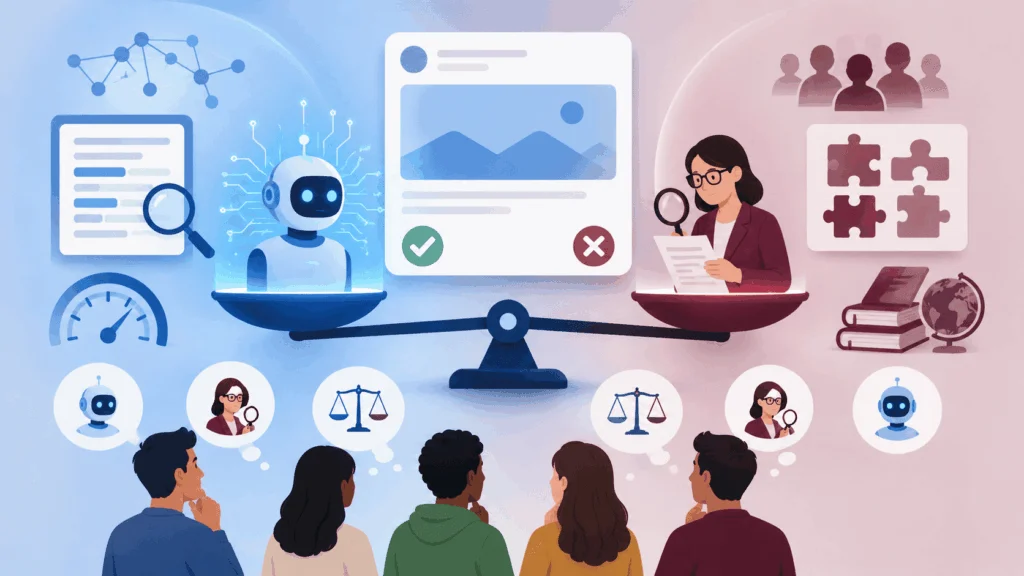
- The study, published in Media Psychology, found participants viewed AI as better at identifying linguistic signals and scanning large volumes of content, while humans were trusted more for evaluating evidence and interpreting complex situations.
- Researchers also found that users were more likely to trust fact-checking systems that explained how decisions were made, suggesting transparency could play an important role as AI takes on a larger role in combating online misinformation.
Researchers at Penn State have found that people trust AI-powered fact-checking systems about as much as human fact-checkers. It’s the reasons that are different. The study, published in Media Psychology, examined how users evaluate fact-checking performed by artificial intelligence compared with human reviewers.
“There’s a very clear distinction that emerges from the study that AI is considered good at low-level linguistic features, like identifying telltale signs that something is not credible,” said S. Shyam Sundar, Evan Pugh University Professor and James P. Jimirro Professor of Media Effects at Penn State. “Humans are seen as being better at corroborating evidence from multiple sources.”
Researchers said that as social media platforms continue to struggle with large volumes of misinformation, AI-based fact-checking systems are increasingly being explored as a way to scale content verification. Human fact-checkers can provide detailed analysis and context, but they face limitations in speed and volume. AI systems can process large amounts of content quickly, but questions remain about whether users trust their judgments.
Fact-checking: AI Versus Humans
“Some studies only compare AI versus human fact-checkers, to find out which is trusted more,” noted first author Mengqi Liao, who is now an assistant professor at the University of Georgia. “They get a lot of inconsistent results. That’s why we proposed a competing hypothesis that showed how positive and negative views of both can coexist and cancel each other out.”
To better understand those perceptions, the researchers conducted a study involving 291 participants in the U.S. The team first identified news headlines with varying levels of credibility and then presented them in simulated social media posts through a research platform called FactDeck.
Some posts were labeled as having been reviewed by an AI fact-checking system, while others were attributed to human fact-checkers. Participants were shown different types of explanations for why content had been flagged, including evidence-based explanations, feature-based explanations that highlighted suspicious language, and instances in which no explanation was provided.
The Findings
The researchers reported finding that users relied on what they described as “machine heuristics,” which are assumptions about how AI systems operate. Participants generally viewed AI systems as objective, accurate and capable of scanning large amounts of information efficiently. At the same time, they expressed concerns that AI lacked the judgment and contextual understanding associated with human decision-making.
As a result, neither humans nor AI emerged as a clear winner in overall trust, according to researchers. Positive perceptions of AI were balanced by concerns about its limitations, while confidence in human judgment was offset by concerns about potential bias or inconsistency.
The study also found that participants preferred fact-checking systems that provided some explanation for their decisions. Whether the explanation was based on supporting evidence or suspicious language patterns, users were more likely to trust the result than when no explanation was offered.
The findings suggest that transparency may play an important role in the adoption of AI-powered fact-checking systems. Providing users with insight into how decisions are made could help them better evaluate the reliability of fact-checking results rather than relying solely on whether the source is human or machine.
The researchers said the results suggest a future in which AI and human expertise work together to address misinformation. While AI may be well suited to identifying potential problems across large volumes of content, human reviewers may remain important for evaluating more complex or nuanced claims.
Co-authors included Sian Lee, an assistant professor at the University of Mississippi; Annie Dooley, a doctoral student at The Ohio State University; and Aiping Xiong, an assistant professor at Penn State.