Insider Brief
- Proception raised $11 million in seed funding and launched ProHand 1.0, a 22-degree-of-freedom robotic hand designed to help humanoids and other robots perform more human-like object handling.
- The round was led by First Round Capital with participation from Y Combinator and BoxGroup, and Proception said the funding will support hiring, production and development of its dexterous-manipulation hardware and data systems.
- The company is also launching ProGlove, a wearable system for collecting human hand-interaction data to train robots, while TechCrunch reported that founder Jay Li recently settled a Tesla lawsuit tied to alleged trade-secret theft.
Proception has raised $11 million in seed funding and launched ProHand 1.0, a robotic hand designed to give humanoids and other robots more human-like control when handling objects.
According to the Silicon Valley startup, the round was led by First Round Capital, with participation from Y Combinator and BoxGroup. Proception said the funding will be used to expand its team, scale production and continue building the hardware and data systems behind its dexterous-manipulation platform.
Last year, founder Jay Li was sued by Tesla, where he had been the technical lead for Optimus, for allegedly taking trade secrets to start Proception. That suit was dismissed after a settlement was reached earlier this year, TechCrunch reported.
What is ProHand 1.0?
Proception noted that in robotics, movement, navigation and vision have improved faster than hands. Many robots still rely on basic grippers, which can work well in structured settings but struggle with tasks that require small adjustments, pressure control or frequent contact with objects.
To address this problem, the company developed ProHand 1.0, a 22-degree-of-freedom, tendon-driven robotic hand built for researchers and robotics companies working on manipulation. Degrees of freedom refer to the number of independent ways a hand or joint can move. In ProHand’s case, the company said the design gives the hand a wider range of finger motions so it can work more like a human hand than a simpler robotic gripper.
“Unlocking this level of dexterous manipulation is one of the keys to making humanoid robots useful in the real world,” the company noted in its announcement.
According to Proception, the ProHand uses a tendon-driven design, meaning motors pull cables to move the fingers. That approach is meant to keep the fingers lighter and more compact, similar to the way muscles and tendons move a human hand. Proception said it worked with hand surgeons on the design, which includes multiple joints per finger, a compact mechanical structure and skin-like sensors that detect contact during gripping and handling.
ProGlove Training System
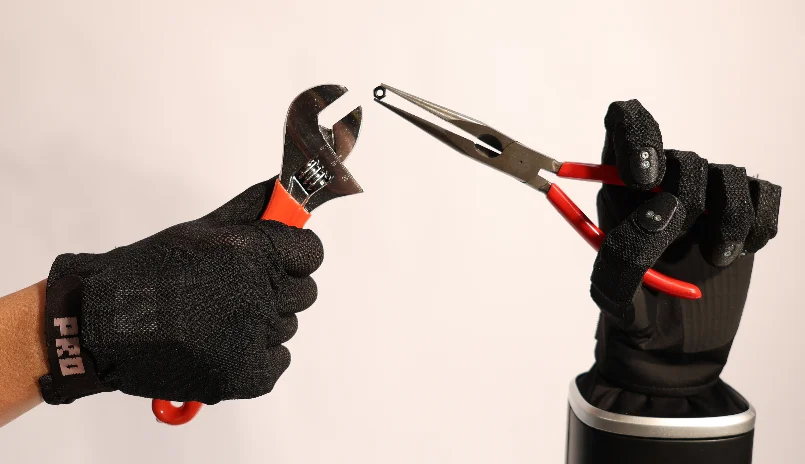
The company is also launching ProGlove, a wearable system designed to collect training data from human hands. Proception said the same sensor skin used on ProHand can be worn as a glove, allowing researchers to capture how people touch, hold and adjust objects during real tasks.
That data is important as the hardware, Proception ponted out. Robotics companies often train manipulation systems through teleoperation, where a person controls a robot remotely. That process can be slow because it depends on available robots and lab time, and it can also miss some of the small contact signals people use when their own hands are directly touching an object.
ProGlove is designed to collect that human interaction data without requiring a robot in the loop and researchers can pair the glove with a headset for visual context and then use the data to help train robotic systems.
The company said the first batch of ProHand units is shipping this week to researchers and robotics companies.
Image credit: Proception