
Insider Brief
- Apptronik expanded its nearly 90,000-square-foot Robot Park facility in Austin, Texas, and introduced Apollo 2 as it gathers more real-world data for humanoid robots designed for industrial and commercial work.
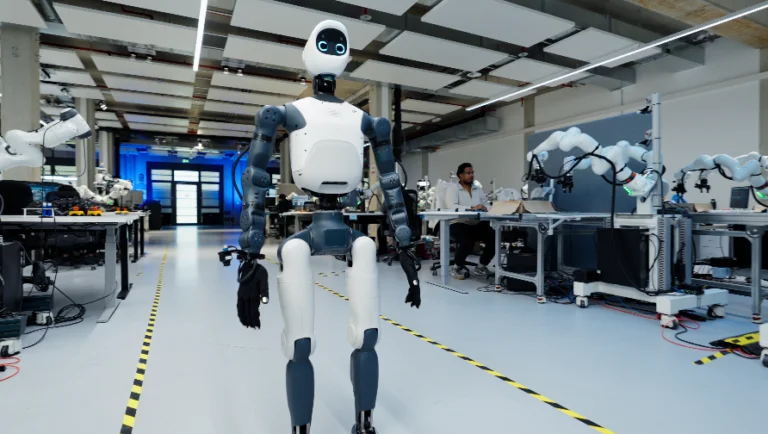
- Apollo 2 is available in bipedal and wheeled-base configurations and is already operating across Robot Park and at customer and partner sites, including Google DeepMind, Mercedes-Benz and GXO.
- The company said data collected through Apollo 2 supports its research partnership with Google DeepMind and helps advance Gemini Robotics, Google DeepMind’s foundation AI models for robotics.
Apptronik has expanded its Texas humanoid-robot training facility as the company looks to gather more real-world data for robots designed for indistrial and commercial work.
The Austin-based robotics company said its newly expanded Robot Park facility covers nearly 90,000 square feet and serves as its flagship site for training and data collection. The facility anchors a broader network of Robot Park locations at customer and partner sites, including Google DeepMind, Mercedes-Benz and GXO.
Apptronik also introduced Apollo 2, the current version of its humanoid robot platform, in both bipedal and wheeled-base configurations. The data collected by Apollo 2 is part of Apptronik’s research partnership with Google DeepMind and is used to help advance Gemini Robotics, Google DeepMind’s foundation AI models for robotics, according to the company.
The company said Apollo 2 robots are already operating across Robot Park and at customer and partner sites around the world.
“The industry has spent years showing what robots can do in demos,” co-founder and CEO Jeff Cardenas said in the announcement. “We’re focused on what they can do every day on the job. What we’re building is a continuous learning loop with the Google DeepMind Robotics team: robots working, collecting data, and improving with every cycle, in real environments, on real tasks. Robot Park enables the data collection that is fuel for that, and Apollo 2 is the machine that makes it possible. That’s how you move from early prototypes to real, deployable humanoid robots.”
Scaling Robotics Training Data
The company indicated it is using a mix of teleoperation, autonomous execution and physics simulation to generate training data and improve both robot hardware and software. Inside Robot Park, Apollo 2 robots are tested on customer-driven use cases across logistics, manufacturing, retail and related environments.
The wheeled version of Apollo 2 is designed to fit more easily into existing industrial operations and align with current safety standards for mobile robots and the bipedal version is intended for more complex environments where walking and greater mobility may be needed, the company noted.
“For truly useful humanoid robots, safety and reliability have to advance alongside capability,” added COO Barry Phillips. “The modular design of Apollo is a direct response to customer demand for adaptable automation. By developing Apollo as a modular platform, we’re able to deploy the same core humanoid technology across different configurations, including wheeled robots that align with current industrial safety standards, and bipedal robots for maximum adaptability. This approach helps us build better robots for customers today while laying the groundwork for broad adoption of humanoid systems in the future.”
Apptronik said the Apollo 2 platform is also being used to support development of Apollo 3, its next-generation commercial robot. The company said the data collected through Apollo 2 and its work with Google DeepMind will help prepare the future commercial fleet for deployment.
Apptronik announced in February it had closed a $520 million Series A-X extension,, bringing its total Series A financing to more than $935 million and total capital raised to nearly $1 billion. as it scales production of its Apollo humanoid robot.