
Insider Brief
- KAIST researchers developed DiSPo, a robot AI model designed to turn rough human demonstrations into more precise robot motions for fine manipulation tasks.
- The model was developed by Professor Daehyung Park’s team in KAIST’s School of Computing and presented in June at the 2026 IEEE International Conference on Robotics and Automation in Vienna.
- KAIST said DiSPo achieved up to an 81% higher task success rate than state-of-the-art models in simulation tests and performed up to four times better than existing AI models in real-world collaborative-robot experiments.
KAIST researchers say they have developed a robot AI model that can turn rough human demonstrations into more precise robot motions, potentially reducing the amount of detailed training data needed for fine manipulation tasks.
According to KAIST, model, called DiSPo, was developed by Professor Daehyung Park’s team in KAIST’s School of Computing and presented in June at the 2026 IEEE International Conference on Robotics and Automation in Vienna. The work is detailed in a paper titled “DiSPo: Diffusion-SSM based Policy Learning for Coarse-to-Fine Action Discretization.”
The Problem
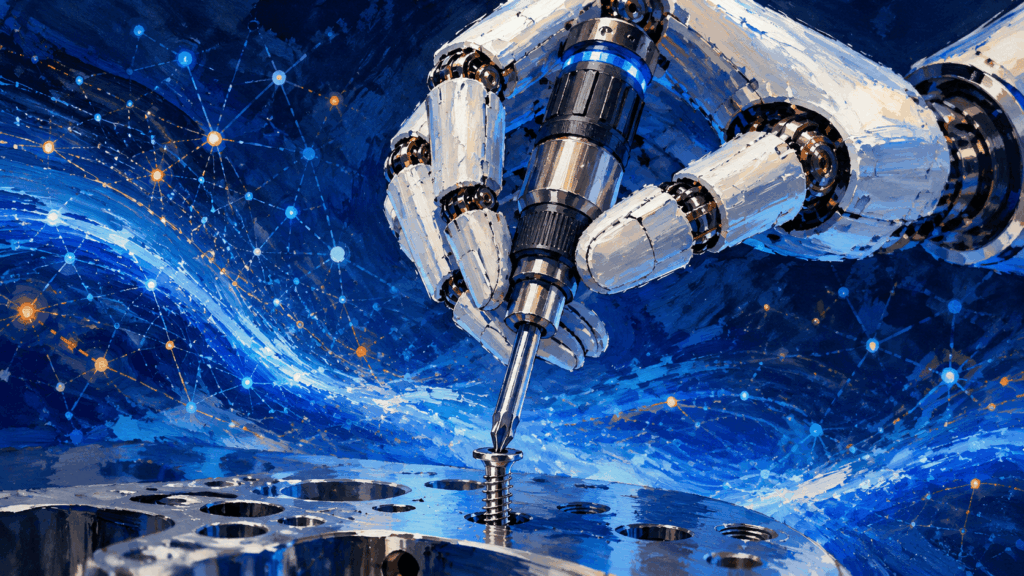
The research addresses a common problem in robot learning. Robots that perform delicate tasks often need training data collected at very short time intervals, which can make data collection expensive and time-consuming. KAIST said existing methods, including Behavior Transformer and Diffusion Policy, depend heavily on the time intervals used in training data, requiring large amounts of finely sampled data for tasks such as screw fastening and component insertion.
DiSPo is designed to reduce that burden by training on low-frequency, or coarse, demonstrations and generating finer robot motions during operation. KAIST described it as a multi-granularity manipulation model, meaning it can adjust the level of detail in a robot’s movement depending on the task.
The research team combined Mamba, a state-space model that can predict time intervals, with a diffusion model designed to represent robot actions. The team also introduced a Step-scale factor mechanism, which lets users control the time intervals used by the robot.
The Results
In simulation tests, DiSPo achieved up to an 81% higher task success rate than state-of-the-art models, according to KAIST. In real-world experiments with a collaborative robot, the system performed tasks including passing a clamp through a narrow gap with 2.5 millimeters of radial clearance and pressing a small shutter button on a smartphone.
KAIST said DiSPo’s performance in those real-world experiments was up to four times higher than existing AI models.
“This study demonstrates that robots can learn precise motions from coarse demonstrations and autonomously adjust their level of precision according to the task situation,” said Professor Daehyung Park. “Moving forward, this technology is expected to dramatically reduce data collection costs while serving as a general-purpose robot learning technology for various industrial fields, including precision assembly and medical applications.”
The study was led by Nayoung Oh, a master’s student at the KAIST Graduate School of AI, as first author. Co-authors include Jaehyeong Jang of the KAIST School of Computing and Moonkyeong Jung of the KAIST Robotics Program, with Park as corresponding author.
The research was supported by South Korea’s Ministry of Science and ICT, the Institute of Information & Communications Technology Planning & Evaluation, IITP’s Global AI Frontier Lab program and the Ministry of Trade, Industry and Energy’s Technology Innovation Program.