
Insider Brief
- UMA unveiled the design of its first humanoid robot and introduced Real-Time Learning, a system meant to let robots learn new tasks from demonstrations rather than manual programming.
- The Paris-based physical AI company said the robot is being developed for factories, warehouses, logistics centers and industrial facilities, where it could handle repetitive, physically demanding or hazardous work.
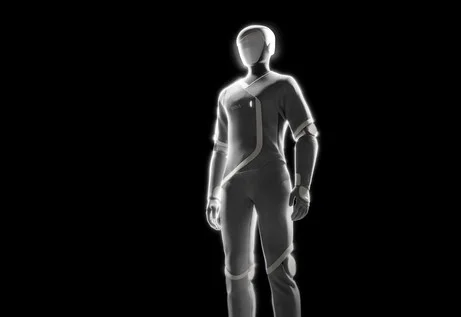
- UMA said the robot uses a neutral visor, soft outer shell and visible mechanical joints, with a design intended for environments built around people and current industrial infrastructure.
UMA unveiled the design of its first humanoid robot and introduced a learning system meant to let robots acquire new tasks through demonstration rather than manual programming.
The Paris-based physical AI company said the system is being developed for factories, warehouses, logistics centers and industrial facilities, where robots could take on repetitive, physically demanding or hazardous work.
“Demographic, industrial, and environmental challenges all point to the same reality: societies need greater productive capacity,” co-founder and CEO Rémi Cadène said in the announcement. “We believe intelligent robots will become part of the solution, not as a substitute for people, but as a new class of tools that enables them to devote more time to what machines will never replace: creativity, judgment, innovation, and caring for others.”
The company also introduced Real-Time Learning, an architecture designed to let robots learn from demonstrations, adapt to unfamiliar situations and improve through experience. UMA said the goal is to reduce the need for engineers to manually program robots for each new application.
UMA said its humanoid design is intended for environments already built around people. The company said the robot’s proportions are meant to help it use existing tools and work within current infrastructure.
The Design
The robot’s design uses a neutral visor instead of facial features, a soft outer shell and visible mechanical joints. UMA said the approach is meant to make clear that the robot is a machine rather than a human-like substitute.
The company noted labor-market pressure in advanced economies, citing Korn Ferry estimates that the global economy could face a shortage of 85 million workers by 2030, as well as aging populations, industrial reshoring and the energy transition increasing demand for automation.
Europe as a Key Market
UMA pointed out that while China and the U.S. are driving forces in the development of humanoid robots, Europe could be an important market because of its scientific research base, industrial capacity and labor shortages.
The company was founded in 2025 by Cadène, Pierre Sermanet, Robert Knight and Simon Alibert, and is headquartered in Paris with teams in London and Geneva.
“We’re still at the beginning of this journey,” added Cadène. “Humanoid robots will take years to reach large-scale deployment, just as the internet and smartphones required time before transforming entire industries. We believe intelligent robots will reshape the physical economy in much the same way.”
Image credit: UMA