Insider Brief
- Aidoptation received approval from Belgian authorities to test a Level 4 autonomous vehicle on public highways at speeds up to 120 kilometers an hour.
- The permit covers 100 kilometers on the E313 and E314 highways in Limburg and is the first approval for Level 4 highway-speed autonomous-driving tests on public roads in the European Union.
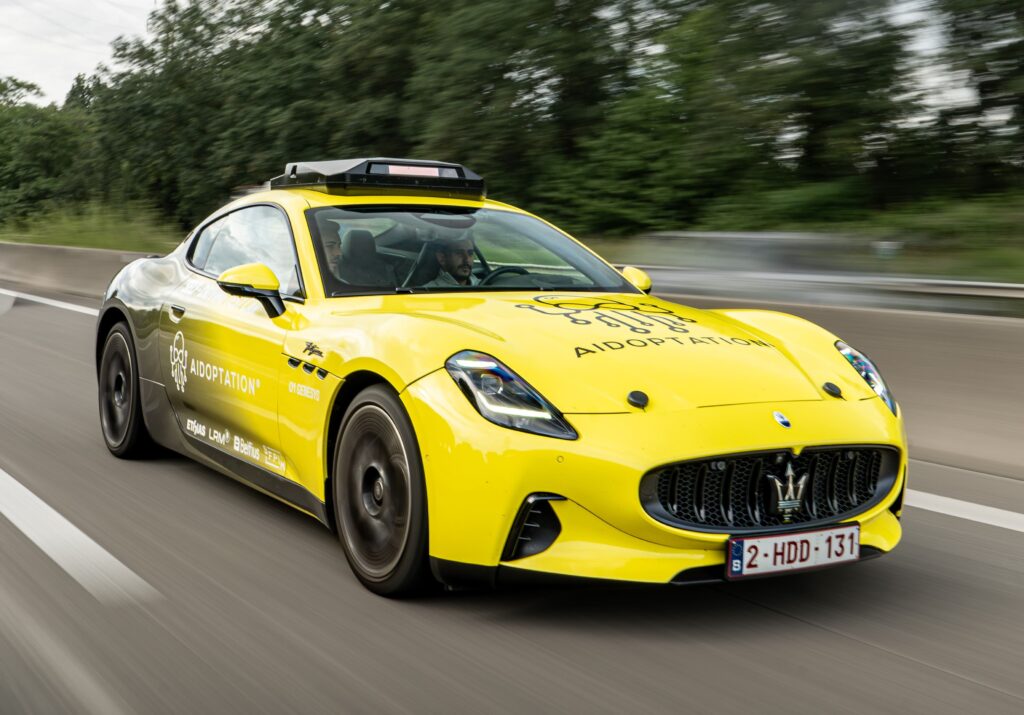
- The tests will use a Maserati GranTurismo Folgore equipped with LiDAR, radar, cameras and robotics hardware, with phased testing and a human safety driver able to take control at any time.
Aidoptation received approval from Belgian authorities for what is says is the first test of a fully autonomous vehicle on public highways at speeds up to 120 kilometers an hour.
According to the Belgium-based autonomous-vehicle company, the permit covers 100 kilometers on the E313 and E314 highways in the province of Limburg. Aidoptation noted it is the first approval for Level 4 autonomous-driving tests at highway speeds on public roads in the European Union. The company noted it will be continuing work at proving grounds and tracks as well. The project is insured by Ethias, according to Aidoptation.
Level 4 autonomy refers to a system that can perform driving tasks and monitor the driving environment without human intervention within its defined operating conditions. Aidoptation pointed out that differs from Level 2 driver-assistance systems, which require constant human supervision.
“Autonomous driving has enormous potential to improve safety and mobility, but commercial adoption will depend on demonstrating safe performance in the most demanding highway scenarios,” CEO Paul Mitchell said in the announcement. “Testing on public highways will generate invaluable real-world data, validate our technology, and advance our mission of reducing fatalities and making highways safer for everyone.”
The tests will use a Maserati GranTurismo Folgore electric vehicle equipped by Aidoptation with LiDAR, radar, cameras and robotics hardware. Testing will be conducted in phases under safety protocols agreed with Belgian authorities, with a human safety driver able to take control at any time, according to the company.
The highway testing will include validating autonomous-driving technology for high-speed crash-avoidance scenarios, and while highway accidents are less common than other road incidents, they can result in severe injuries, deaths, road closures and property damage.
The company’s first commercial product, EdgeDrive, is a Level 4 autonomous-driving platform designed for highway operation at speeds of 120 kilometers an hour and above where speed limits allow. Aidoptation said the platform is built to handle emergency maneuvers, sudden obstacle avoidance and high-speed hazard response.
Aidoptation’s EdgeDrive uses deterministic models rather than AI for decision-making, making driving results traceable and auditable for regulators and insurers. The company said it plans to offer EdgeDrive as a separate or integrated safety module for automotive manufacturers and robotaxi customers.
Aidoptation said it spent a year testing its high-speed autonomous-driving technology across weather and driving conditions at sites in Belgium, including Ford Lommel Proving Grounds, DronePort runway, Circuit of Spa-Francorchamps and Circuit Zolder. Its engineering team set a world autonomous speed record of 318 kilometers an hour, or 197.7 miles an hour, at the Kennedy Space Center in Florida using a production Maserati MC20 without a human driver on board.
Aidoptation was founded in 2025 as a commercial spin-off of the Indy Autonomous Challenge, an autonomous racing competition based in the U.S. In January, the startup announced it had secured €20 million in additional financing to accelerate the development and industrialisation of advanced AI-powered autonomous systems. The round included backing from SFPIM, John Cockerill Defence, Ethias Ventures, and Belfius Bank & Insurance.
“As a Belgian insurer and partner to thousands of public institutions, local authorities and emergency services, we see every day just how essential safety and mobility are to society,” added Ethias CEO Philippe Lallemand. “That is why we invest in companies such as Aidoptation. Its technology has the potential to make our roads safer and help prevent road casualties. At the same time, Aidoptation demonstrates how Belgium can develop new areas of economic strength in advanced mobility technology. In this way, we combine social impact with investment in the future of our country.”
Image credit: Aidoptation