
Insider Brief
- UC San Diego engineers and surgeons used teleoperated humanoid robots to complete two surgeries in a preclinical trial, marking a proof-of-concept step toward humanoid robots in operating rooms.
- The study, published in the July 8 issue of Nature, included one procedure performed by a human-robot team and a second performed by two humanoid robots working side by side.
- Researchers said the 5-foot, 60-pound robots could eventually help expand surgical access in remote, under-resourced, military, disaster-response and space settings, though recalibration, longer procedure times and latency remain limitations.
Teleoperated humanoid robots completed two surgeries in a preclinical trial, a first step toward using more mobile and flexible robots in operating rooms where surgical access is limited.
The proof-of-concept experiment, published in the July 8 issue of Nature, was conducted by engineers and surgeons at UC San Diego to test whether humanoid robots could perform surgical tasks in a live preclinical setting.
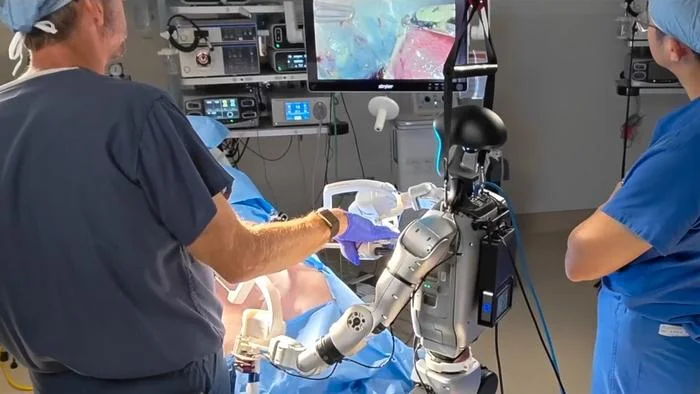
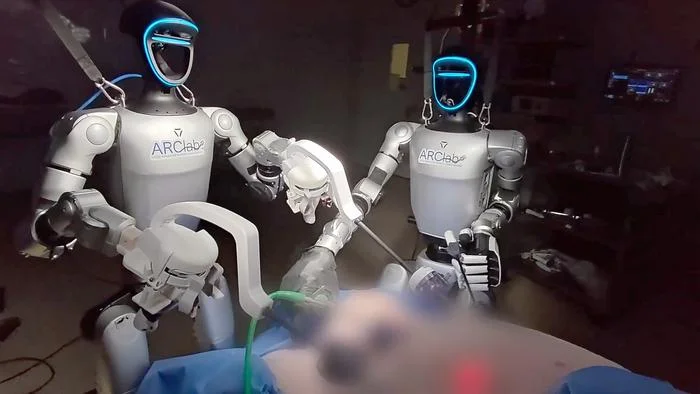
According to the University of California San Diego, one procedure was completed by a human-robot team, with a humanoid robot operating alongside a human surgeon serving as an assistant. A second procedure was completed by two humanoid robots working side by side. Both surgeries were gallbladder removals performed on large non-primate mammals.
Addressing the Problem of Access
A shortage of surgeons and rising patient demand is a mismatch researchers said can increase wait times, reduce access to care and deepen healthcare disparities. They said teleoperated humanoid robots could eventually help extend surgical care to places that lack enough specialists.
“This study shows that humanoid robots have a viable future in the field of surgery,” noted Michael Yip, one of the paper’s senior authors and member of the faculty of UC San Diego’s department of electrical and computer engineering. “You can imagine these robots being deployed in remote communities where staffing is challenging, or in austere environments like search and rescue scenarios where a massive deployment of field medicine is needed in a short period of time.”
Potential of Humanoid Surgical Robots
Humanoid robots could have advantages over current specialized robotic surgery systems, according to the researchers. Existing systems often rely on several robotic arms, specialized tools and proprietary software. They also can weigh about 1,800 pounds, require large setup teams and take up enough room that operating rooms often need to be retrofitted.
The humanoid robots used in the study, nicknamed Surgie, are 5 feet tall and weigh 60 pounds. UC San Diego said the robots are mobile and compact enough to fit more naturally into operating rooms and could be more practical in remote, under-resourced or field medicine settings.
The researchers said humanoid robots also are more versatile than specialized surgery systems because they can perform a wider range of movements and general tasks. In this study, the team built adapters so Surgie could hold traditional surgical tools. The researchers also said controlling the humanoid robot can feel more natural for operators who are not trained on specialized robotic surgery platforms.
The Findings
The study’s main finding is that teleoperated humanoid robots can complete surgical procedures in a preclinical setting. The researchers said a procedure performed by a teleoperated humanoid robot can be as precise as one performed with a teleoperated surgical robotic system.
The study also showed that the robots can be used in different team configurations, suggesting a possible path toward mixed human-robot and robot-robot teams in operating rooms.
The implications are especially relevant for rural areas, military or disaster-response settings, space missions and other environments where large surgical systems or full surgical teams may be hard to deploy. The researchers said humanoid robots could also take on support tasks, such as fetching tools or cleaning an operating room after a procedure.
“It’s a fraction of the cost and it takes a fraction of the space in an operating room,” added senior author of the paper and one of the teleoperators during the study Shanglei Liu, MD, an assistant professor of surgery at the UC San Diego School of Medicine. “So it’s easy to deploy, anywhere from rural areas, to the battlefield, and even to space.”
The Limitations
The work did show limitations as the robots had to be recalibrated several times during surgery, and the procedures took much longer than those performed with existing specialized surgical systems. The researchers said this type of delay is common in early-stage robotic surgery systems and they expect that will improve over time.
Latency also remains an issue and the researchers said they are working to reduce the delay between a surgeon’s movement at the controller and the robot’s movement. That is particularly important if it is to be used for longer-distance operations for remote communities.
Who Participated?
The study was carried out by researchers from the Department of Electrical and Computer Engineering at the UC San Diego Jacobs School of Engineering and the Department of Surgery at the UC San Diego School of Medicine. The engineering team included Yip, Lucas Zekai Liang, Peihan Zhang, Calvin Joyce, Soofiyan Atar and Florian Richter. The surgery team included Liu, Nikita Thareja, Garth Jacobsen and Ryan Broderick.
The researchers said the project depended on close collaboration between engineers and surgeons, along with the role of the UC San Diego Center for the Future of Surgery.
“This achievement reflects the power of bringing engineers and surgeon innovators together to solve meaningful clinical problems at our world-class training and research lab,” noted Ryan Broderick, MD, the interim director of the Center for the Future of Surgery and associate professor of surgery at the UC San Diego School of Medicine. “Our center provides a setting to bridge engineering innovation and clinical expertise, allowing transformative ideas to be rigorously developed, tested, and refined.”
Featured image credit: University of California San Diego