Insider Brief
- Chinese robot maker X Square Robot launched Quanxta Zero, a software-and-hardware platform designed to help collect, process and use data for embodied AI models.
- The Quanxta Zero Series includes three products for different data-collection needs, including the G1 headband-and-gripper system, the G0 VR-and-backpack system and the E0 first-person context device.
- X Square said the platform connects data collection, synchronization, cleaning, annotation, model training and evaluation into a closed-loop workflow for general-purpose robots.
Chinese humanoid robot maker X Square Robot launched a software-and-hardware platform designed to help collect, process and use data for embodied AI models.
According to X Square, the Quanxta Zero Series is intended to address three problems in robotics data — limited volume, slow collection and inconsistent quality.
Traditional robot teleoperation systems can be costly, difficult to deploy and often produce raw data that loses value during downstream training, according to the company. X Square said Quanxta Zero is intended to turn embodied data collection from a fragmented hardware task into an industrial-grade data production workflow for general-purpose robots.
The Quanxta Zero Series includes three products:
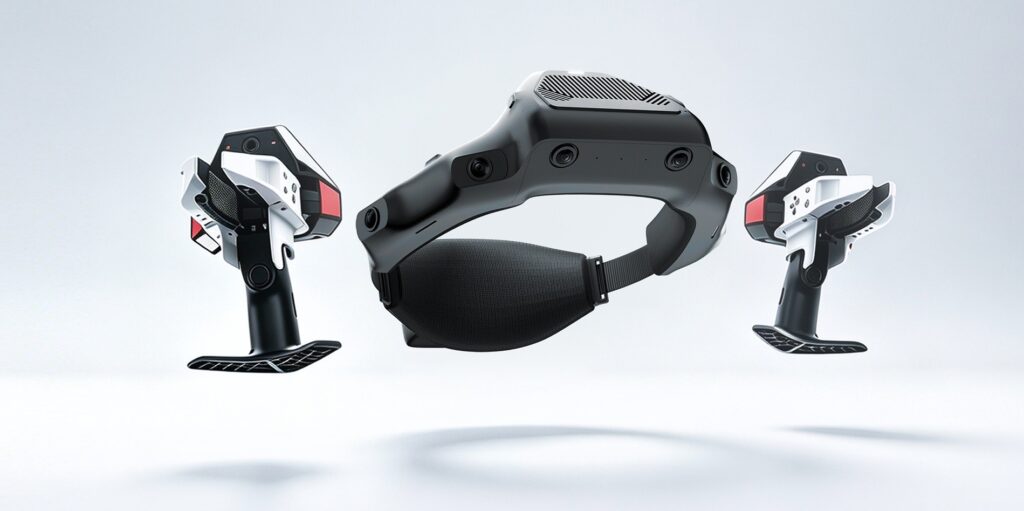
Quanxta Zero-G1 — The flagship UMI-VIO version uses one headband and two grippers to balance data quality, user experience and endurance.
Quanxta Zero-G0 — The UMI-VR version uses a PICO 4 VR headset, two grippers and a backpack system for whole-body mobile data collection with precise and stable localization.
Quanxta Zero-E0 — The Ego version is a lightweight first-person context collection device with six cameras.
X Square said the G1 system captures visual, tactile and audio data in one system and can collect data across movement, dual-arm manipulation, lifting and other full-body behaviors. The system combines first-person views with close-range wrist views, allowing it to capture the broader environment as well as manipulation details such as grasping, contact and occlusion.
Sensor synchronization is controlled within 1 millisecond, with full frame-level video alignment, according to the company. The company stressed it is that alignment allows data to be replayed across different robot bodies.
G1 Features
The company said the G1 is also designed to improve data-collection efficiency. It has one-click start and stop controls and automated downstream annotation, allowing operators to focus on the demonstrated action. In testing, collection speed reached nearly 100 demonstrations an hour, or 2.33 times faster than conventional teleoperation methods, according to X Square Robot.
The G1 removes the backpack used in some data-collection systems and instead uses one headband and two grippers. It also has a magnetic hot-swappable battery for faster replacement and continuous operation.
X Square indicated the harder task is turning collected data into material that can be used for training. Quanxta Zero includes an app and data pipeline to manage that process.
The Quanxta Zero App includes a task marketplace and data dashboard for high-dimensional, long-sequence data collection. Operators can claim tasks, check device status, start and stop collection and receive feedback without manually splitting tasks into smaller steps.
X Square’s Data Pipeline
The company’s data pipeline covers four stages:
Synchronization: The system connects to collection interfaces and uses high-frequency temporal alignment and interpolation-based cleaning to achieve microsecond-level timestamp alignment.
Cleaning and annotation: The pipeline removes low-value segments, including pauses, preparation motions, failures and abnormal trajectories, and uses multimodal foundation models for action segmentation and semantic labeling.
Quality control and security: The platform routes data based on AI confidence scores, sending high-confidence samples through automatically and lower-confidence samples to human reviewers. X Square Robot said the approach can raise data yield to as much as 85%. The platform also supports face and sensitive-background blurring, dynamic watermarking and short-term access controls.
Training and evaluation: Cleaned and annotated data can move directly into model training, fine-tuning and evaluation. The company said model performance can then be used to identify weak scenarios and guide collection of targeted new data.
X Square Robot said Quanxta Zero is intended to make embodied data collection less fragmented and more suitable for industrial-scale robotics model development.
Image credit: X Square Robot