
Insider Brief
- A new MIT FutureTech-led study found that 21% of S&P 500 companies had AI deployed in production or deeply integrated into business operations by 2025, with only 11% reaching the highest level of enterprise adoption.
- AI adoption has more than quadrupled since 2022, led by technology companies, while most firms outside the tech sector remain in pilot programs or early implementation stages.
- Companies with deeply integrated AI generally reported higher profit margins, but the study found no clear evidence that AI adoption has yet produced broad improvements in productivity or capital investment.
- Image: Vishnu Mohanan
Artificial intelligence adoption among America’s largest public companies accelerated sharply after the arrival of generative AI, but only about one in nine S&P 500 firms had deeply integrated the technology into core business operations by 2025, according to a new study posted on the pre-print server arXiv.
The research, led by scientists at MIT FutureTech and Carnegie Mellon University, found that 21% of S&P 500 companies had either deployed AI in production or deeply embedded it into business processes by 2025. Of those, 11% had reached the highest level of integration, where AI plays a central role in strategy and day-to-day operations.
The findings suggest that while enthusiasm surrounding generative AI has been widespread since ChatGPT’s release in late 2022, enterprise deployment remains in its early stages. The researchers also found that companies with the deepest AI integration tended to report higher profit margins, but they found little evidence that AI has yet translated into broader gains in productivity or capital investment.
The study examined 510 companies that were members of the S&P 500 between 2016 and 2025. Rather than relying on surveys or executive interviews, the researchers developed a new method for measuring enterprise AI adoption using companies’ annual SEC 10-K filings, where firms face legal obligations to avoid materially misleading statements.
“While generative AI tools are useful for personal and professional applications, our focus is on the deep integration of AI in the business processes of large enterprises which are bellwethers for firm adoption more broadly,” the researchers wrote in the study.
Measuring Real AI Adoption Instead of AI Hype
The researchers sought to distinguish between companies discussing AI as a buzzword and those that had meaningfully deployed it.
To do that, they built a five-level scoring system with companies receiving the lowest score if they merely mentioned AI as an industry trend or future possibility. Higher scores reflected increasing levels of adoption, progressing from exploratory efforts and pilot projects to AI being used in production. The highest score was reserved for firms where AI had become deeply embedded across operations and business strategy.
The team first extracted AI-related passages from thousands of SEC filings using a broad list of artificial intelligence keywords. Those passages were then evaluated using GPT-5-mini against the researchers’ scoring rubric. The researchers manually reviewed and refined the process to improve consistency.
The resulting database covered more than 4,400 firm-year observations between 2016 and 2025.
To test whether their approach reflected real-world adoption, the researchers compared their scores with the U.S. Census Bureau’s Business Trends and Outlook Survey and business spending data collected by fintech company Ramp. Their AI adoption metric showed strong correlations with both datasets, suggesting it captured meaningful patterns rather than simply counting AI mentions.
Technology Firms Continue to Lead
The study found that AI adoption accelerated dramatically beginning in 2023, following the public release of ChatGPT.
Technology companies accounted for roughly two-thirds of firms that had reached deep AI integration by 2025. Overall, 62% of technology firms scored at the two highest adoption levels, compared with much lower adoption rates across most other industries.
Software companies led all sectors, with 70% achieving the highest level of AI integration. Semiconductor companies and technology hardware firms also ranked near the top.
Financial services companies showed substantial activity, although much of it remained in pilot deployments rather than full production. Banks, insurers and diversified financial companies frequently reported integrating AI into selected products and operational processes without yet emphasizing AI as a core driver of financial performance.
Industries such as consumer staples, food production, household products and utilities lagged. In several of those sectors, roughly one-quarter or more of companies made no meaningful mention of AI adoption in their filings.
The researchers said the pattern suggests AI adoption remains concentrated in industries where digital products and software already play a central role.
Profit Gains Appear Before Productivity Gains
Another important finding tracks the relationship between AI adoption and financial performance.
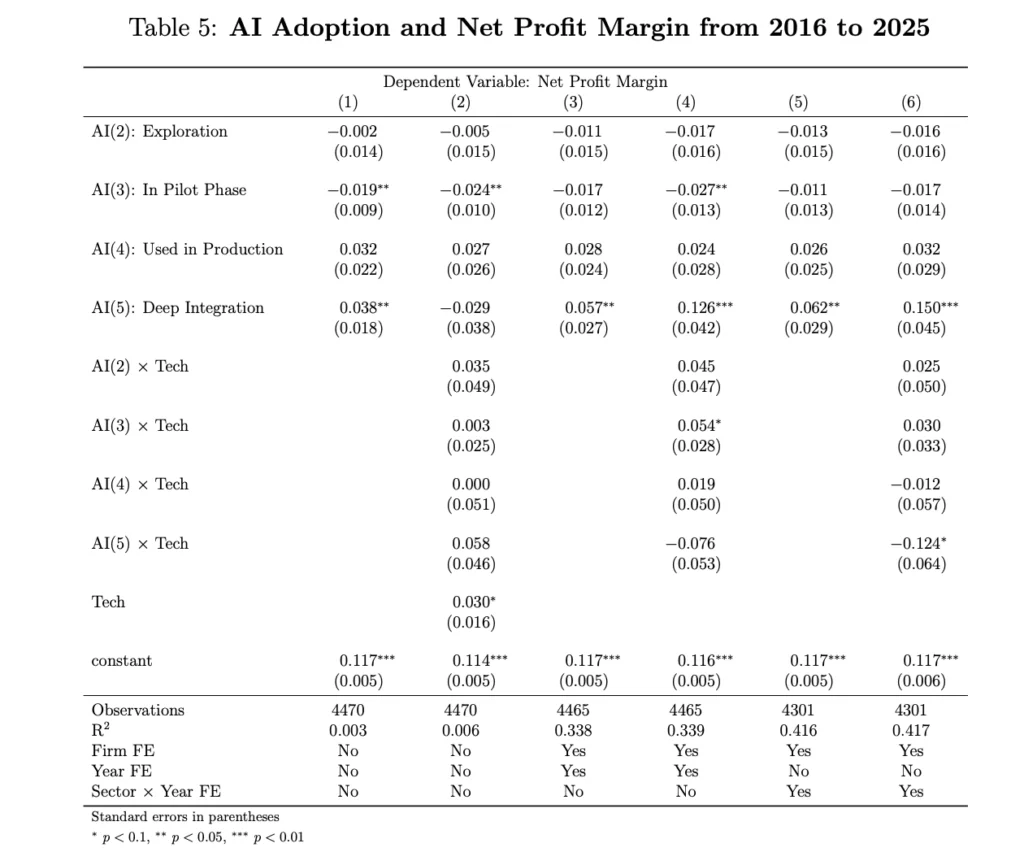
Companies that had deeply integrated AI generally reported stronger net profit margins than firms with little or no adoption. The researchers described the pattern as resembling a “J-curve.”
Early adopters often experienced lower profitability while investing in digital infrastructure, organizational changes, employee training and AI implementation. Companies with mature AI deployments, however, tended to outperform those still in earlier adoption stages.
The effect appeared especially pronounced outside the technology sector.
According to the researchers, companies in manufacturing, healthcare, retail and other traditional industries may have greater opportunities to improve efficiency because they are starting from lower levels of digital automation. By contrast, technology companies often face substantial AI infrastructure costs that can offset some of the financial gains from adoption.
At the same time, the researchers emphasized that their analysis identifies statistical relationships rather than cause and effect. More profitable companies may also be better positioned to invest aggressively in AI.
The study found little evidence that AI adoption was associated with higher revenue per employee, which the researchers used as a proxy for productivity.
That result suggests many anticipated productivity gains may not yet have appeared in financial data, despite rapid advances in AI technology.
The researchers also found no consistent relationship between AI adoption and capital expenditures across most companies.
Instead, they report that only a handful of major technology firms — including members of the so-called Magnificent Seven — are making the massive infrastructure investments associated with building AI systems. Most companies instead purchase AI capabilities through cloud providers or software services, meaning AI spending appears primarily as operating expenses rather than capital investments.
Labor Impact Remains Unclear
The study also examined employment patterns.
Despite growing public concern that AI will eliminate jobs, the researchers found no broad evidence of shrinking workforces among firms adopting AI.
Technology companies with the deepest AI adoption actually tended to employ more workers, reflecting the fact that larger organizations possess the data infrastructure, computing resources and engineering talent needed to deploy AI at scale.
Outside the technology sector, company size showed little relationship with AI adoption.
The researchers cautioned that the absence of large employment declines should not be interpreted as evidence that AI will have little effect on labor markets. Companies may simultaneously eliminate some positions while hiring workers with AI-related skills, masking changes in overall headcount. More detailed analyses of hiring, job postings and worker transitions will be needed to understand AI’s long-term impact on employment.
Adoption Likely to Continue Accelerating
The researchers report that enterprise AI adoption remains in an early phase despite the rapid attention generated by generative AI over the past three years.
They suggest several factors continue to slow deployment, including the high cost of developing reliable AI systems, the organizational changes required to integrate AI into existing workflows, and uncertainty surrounding operational and regulatory risks.
The researchers also note that many businesses may be deliberately moving cautiously. Rather than deploying AI across entire organizations immediately, firms may prefer gradual implementation that allows them to evaluate risks and refine business processes before expanding adoption.
The study has several limitations. It focuses exclusively on large publicly traded companies, meaning adoption patterns among smaller businesses may differ. The AI scores are derived from company disclosures rather than direct observation of internal operations, and the statistical analysis identifies correlations rather than causal relationships between AI adoption and financial outcomes.
Future research could examine whether today’s pilot deployments mature into broader enterprise integration, whether productivity gains eventually become visible in financial performance, and how AI adoption affects employment, investment and competition over longer periods.