What happens when government relations professionals stop chasing information and start commanding it?
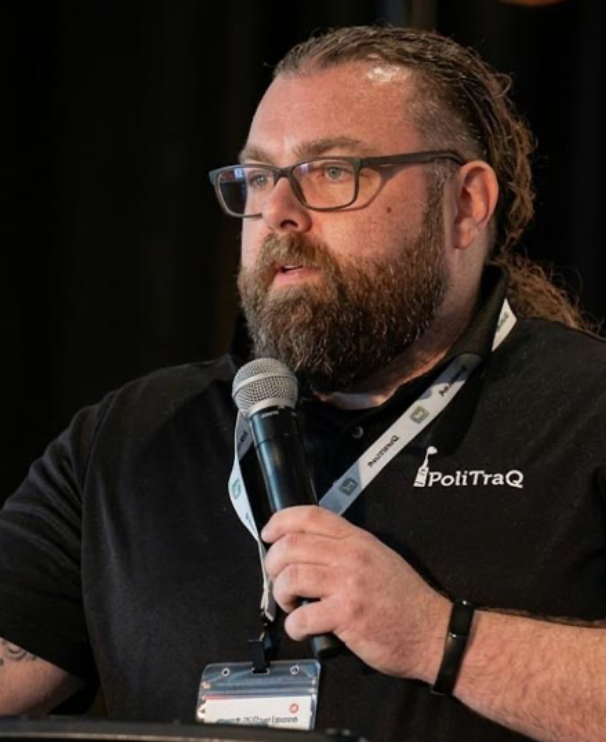
That question sits at the heart of PoliTraQ, a Canadian government relations platform founded by veteran public affairs practitioner Chris Moffatt Armes. At a time when artificial intelligence is transforming industries ranging from software development to healthcare, Moffatt Armes believes government relations is approaching a similar inflection point.
The founder’s vision is straightforward: give advocacy teams the tools to spend less time on administrative work and more time shaping policy outcomes.
When AI Insider spoke with Moffatt Armes, he described an industry that has long been hampered by outdated workflows, fragmented information, and manual processes that have changed little despite the increasing complexity of modern politics.
The idea for PoliTraQ emerged from a problem he experienced first-hand as a government relations practitioner.
“The breaking point for me came when a new director asked for a quantitative report on our recent advocacy meetings, and a colleague handed over a literal stack of business cards with dates scribbled on the back,” Moffatt Armes recalled. “I realized that public affairs was trapped in spreadsheets and paperwork.”
For someone whose career was built around helping organizations navigate government, the moment exposed a deeper problem. While industries across the economy were embracing digital transformation, government relations teams often remained dependent on spreadsheets, email chains, disconnected databases, and institutional knowledge locked inside the minds of senior practitioners.
“The existing tools on the market didn’t speak our language or understand how GR actually works,” he said.
That realization eventually led him to found PoliTraQ.
“No one enters this field to be an administrator; we do it to shape policy,” Moffatt Armes told AI Insider. “I realized the only way to get a purpose-built command center for GR was to build it myself.”
Building a Government Relations Operating System
Government relations has become significantly more complicated over the past decade.
Legislators, regulators, committees, public consultations, stakeholder groups, advocacy campaigns, and media narratives now generate vast quantities of information every day. Organizations are expected to monitor developments across multiple jurisdictions while responding quickly to political and regulatory changes.
The challenge is no longer access to information.
The challenge is extracting actionable intelligence from an overwhelming volume of information.
That reality has helped fuel the growth of specialized government affairs technology providers such as Bloomberg Government and other public affairs platforms designed to streamline policy monitoring and advocacy efforts.
PoliTraQ enters this market with a different ambition.
Rather than functioning as a simple legislative database or monitoring tool, the company positions itself as a centralized command centre where public affairs teams can monitor legislation, manage stakeholder relationships, coordinate advocacy campaigns, and demonstrate impact through reporting.
The goal is to create a single source of truth for government relations operations.
For practitioners, that means fewer spreadsheets, less manual administration, and greater visibility into how advocacy efforts connect to strategic outcomes.
For leadership teams, it means clearer reporting and a better understanding of policy risks and opportunities.
AI Changes the Equation
If the first chapter of PoliTraQ was about solving operational inefficiencies, the next chapter is increasingly focused on artificial intelligence.
According to Moffatt Armes, AI is already reshaping the daily responsibilities of government relations professionals.
“It’s shifting us away from the grunt work,” he explained.
Historically, many entry-level practitioners spent large portions of their careers reviewing legislative transcripts, monitoring committee proceedings, tracking bills, and producing briefing materials.
Artificial intelligence is rapidly changing that equation.
“AI is automating those time-consuming tasks,” Moffatt Armes said. “While that is an incredible force-multiplier for solo practitioners or lean, low-budget teams who suddenly have massive new capacity, it creates a fascinating paradox for the industry.”
That paradox centers on talent development.
The administrative and research-heavy work now being automated has traditionally served as the training ground for future government relations leaders.
“The biggest challenge over the next five years will be training the next generation,” he said. “When AI does the initial heavy lifting, how do we accelerate a junior staffer’s development so they can master the political nuance, context, and ‘taste’ required to understand not just how to draft a brief, but what arguments will actually persuade a specific decision-maker?”
The observation reflects a broader challenge emerging across many professional industries as AI becomes more capable. While automation creates substantial efficiency gains, organizations must also rethink how they develop expertise.
For government relations professionals, success has always depended on understanding the human side of politics. Relationships, timing, persuasion, and political judgment remain difficult to automate.
AI may process information faster, but practitioners must still understand how to act on it.
Introducing FINLAI
Central to PoliTraQ’s AI strategy is FINLAI, the company’s proprietary artificial intelligence platform designed specifically for Canadian public affairs professionals.
Moffatt Armes believes many organizations are making a mistake when they rely exclusively on general-purpose AI tools.
“General-purpose AI tools are brilliant, but they suffer from two fatal flaws in public affairs: static training data and a lack of political context,” he said.
For government relations professionals, those limitations can be significant.
A generic AI model may not have access to the latest committee hearings, legislative debates, or policy developments. Even when it does, it may struggle to understand the relationships between political actors, organizations, jurisdictions, and issues.
FINLAI was built to address those challenges.
According to Moffatt Armes, the platform continuously updates its knowledge base using a custom knowledge graph built from nearly two million Canadian parliamentary and legislative records.
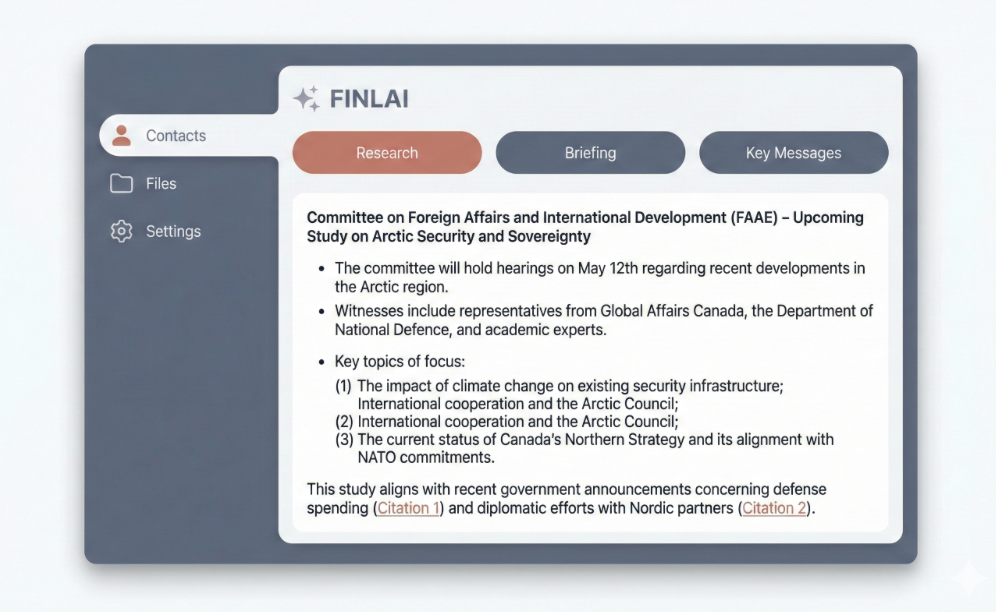
More importantly, it was designed specifically for the Canadian political ecosystem.
“It inherently understands the hyper-specific terminology, jurisdictional nuances, and the hidden connective tissue between organizations, officials, and policy issues that generic models completely miss,” he explained.
The difference, he argues, is not simply access to more information but access to better context.
“It doesn’t give you a generic summary,” Moffatt Armes said. “It gives you cited, contextual intelligence.”
What began as a tool designed exclusively for government relations professionals has evolved into something much broader. As FINLAI’s legislative intelligence capabilities expanded, PoliTraQ discovered that many organizations facing policy, regulatory, and political risk shared the same need for timely, contextual information. Today, legal professionals, compliance teams, corporate executives, industry associations, investors, researchers, and organizations operating in highly regulated sectors are increasingly using legislative intelligence to anticipate change before it impacts their business.
Through FINLAI Intel, users gain real-time visibility into bills, debates, committee proceedings, and policy developments across federal and provincial jurisdictions from a single interface. For some organizations, that intelligence helps shape advocacy strategies. For others, it supports risk management, strategic planning, investment decisions, regulatory compliance, and executive decision-making. The common thread is the growing recognition that legislative and committee activity is no longer just a government relations concern — it has become a critical source of business intelligence.
The Democratization of Advocacy
While much of the AI discussion focuses on productivity gains, Moffatt Armes sees an even larger opportunity.
He believes artificial intelligence has the potential to democratize advocacy itself.
“The greatest opportunity is the democratization of advocacy capacity,” he told AI Insider. “AI acts as an equalizer, giving a lean non-profit or a small community group the monitoring and research capabilities of a massive, well-funded firm.”
Historically, organizations with larger budgets often enjoyed significant advantages because they could dedicate more resources to policy research, legislative monitoring, and stakeholder engagement.
AI has the potential to narrow that gap.
Small organizations can now access analytical capabilities that previously required teams of researchers and consultants.
That shift could expand participation in public policy debates and enable a wider range of voices to engage effectively with government decision-makers.
Yet Moffatt Armes is equally aware of the risks.
“The risk is a massive acceleration of noise,” he warned.
As AI makes content creation easier, governments and advocacy organizations may face growing volumes of automated messaging, synthetic campaigns, and misinformation.
“Because AI makes content generation effortless, we are going to see astroturfing and targeted misinformation deployed at a scale and speed that will test the blast radius of public policy,” he said.
For public affairs professionals, the result may be shorter reaction times and increasingly complex decision-making environments.
“We will have to make highly complex strategic decisions faster than ever before.”
A Profession Ready for Change
Despite those challenges, Moffatt Armes remains optimistic about the future of government relations.
In fact, one of the most surprising developments he has observed is how quickly practitioners are embracing AI.
Government relations has not traditionally been known as a technology-forward profession. Institutional knowledge has often been highly personal, with critical expertise residing inside individual practitioners rather than formal systems.
Yet that appears to be changing.
“For an industry that has historically been incredibly slow to adopt new technologies, the speed of AI adoption has been staggering,” Moffatt Armes said.
More importantly, he believes the profession is no longer content with reactive approaches to policy monitoring.
“GR professionals are actively looking for ways to move from playing defense to playing offense.”
That shift may ultimately define the next era of government relations.
Instead of simply responding to policy developments after they emerge, organizations increasingly want the ability to identify opportunities earlier, anticipate risks sooner, and engage more strategically.
According to Moffatt Armes, the appetite for that transformation is already evident among customers.
“The trend we are seeing isn’t resistance; it’s an appetite for modernization,” he said.
For PoliTraQ, that momentum represents both validation and opportunity.
As governments generate more data, policy environments become more complex, and AI capabilities continue to advance, the need for intelligent public affairs infrastructure is likely to grow.
The future of government relations may not belong to the organizations with the largest teams or budgets.
It may belong to those with the best intelligence, the fastest insights, and the ability to transform information into action.
If Chris Moffatt Armes is right, that future has already begun.