
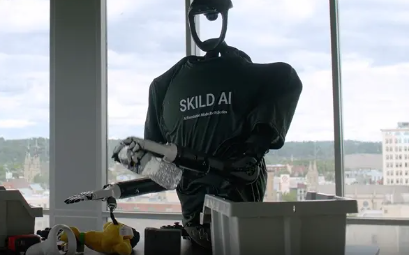
Insider Brief
- Skild AI, a Pittsburgh-based startup, is developing a general-purpose AI brain capable of controlling diverse robot types, from humanoids to industrial arms, under the concept of “omni-bodied intelligence.”
- The company’s Skild Brain uses a hierarchical architecture trained on simulated environments, internet videos, and limited real-world data, enabling it to generalize across platforms and adapt to unfamiliar tasks and hardware failures.
- Skild AI aims to challenge traditional robotics by replacing narrow, task-specific models with a scalable robotics foundation model that can exhibit emergent behaviors and operate across multiple machines using a single AI system.
A U.S. startup Skild AI is developing an AI “brain” that can control many different types of robots, aiming to make general-purpose robotic intelligence a reality.
Skild AI says its system, called the Skild Brain, is designed to operate across a wide range of robot types, from humanoid machines to quadrupeds and industrial arms. The goal is to create what the company calls “omni-bodied intelligence,” meaning a single AI that can adapt to any hardware and perform a wide array of physical tasks.
The announcement, made on the Pittsburgh-based company’s website, marks a challenge to the current generation of robotics systems, which are typically built for narrow tasks using specific machine designs.
“One of the biggest challenges in building a robotics foundation model is the lack of any large-scale robotics data,” the company noted in its blog post update of progress made in 2024. The team added collecting real-world data using hardware is slow cost-prohibitive, so a lot of researcher just go with an existing vision-and-language model (VLM) and add in less than 1% of real robot data. “But is this a true robotics foundation model?”
Most current AI systems that interact with the real world are built for limited purposes and are tightly linked to the physical robots they control. Skild AI says its model breaks this pattern by learning from a vast dataset spanning many types of robots and behaviors. The result, according to the company, is a system that can adapt more easily to new environments, hardware failures, or unexpected conditions in the real world.
According to the SoftBank and Amazon backed Skild AI, the Skild Brain is structured with two layers of control. A high-level system decides what actions to take—such as navigating or manipulating objects—while a lower-level module translates those actions into specific motor commands for a given robot. This layered design allows the same decision-making system to operate across many different machines.
The company says the model has already been trained on diverse datasets, including simulation environments, videos of humans performing tasks, and a limited set of real-world robotic data. The emphasis on simulation and video, Skild says, is a deliberate choice. Gathering physical data with robots is time-consuming and expensive, and to train a truly general model, Skild believes the scale must be in the trillions of examples. That’s a number unreachable by physical data alone in any reasonable time frame, the company says.
The team behind the effort includes engineers and researchers who have worked at companies including Tesla, Meta, Amazon, and Google, and have presented at major conferences in artificial intelligence and robotics. Their previous work includes research in dexterous manipulation, self-supervised learning, and sim-to-real transfer, all areas that support the current foundation model effort.
Skild AI says its robots are already showing signs of emergent behavior—that is, skills and responses that weren’t directly programmed but developed as the system trained across a broad and varied dataset. The company plans to release more details in the coming months as it expands the model’s capabilities and demonstrates further applications.