Insider Brief
- Boston Dynamics and Toyota Research Institute demonstrated a Large Behavior Model (LBM) controlling the Atlas humanoid, enabling long sequences of tasks without hand-coded instructions.
- The system integrates locomotion and manipulation under a single AI model, allowing Atlas to adapt in real time to unexpected changes such as shifted objects or closed containers.
- The joint research partnership, launched in October 2024, aims to advance general-purpose humanoids by scaling skills through human demonstrations and applying large models to whole-body control and dynamic behaviors.
Boston Dynamics and Toyota Research Institute have demonstrated a new artificial intelligence system that allows a humanoid robot to perform long sequences of complex tasks without hand-coded instructions.
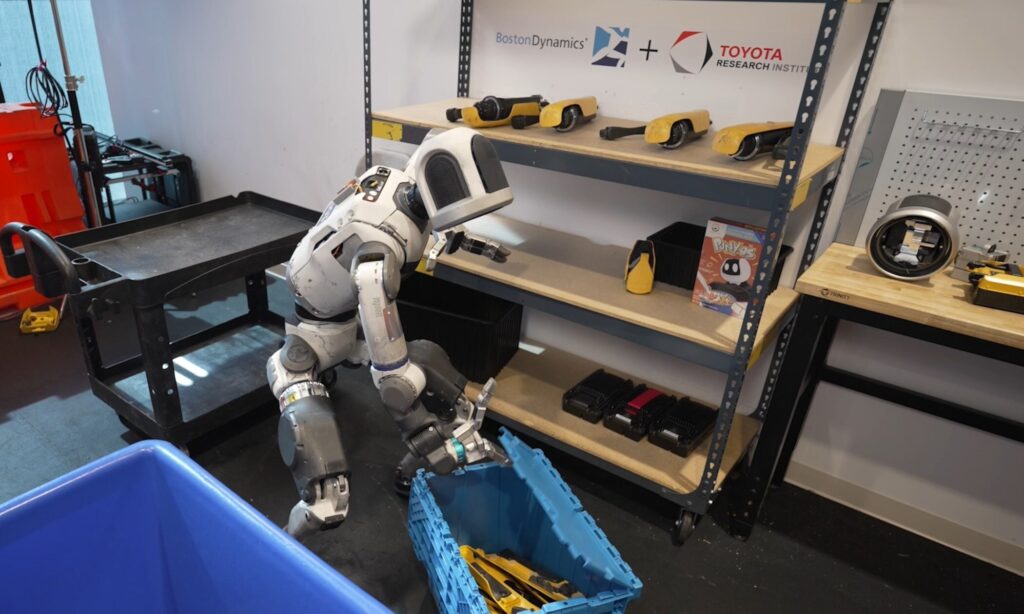
In a video released by the two organizations, the humanoid robot Atlas packs, sorts, and organizes objects using whole-body movements such as walking, crouching, and lifting. Mid-task interruptions, like closing a box lid or sliding it away, were introduced to show Atlas adjusting in real time.
According to the companies, the advancement comes from using what they call a Large Behavior Model, or LBM, to control both manipulation and locomotion through a single system. Previous approaches typically divided the control of arms and legs.
The advance is the product of a joint research partnership formed in October 2024 between Boston Dynamics and Toyota Research Institute, known as TRI, the companies saaid in announcing the latest advancement. The project is aimed at answering fundamental questions about humanoids and the application of large models for physical control. Researchers see it as a path to creating robots capable of a wide range of useful tasks in everyday environments.
“This work provides a glimpse into how we’re thinking about building general-purpose robots that will transform how we live and work,” said Scott Kuindersma, vice president of Robotics Research at Boston Dynamics. “Training a single neural network to perform many long-horizon manipulation tasks will lead to better generalization, and highly capable robots like Atlas present the fewest barriers to data collection for tasks requiring whole-body precision, dexterity, and strength.”
The LBM system is designed to make robots more adaptable by treating the feet and hands similarly, enabling coordinated control of the whole body. That could help machines manage situations that mix movement with fine manipulation, such as navigating cluttered environments while carrying out work.
“One of the main value propositions of humanoids is that they can achieve a huge variety of tasks directly in existing environments, but the previous approaches to programming these tasks simply could not scale to meet this challenge,” noted Russ Tedrake, senior vice president of Large Behavior Models at Toyota Research Institute. “Large Behavior Models address this opportunity in a fundamentally new way – skills are added quickly via demonstrations from humans, and as the LBMs get stronger, they require less and less demonstrations to achieve more and more robust behaviors.”
The companies said the project reaffirms the potential of AI in building general-purpose humanoid assistants. At a technical level, the effort expands the field’s understanding of how large models can be applied to whole-body control, advanced manipulation, and dynamic behaviors.
Boston Dynamics is known for mobile robots like Spot, used in industrial inspections and safety tasks, and Stretch, designed for logistics work. Atlas remains its experimental humanoid platform. TRI, founded in 2016, focuses on research in robotics, automated driving, and human-centered AI, with facilities in California and Massachusetts.