Insider Brief
- Rendezvous Robotics, a space infrastructure startup spun out of MIT and Aurelia Institute, has emerged from stealth with $3M in pre-seed funding led by Aurelia Foundry and 8090 Industries.
- The company’s patented TESSERAE modular tile system and autonomous swarm robotics enable scalable, reconfigurable, and resilient in-orbit infrastructure, proven through parabolic flights, Blue Origin’s New Shepard, and ISS missions.
- With leadership from SpaceX, Blue Origin, and Lockheed Martin, Rendezvous plans its 5th-generation ISS demonstration in 2026, advancing toward orbital solar farms, massive antennas, and reconfigurable national security platforms.
PRESS RELEASE — Rendezvous Robotics, a breakthrough space infrastructure company pioneering modular, autonomous in-orbit assembly, today announced the close of its Pre-Seed round and emergence from stealth. Its patented TESSERAE technology was invented at MIT by Dr. Ariel Ekblaw, incubated at the Aurelia Institute, and spun out as Rendezvous, co-founded by Ekblaw alongside Phil Frank and Joe Landon. The leadership team brings experience from SpaceX, Blue Origin, Lockheed Martin, and Nokia — spanning aerospace, telecom, and advanced technology — to enable the first-of-its-kind development of large-scale infrastructure built in orbit.
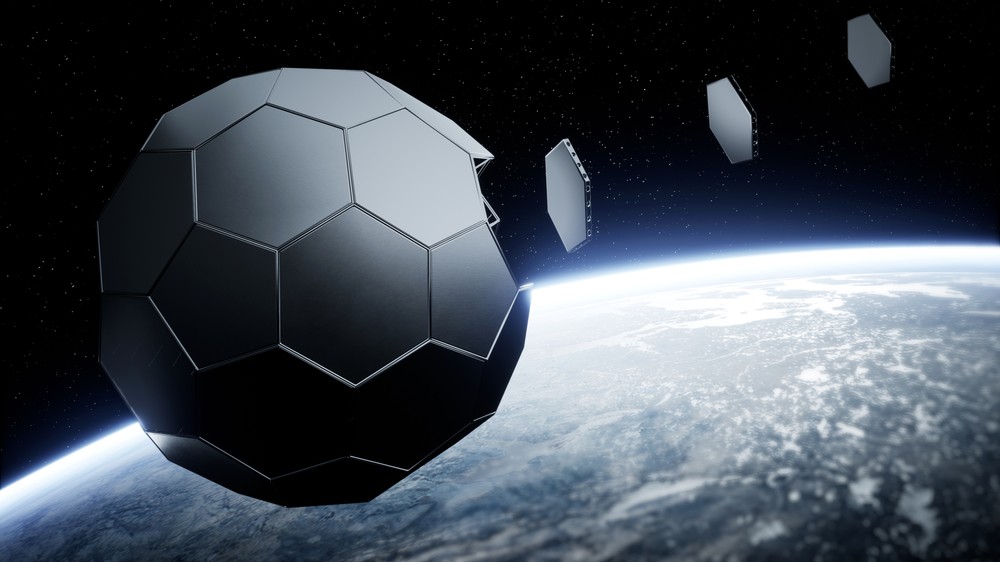
For more than six decades, space infrastructure has been limited by what can be folded up to fit inside rocket fairings. Rendezvous is redefining what’s possible by launching modular tiles to assemble systems and infrastructure in space. Its patented flat-packed modular tiles and autonomous swarm robotics assemble directly in orbit using electromagnetic formation flying. The autonomous modules dock, correct mistakes, and can reconfigure over time — creating infrastructure beyond what is currently available: scalable, reconfigurable, and resilient platforms for national security, commerce, and exploration.
“The ISS is about the size of a four-bedroom house, costing over $100 billion to build,” said Phil Frank, Co-Founder and CEO of Rendezvous. “It’s a remarkable achievement, but if we’re truly going to scale in space, we need a better way to build.”
“It’s time to profoundly scale up our ambitions in orbit. We’re launching a new paradigm for in-space construction,” said Dr. Ariel Ekblaw, Co-Founder of Rendezvous. “This technology makes more room for humanity — space for science, for nations, for life itself.”
The system builds on years of research, testing, and demonstrations – from parabolic flights to Blue Origin’s New Shepard, to two missions aboard the International Space Station (ISS) with NASA support. Having proven performance in orbit, Rendezvous is now advancing toward large-scale systems designed to self-assemble, self-correct, and endure in the harshest space environments.
“No one has done this before — intelligent assembly in orbit, proven in space and now ready to scale,” said Joe Landon, Co-Founder and President of Rendezvous. “This is the technology that will enable antennas larger than football fields, reconfigurable systems for defense, orbital solar farms, and even data centers in space. Launch opened access to space; Rendezvous is building what comes next.”
Rendezvous has secured $3M in pre-seed funding led by Aurelia Foundry and 8090 Industries, with participation from ATX Venture Partners, Mana Ventures, and a group of other significant angel investors. This initial raise fuels team expansion and accelerates the transition from proven demonstrations to large-scale orbital platforms. The company expects to share additional funding details in the coming weeks.
Looking ahead, Rendezvous will demonstrate its 5th-generation technology on the ISS in early 2026 — its third orbital demonstration and a milestone toward building large mission-specific systems and infrastructure directly in space.