

Insider Brief
- The U.S. Coast Guard will invest nearly $350 million under the One Big Beautiful Bill Act to expand robotics and autonomous systems, including $11 million in FY2025 for immediate upgrades to critical platforms.
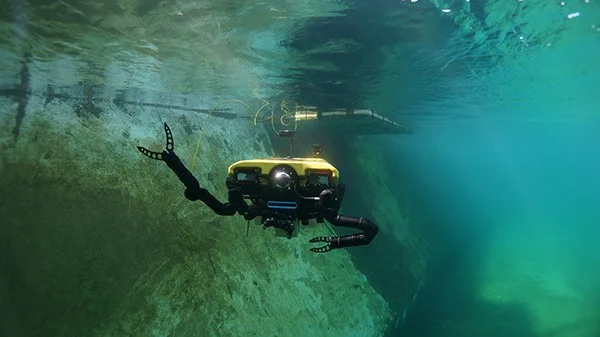
- Initial buys include $4.8 million for 16 VideoRay Defender ROVs, $2 million for six QinetiQ SPUR and 12 mini‑SPUR UGVs, and $4.3 million for 125 Skydio X10D short‑range UAS.
- The new systems will support inspections, disaster and CBRN response, search and rescue, and environmental missions while advancing the service’s Force Design 2028 plan to integrate unmanned capabilities across the fleet.
- Photo Credit: VideoRay
The U.S. Coast Guard said it will invest nearly $350 million to expand robotics and autonomous systems. The funding, provided under the One Big Beautiful Bill Act (OBBBA), includes $11 million in fiscal year 2025 for immediate upgrades to critical systems.
“These unmanned systems provide increased domain awareness, mitigating risk and enhancing mission success as the Coast Guard continues to operate in hazardous environments,” Anthony Antognoli, the Coast Guard’s first RAS program executive officer, said in a statement. “The Coast Guard’s mission demands agility, awareness and adaptability. Robotics and autonomous systems deliver all three, enabling us to respond faster, operate smarter and extend our reach where it matters most. We are not waiting for the future to arrive. We are delivering it to the fleet today.”
The first tranche targets three frontline tools:
- $4.8 million to procure 16 VideoRay Defender remotely operated vehicles (ROVs) to replace Deployable Specialized Forces’ aging fleet.
- $2 million to procure six QinetiQ Squad Packable Utility Robots (SPUR) and 12 mini‑SPUR unmanned ground vehicles (UGVs) for Coast Guard Strike Teams.
- $4.3 million to purchase 125 Skydio X10D short‑range unmanned aircraft systems (SR‑UAS).
Officials said these technologies meet immediate mission needs, reduce risk to personnel and strengthen the Coast Guard’s ability to control, secure and defend U.S. maritime approaches
How the Gear Will Be Used
The new ROVs will support waterfront and pier inspections, hull assessments, subsurface infrastructure surveys, disaster response and search‑and‑rescue—tasks that otherwise rely on divers. UGVs will equip Strike Teams—units that respond to hazardous‑materials spills, major marine casualties, groundings, natural disasters and chemical, biological, radiological or nuclear (CBRN) incidents—to reach confined spaces aboard commercial vessels and sample air without exposing responders. The SR‑UAS will back infrastructure inspections, environmental observation, pollution response, post‑storm and ice surveys, and ad‑hoc communications.
Wednesday’s announcement is the first in a series of robotics and autonomy projects the Coast Guard plans to pursue with OBBBA funds. Program officials said subsequent buys will build on operational feedback from these initial deployments to scale what works across sectors and regions.
The RAS office sits within the service’s broader Force Design 2028 initiative, an accelerated blueprint to integrate new capabilities across the organization. The plan concentrates on four campaigns—people, organization, contracting and acquisition, and technology—to make the Coast Guard more agile, capable and responsive. Robotics and autonomy are a centerpiece of the technology track, meant to extend the reach of cutters, aircraft and small boats while reducing risk to crews.
The Coast Guard operates across more than 95,000 miles of shoreline, 25,000 miles of navigable rivers and 4.5 million square miles of exclusive economic zone. As a member of the joint force, a law‑enforcement agency, a regulator and an intelligence‑community component, the service uses a mix of authorities to defend the nation, safeguard ports and waterways, interdict drugs and secure maritime borders. Its more than 55,000 members run a multimission fleet of 250+ cutters, 200 aircraft, 1,600 boats and a dedicated cyber command—an operating footprint officials say will increasingly rely on unmanned systems to gain awareness and act faster in high‑risk environments.