Insider Brief
- Microsoft has introduced Rho-alpha, a research robotics model designed to translate natural-language instructions into physical actions for dual-arm robots performing manipulation tasks.
- Rho-alpha extends vision-language-action approaches by incorporating tactile sensing and is being developed to learn from human feedback during deployment, targeting tasks such as button pushing, knob turning, plug insertion, and tool handling.
- The model remains in research, with testing on dual-arm industrial and humanoid robots and planned access through an early access program and later via Microsoft Foundry, supported by training that combines physical demonstrations with synthetic simulation data.
Microsoft has introduced a robotics model designed to translate natural-language instructions into physical actions for dual-arm robots performing manipulation tasks.
“Physical AI, where agentic AI meets physical systems, is poised to redefine robotics in the same way that generative models have transformed language and vision processing,” Microsoft noted in the announcement this week of Rho-alpha, its first robotics model derived from the Phi family of compact vision-language models.
The system is aimed at robotic manipulation tasks that require two arms and fine motor control, such as pushing buttons, turning knobs, inserting plugs, and handling tools, the company said.
“The emergence of vision-language-action (VLA) models for physical systems is enabling systems to perceive, reason, and act with increasing autonomy alongside humans in environments that are far less structured,” Ashley Llorens, Corporate Vice President and Managing Director, Microsoft Research Accelerator, said in a statement.
According to Microsoft, Rho-alpha converts natural-language commands into low-level control signals that can drive robotic hardware. The model is designed to operate across multiple sensing modalities, combining vision and language with tactile input, and potentially force feedback, to better manage contact-heavy tasks where visual cues alone are insufficient.
“We believe robots that can adapt more easily to dynamic situations and to human preferences will be more useful in the environments in which we live and work and more trusted by the people who deploy and operate them,” the company said.
Microsoft described Rho-alpha as an extension of the vision-language-action, or VLA, approach that has gained traction in robotics research. Unlike earlier VLAs, which typically rely on camera data and pre-recorded demonstrations, Rho-alpha incorporates tactile sensing and is being developed to learn continuously during deployment by incorporating feedback from human operators.
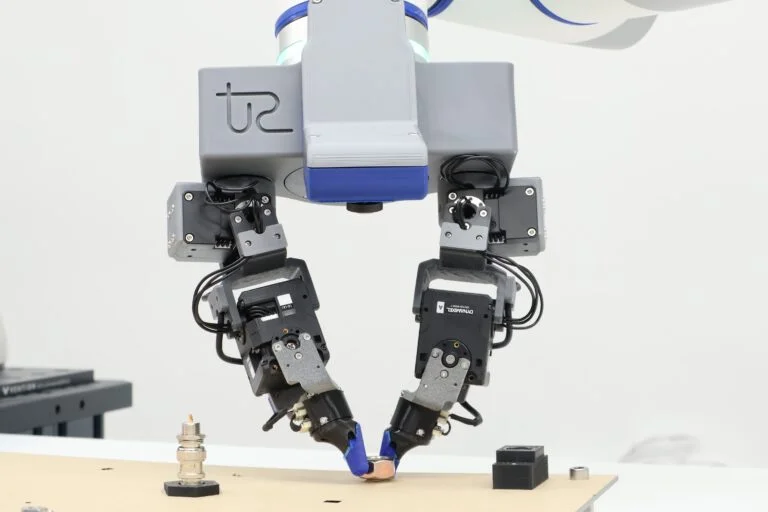
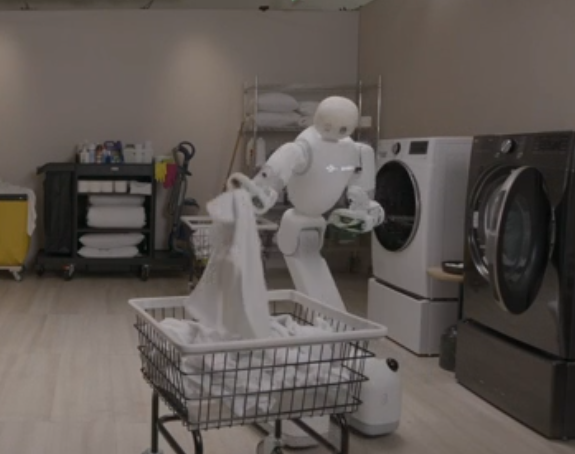
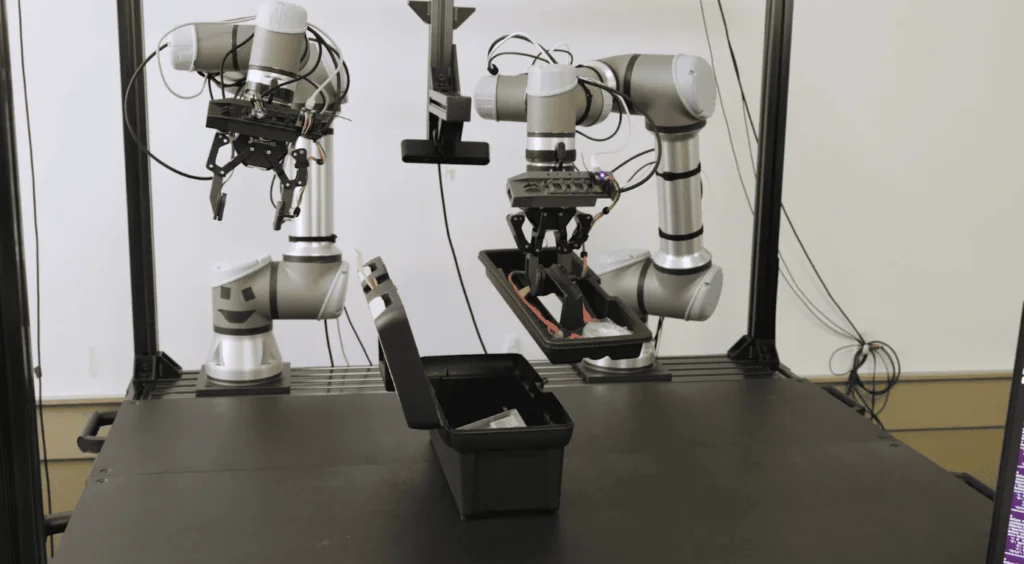
The system has been tested on dual-arm industrial robots and on humanoid platforms, with demonstrations showing robots following spoken or written instructions to manipulate a standardized “BusyBox” benchmark device introduced by Microsoft Research. Additional trials include plug insertion and toolbox packing using a dual-arm setup equipped with tactile sensors. In some cases, the robot required real-time human guidance to recover from errors, highlighting one of the current limitations of robot learning.
The company said it plans to offer access through a Research Early Access Program and later through Microsoft Foundry, its platform for hosting and deploying AI models. A technical paper detailing the model architecture and training methods is expected in the coming months.
The company pointed out that training remains a central challenge. Robotics models require large volumes of diverse data that capture physical interaction, including touch and force, which are costly and difficult to collect at scale. To address this, Microsoft Research is combining real-world demonstrations with synthetic data generated in simulation. The training pipeline blends trajectories from physical robots with simulated tasks and web-scale visual question-answering data.
Simulation plays a significant role in this process. Microsoft said it is using the open Isaac Sim framework from NVIDIA to generate physically realistic synthetic data, which is then mixed with commercial and open robotic datasets. The goal is to expose the model to a broader range of scenarios than would be practical to gather through teleoperation alone, particularly for tasks involving tactile feedback.
“While generating training data by teleoperating robotic systems has become a standard practice, there are many settings where teleoperation is impractical or impossible,” Professor Abhishek Gupta, Assistant Professor, University of Washington, noted. “We are working with Microsoft Research to enrich pre-training datasets collected from physical robots with diverse synthetic demonstrations using a combination of simulation and reinforcement learning.”
Despite the added sensing capabilities, Microsoft acknowledged that robots powered by Rho-alpha can still fail in ways that are difficult to correct autonomously. To address this, the company is developing tools that allow human operators to intervene using intuitive input devices and to provide corrective feedback that the model can learn from over time. This human-in-the-loop strategy is meant to improve reliability during real-world operation rather than relying solely on offline retraining.
Microsoft framed Rho-alpha as part of a broader effort to give robotics manufacturers, system integrators, and enterprise users the ability to train and adapt their own cloud-hosted models using proprietary data and hardware. Rather than delivering a finished product, the company is positioning the system as a foundation that partners can build on for specific environments and tasks.
Image credit: Microsoft