Insider Brief
- Uber founder Travis Kalanick is rebranding his startup City Storage Systems as Atoms, expanding the company into a broader industrial automation platform focused on sectors including food production, mining and transportation.
- Kalanick said the strategy centers on “digitizing the physical world” by applying data, robotics and automation to industries built around producing and moving physical goods.
- The approach involves building “atoms-based computers” that integrate manufacturing, real estate and transportation infrastructure while using sensors, AI models and robotics to automate real-world industrial systems.
Uber founder Travis Kalanick announced he is repositioning his new company, previously known as City Storage Systems, as a broader physical AI platform called Atoms, focused on automation across sectors including food production, mining and transportation.
Kalanick, who left Uber in 2017 following a investor pressure and critizism of the company’s internal culture, described in a post on the company’s website that the new effort as part of a longer-term focus on applying computation and software-style systems thinking to physical industries. After departing Uber, he launched City Storage Systems, initially focusing on real estate and logistics infrastructure tied to food delivery operations.
City Storage System has launched companies such as CloudKitchens, Otter, Lab37, Picnic and ProFood Properties, which provide infrastructure, software and robotics systems designed to support automated restaurant operations and delivery-first food production networks. In a LinkedIn post, Atoms indicated those will become part of Atoms.
Whats Next for Kalanick and Atom?
Kalanick wrote the company is now expanding its strategy beyond food services to include automation technologies for mining and transportation and will operate under the Atoms brand. The shift reflects a broader vision centered on what Kalanick describes as “digitizing the physical world,” applying data, automation and robotics to industries built around producing and moving physical goods.
He listed the company’s compuers to include:
- Atoms Food: Infrastructure platform focused on producing “better food.”.
- Atoms Mining: Automation systems designed to increase productivity in mining operations.
- Atoms Transport: A robotic “wheelbase” platform.
“It means approaching physical world problems like software problems — building atoms-based computers. The core computing resources: CPU, Storage, Network for the physical world — digitized manufacturing, real estate and transport,” Kalanick wrote.
The company’s focus on infrastructure platforms for food production, systems aimed at improving productivity in mining operations and robotics frameworks designed to support autonomous transportation isn’t random, Kalanick explained.
“Everything in our world, in our cities, in our civilization — look around you — is mined or grown — manufactured and moved,” he wrote.
Kalanick said the next “Golden Age” will arrive when “these can be fully divorced from human”growing, mining, manufacturing and moving physical things becomes fully divorced from human labor.”
In his post, Kalanick argues that progress comes from discovering insights others have not yet uncovered. Organizations that consistently identify these “unknown truths” gain knowledge advantages that allow them to solve problems and build technologies others cannot, accelerating innovation and societal advancement. He frames this pursuit as a fundamental driver of human progress and civilization.
Kalanick said the long-term objective is to expand the role of robotics and autonomous systems in physical industries, particularly those involving large-scale production and logistics. He argued that while software has automated many information-based tasks, the automation of physical labor remains an early-stage opportunity that could reshape manufacturing, transportation and resource extraction.
What Are Kalanick’s Three Steps for Digitzing the Pgysical World?
- Understand the current state of the physical world
- Predict the future state of the physical world
- Control the future state of the physical world
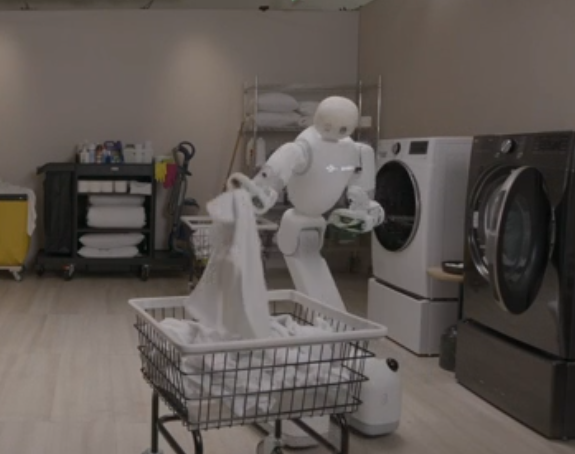
Kalanick also emphasized a strategic focus on specialized robotic systems designed for specific industrial tasks rather than general-purpose humanoid machines. He said said robots designed around particular production environments could deliver higher efficiency and throughput than anthropomorphic designs in many industrial applications.
“At Atoms we make gainfully employed robots — specialized robots with productive jobs that bring abundance to their owners and society at large,” Kalanick wrote.
Kalanick argues that building large-scale physical automation systems will require integrating a broad technology stack that spans both digital and industrial capabilities. He describes the physical AI stack as combining sensors, computing infrastructure, AI models, robotics manipulation, software systems, operations research, manufacturing, real estate development, energy systems and materials chemistry to support automation of real-world industries.
Kalanick said entrepreneurs often find their next venture by focusing on self-awareness and recognizing opportunities that align with their interests and experience. He described his latest effort as a continuation of his long-standing focus on building technology platforms for physical industries.
“When I told my friends, family and colleagues about my plans for what was next, they were really excited that I was ‘coming back.'” Kalanick wrote. “The thing is, I never left.”