Insider Brief
- Ant Group’s robotics unit Robbyant has partnered with Leju Robot to develop embodied AI systems for industrial and commercial deployment.
- The companies plan to combine Leju’s robotics hardware and operational data with Robbyant’s AI models to build large datasets of real robot interactions and train systems capable of improved perception, decision-making and learning in physical environments.
- Leju previously supplied nearly 10,000 hours of multimodal robot data used to train Robbyant’s LingBot-VLA vision-language-action model, which can transfer capabilities across different robot platforms.
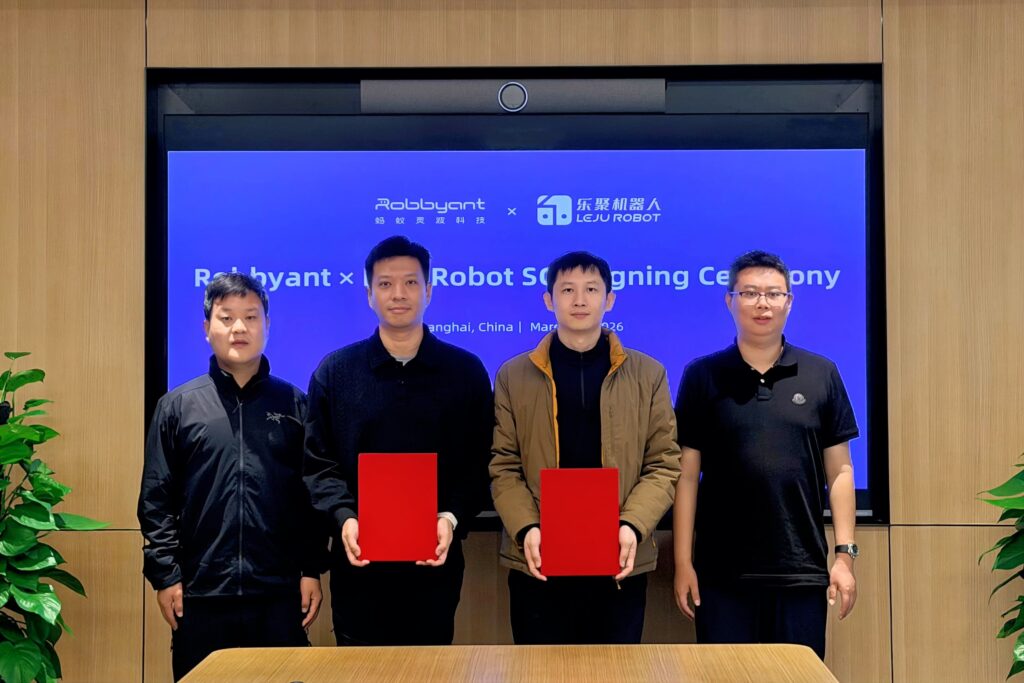
Ant Group company Robbyant has formed a strategic partnership with Leju Robot to develop embodied artificial intelligence systems designed for real-world deployment in industrial and commercial settings.
According to Robbyant, the collaboration aims to combine Leju’s robotics hardware and operational data with Robbyant’s AI model development to build large datasets of real robot interactions and train new embodied AI systems. The company said the effort will focus on improving robots’ perception, decision-making and learning capabilities while developing industrial and commercial applications to speed up the commercialization of embodied AI.
“The embodied AI industry is evolving from technical verification to real-world deployment,” Zhu Xing, CEO of Robbyant, said in the announcement. “How to seamlessly integrate model capabilities, robotic embodiments, and practical use cases has become a key direction for industry development in the next stage. Through this partnership, we aim to advance the verification and application of related technologies in real-world scenarios and accelerate industrial progress.”
Leju has already provided nearly 10,000 hours of multimodal robot data to support Robbyant’s LingBot-VLA model, a vision-language-action system designed to function as a general control framework for robots. Robbyant said the model’s ability to transfer capabilities between different robot designs has been shown by its adaption for robots from multiple manufacturers.
In January, Robbyant introduced a broader suite of embodied AI models including LingBot-Depth for spatial perception, LingBot-World for world-model simulation and LingBot-VA, which uses video prediction to enable robotic reasoning. The company said the systems are intended to improve robot perception, decision-making and interaction in complex physical environments.
Earlier this month, Schaeffler announced it had partnered with Leju Robot to accelerate development and industrial deployment of humanoid robots, marking the German manufacturer’s first collaboration with a Chinese humanoid robotics developer. The companies plan to focus on factory inspection, equipment support, logistics and human-robot collaboration, with Schaeffler aiming to deploy a mid-four-digit number of humanoids in its production facilities by 2035.
Featured Image: Zhu Xing (1st left), CEO of Robbyant, and Chang Lin (1st right), CEO of Leju Robot, witness the signing ceremony. (Credit: Robbyant)