Insider Brief
- Monumental raised $32 million in Series B funding to expand its autonomous bricklaying systems across construction sites in Europe and enter the U.S. market this year.
- The round was led by Khosla Ventures, with participation from existing investors Hummingbird, Plural and others, and will support hiring, robot deployments and expansion into more construction tasks.
- Monumental operates as an autonomous subcontractor, using electric robots and its Atrium AI software platform to lay brick and mortar while customers pay for completed walls rather than buying or operating the machines.
Monumental, a Dutch robotics company that builds autonomous bricklaying systems for construction sites, has raised $32 million in Series B funding. The round was led by Khosla Ventures, with participation from existing investors Hummingbird, Plural and others, according to the company.
The company indicated it plans to use the capital to expand its team of hardware and software engineers, deploy more robots on construction sites across Europe, enter the U.S. market this year and increase the types of construction tasks its systems can handle.
Monumental’s electric robots use sensors, computer vision and small cranes controlled by its Atrium AI software platform to lay brick and mortar to millimeter precision. Rather than selling the machines, the company operates as an autonomous subcontractor with builders hiring Monumental and paying for completed walls on an outcome-based basis. This approach, which the company describes as “forward-deployed”outcome-priced and forward-deployed,” removes the need for customers to own or operate the robots.
The business model draws on the forward-deployed engineering approach that co-founders CEO Salar al Khafaji and CTO Sebastiaan Visser previously used at the previous company they founded Silk, which Palantir acquired in 2016. Monumental says it was the first company to apply that model to robotics.
The company pointed out that ongoing construction labor shortages as the core problem its systems address., using as an example that U.S. home builders face a monthly shortfall of 200,000 to 400,000 workers and will need to add 2.2 million more over the next three years. By adding automated capacity, Monumental aims to increase the volume of housing and infrastructure that can be built while shifting human crews into higher-skilled roles overseeing the robots.
“The world simply does not have enough people to build what it needs, and that shortage will not be solved by another app or another robot doing backflips on stage,” al Khafaji noted in the announcement. “It takes machines that turn up on site and lay real brick all day, to spec, which is what our fleet already does today. Every robot we deploy expands the industry’s capacity to build, bringing a future of beautiful, affordable, bespoke buildings and infrastructure closer to reality. Khosla’s investment lets us put many more of them to work in more countries while expanding beyond bricklaying.”
According to Monumental, the company’s robots have already built exterior walls for more than 100 homes in the Netherlands and the U.K., along with a school, a community center, a hotel and sections of canal wall. Nearly half of those homes were completed in the most recent three months, compared with eight in the prior quarter. Monumental currently runs a fleet of more than 100 robots.
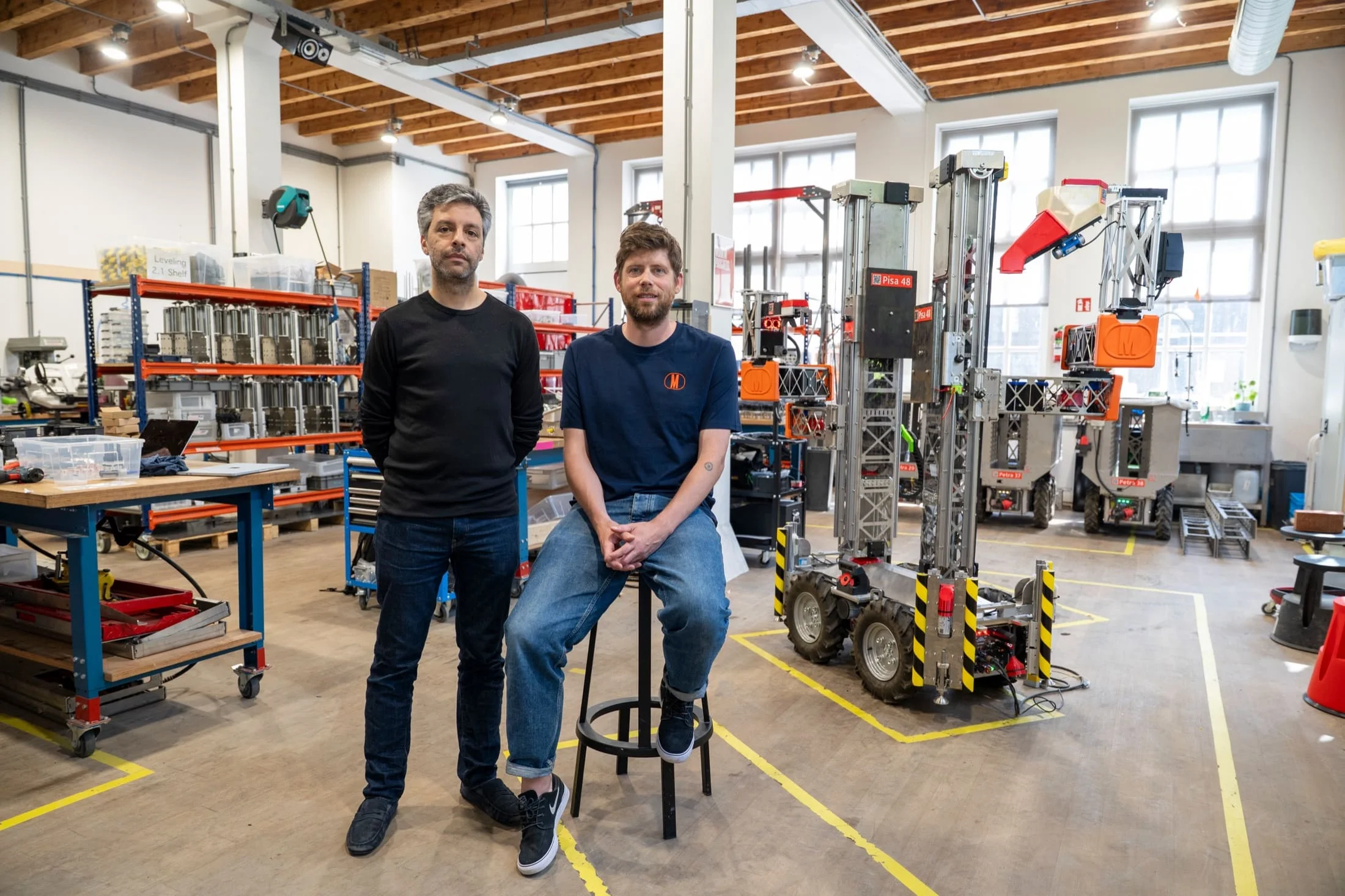
Featured image: Monumental founders CEO Salar al Khafaji and CTO Sebastiaan Visser. (Credit: Monumental)