
Insider Brief
- An AI-designed drug for idiopathic pulmonary fibrosis produced protein changes associated with lower biological age in a 12-week phase 2a clinical trial.
- Six machine-learning aging clocks detected biological-age reductions among treated participants, with the most consistent results from the 30-milligram twice-daily dose.
- The small study could not separate the drug’s anti-fibrotic activity from a possible anti-aging effect, which will require testing in larger and non-IPF populations.
An artificial intelligence-designed drug for a deadly lung disease produced protein changes associated with lower biological age, offering early evidence that AI-discovered medicines could be evaluated for effects beyond the diseases they were created to treat.
Researchers reported in Nature Biotechnology that rentosertib, an experimental treatment for idiopathic pulmonary fibrosis, or IPF, reduced predicted biological age across six computational aging models in a 12-week phase 2a clinical trial. The models analyzed proteins circulating in the blood to estimate how quickly a person’s body appears to be aging.
While the findings do not establish that rentosertib slows aging or extends life and the trial included only 42 people, the study connects several emerging uses of AI in drug development. AI tools helped researchers identify the drug’s biological target and design the compound. Machine-learning models were then used to evaluate changes in biological age during the clinical trial. The approach could give drug developers a way to search for broader effects of new medicines while they are still being tested for conventional diseases.
The researchers said the work supports clinical trials that simultaneously measure a drug’s effect on a specific illness and its possible influence on aging-related processes.
They write: “This work supports the goal of dual-purpose clinical trial designs that integrate aging endpoints into studies for specific disease indications.”
Six AI Models Point in the Same Direction
Rentosertib, previously known as INS018_055, inhibits an enzyme called TRAF2- and NCK-interacting kinase, or TNIK. The protein plays a role in several biological processes associated with aging as well as the formation of scar tissue, known as fibrosis.
IPF is a progressive disease in which scar tissue builds up in the lungs, making breathing increasingly difficult. It occurs mainly in older adults and is closely connected to inflammation, cellular stress and other processes commonly associated with aging.
Insilico Medicine used its PandaOmics AI platform to study connections among diseases, genes and biological pathways and identify TNIK as a possible drug target. Such systems combine information from scientific papers, biological databases and other sources. The study said the platform includes models designed to work in areas where experimental data are limited, including algorithms that trace relationships across networks of diseases, genes and proteins.
Rentosertib was subsequently designed with AI-assisted drug-discovery methods and advanced into clinical testing. The new study asked whether the compound’s biological effects extended beyond its intended action against lung fibrosis.
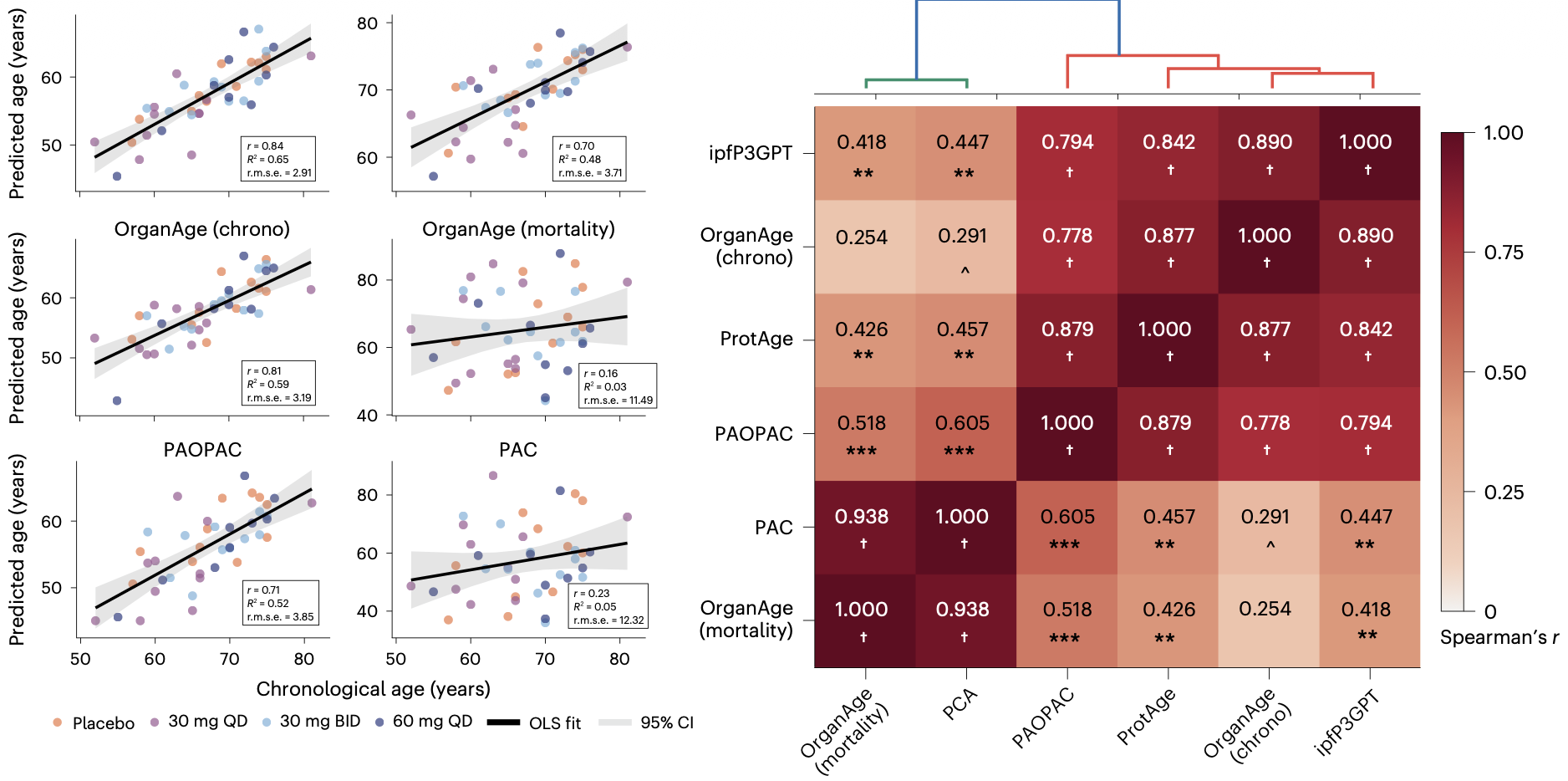
Researchers applied six previously published proteomic aging clocks to blood samples collected during the trial. Proteomic clocks use patterns among proteins in the blood to estimate biological age or mortality risk. Unlike chronological age, which simply counts years since birth, biological age is intended to reflect the condition of the body.
Four of the clocks were trained to predict chronological age, while two were trained using mortality data. Some relied on conventional machine learning, and others used deep learning, a form of AI that learns complex patterns from large datasets.
The clocks differed in their design, training goals and number of protein measurements. That diversity was important because aging clocks can produce inconsistent results. Agreement among several independent models may provide stronger evidence than a prediction from one clock alone.
All six detected changes associated with a reduction in biological age among participants who received rentosertib. The placebo group showed little change or a slight increase over the study period.
The strongest agreement emerged four weeks after treatment began, showing that across the three dosing regimens and six clocks, the researchers found 21 statistically significant comparisons with placebo, far more than would be expected by chance.
The 30-milligram twice-daily dose generated the broadest agreement, producing significant results in nine comparisons. The 60-milligram once-daily dose produced seven, while the 30-milligram once-daily dose produced five.
Four clocks trained to estimate chronological age associated the 60-milligram once-daily regimen with a biological-age reduction of between 2.71 and 3.46 years at week four. The researchers cautioned that such numbers are model outputs, not evidence that patients literally became several years younger.
Protein Data May Reveal a Broader Response
The trial initially enrolled 71 participants at sites in China. For the new analysis, researchers examined serum samples from the 42 participants who consented to the additional protein study and had samples available at baseline and after two, four and 12 weeks. Their average age was 67.1 years.
Participants received a placebo or one of three rentosertib regimens. The researchers measured 2,841 proteins using the Olink Explore 3072 platform, producing a series of molecular snapshots during treatment.
Statistical analysis identified changes in the trajectories of 326 proteins across the rentosertib groups, compared with only two in the placebo group. The twice-daily 30-milligram regimen generated the broadest response, including changes in 142 proteins not significantly affected in the other groups.
Several proteins associated with fibrosis and the remodeling of tissue around cells declined during treatment. Other changes involved metabolism, resistance to cellular stress and antioxidant activity.
The results also highlighted an important complication for AI-based aging measures. A drug that improves a serious age-related disease may make a patient’s blood-protein profile look younger even if the treatment does not affect aging more generally.
The researchers used several additional analyses to explore that issue. They found that improvement in forced vital capacity, a measure of lung function, explained little of the variation in biological-age predictions. The 60-milligram once-daily group had produced the largest lung-function improvement in the original trial, but the 30-milligram twice-daily group generated the most consistent aging-clock response.
The team also compared the trial’s protein changes with normal aging patterns drawn from 55,319 older participants in the UK Biobank. Proteins affected by rentosertib were 1.74 times as likely to be associated with age as would be expected from the broader set of measured proteins.
In the twice-daily group, treatment tended to move age-associated proteins in the opposite direction from normal aging. The same relationship was not statistically significant in the 60-milligram once-daily group, despite that group’s stronger lung-function result.
The researchers interpreted the difference as indirect evidence that the aging-clock findings cannot be explained entirely by reduced fibrosis. They stressed, however, that the computational comparisons cannot prove an independent anti-aging effect.
Pathway analysis also found signs that rentosertib affected cellular senescence, a state in which damaged or stressed cells stop dividing but remain active and can release inflammatory signals. Senescent cells accumulate with age and have been implicated in IPF and other chronic diseases.
Protein signatures associated with senescence increased in the placebo group but generally declined in the treatment groups. Rentosertib also affected growth-factor and nutrient-sensing pathways that have previously been connected to aging.
A Possible New Role for AI in Clinical Trials
The researchers proposed using aging measures as exploratory endpoints in trials for recognized age-related diseases rather than treating aging itself as the initial indication. Under current U.S. regulatory frameworks, a drug would still need conventional clinical evidence for a specific disease or a formally accepted biomarker before its developer could make therapeutic claims.
Future studies would need to reproduce the results in larger groups, extend the observation period and include people without IPF. The researchers also called for tissue sampling, direct measurements of senescent cells and additional molecular tests covering gene activity, epigenetic changes and other biological layers.
Such trials could help determine whether rentosertib’s apparent aging effects are independent of its action against fibrosis. They could also test whether proteomic clocks predict meaningful outcomes such as better health, lower disease risk or longer survival.
The larger implication concerns how AI-discovered drugs are developed. AI systems are increasingly used to select targets and generate candidate molecules, but clinical trials typically evaluate those drugs against a narrow set of disease-specific measures. Adding machine-learning aging models could reveal effects on related biological processes and identify opportunities to use a drug for other conditions.
The study offers an early example of that full-circle approach. AI helped identify the target and create the medicine, while another collection of computational models helped examine what the drug did inside patients.
Limitations and Next Steps
The researchers indicate several limitations and challenges that they or other scientists must tackle in the future. First, biological-age signal was strongest at week four and then leveled off. The researchers said the pattern could reflect adaptation to the drug, a new biological equilibrium or a limitation of the aging clocks. It does not necessarily mean the underlying protein effects disappeared because many treatment-associated protein changes continued through week 12.
The different results for the two regimens delivering a total of 60 milligrams a day also raise questions about dosing. Rentosertib has a half-life of approximately seven to 11 hours. Two smaller doses may maintain steadier drug levels than one larger dose, potentially affecting metabolic and aging-related pathways differently.
That possibility remains a hypothesis because the trial was not designed to determine whether intermittent or evenly distributed dosing is better for influencing aging.
Another limitation is the study size with the the proteomic analysis including 42 participants and only nine to 11 people in each treatment group. The study lasted only 12 weeks and included no healthy participants. All participants had IPF, a disease that itself alters many of the same proteins and pathways used by aging clocks.
The protein platform also measured fewer than 3,000 proteins, while the human proteome contains many more. TNIK itself was not included on the panel, preventing direct measurement of the drug’s engagement with its intended target.
Aging clocks identify statistical patterns rather than causes. A younger prediction does not necessarily mean a person will live longer, avoid age-related disease or experience improved physical function. Some protein changes could reflect beneficial repair, harmful stress or the body’s attempt to compensate for treatment.
Alex Zhavoronkov, the study’s corresponding researcher, is founder and chief executive of Insilico Medicine, and several other researchers are company employees. Insilico is developing rentosertib and other treatments for fibrotic diseases.