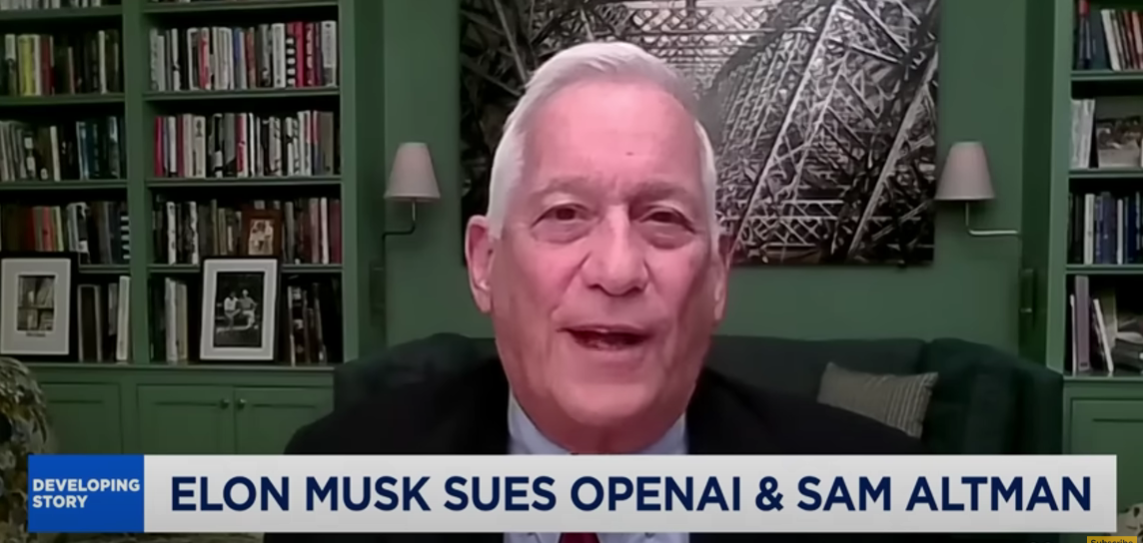
Walter Isaacson, a renowned biographer and partner at Perella Weinberg, is no stranger to reaching into the lives and motivations of influential figures in technology and business. In his latest discussions on CNBC’s ‘Squawk Box’, Isaacson provided insights into the lawsuit filed by Elon Musk against OpenAI and its CEO, Sam Altman. Isaacson, who spent two years with Musk for his biography, offered a unique perspective on Musk’s deep involvement and concerns regarding artificial intelligence (AI).
Isaacson’s account highlights Musk’s initial vision for OpenAI: a fear that large corporations like Google and Microsoft could monopolize AI, driving him and Sam Altman to establish OpenAI as an open-source and nonprofit entity. Isaacson underscores Musk’s disappointment with the shift away from this vision.
“What Musk wanted was it to be open and nonprofit,” said Isaacson. “What they decided at the beginning. Why he’s so upset is because, obviously, you know, OpenAI is no longer open source, and Microsoft has 49% of a for-profit arm of it.”
This pivot from OpenAI’s original mission has evidently struck a chord with Musk, leading to a broader discourse on the ethics and future direction of AI development. Isaacson conveyed Musk’s disillusionment and determination, recounting a moment when Musk confided in him about starting his own AI company in response to the perceived disaster unfolding at OpenAI.
“Near the end of my book, there’s a wonderful scene where Elon Musk said, ‘I’ve got to start my own AI company, because this is a disaster, what’s happening with OpenAI,’” said Isaacson.
The author also reflects on Musk’s motivations beyond mere financial gain, highlighting his passion for a decentralized AI landscape. Musk’s refusal of shares in OpenAI, as mentioned by Isaacson, signifies his broader concern for the industry’s direction rather than personal profit:
Isaacson also said in the interview that Musk expressed no interest in financial gain from his involvement with AI, emphasizing instead his desire to prevent companies like Microsoft and Google from dominating the industry. This perspective highlights Musk’s deep-seated concern over the monopolization of AI by a few large corporations, a theme Isaacson has noted as a consistent thread throughout Musk’s career spanning over a decade.
The conversation with Isaacson sheds light on the complexities underlying Musk’s legal battle against OpenAI. It is not merely a matter of legal or financial disputes but a profound concern for the future of AI, its accessibility, and its ethical deployment. Through Isaacson’s insights, we gain a deeper understanding of Musk’s actions, driven by a vision for an AI that benefits all of humanity, not just the interests of a few corporate entities.
Featured image: Credit: CNBC