
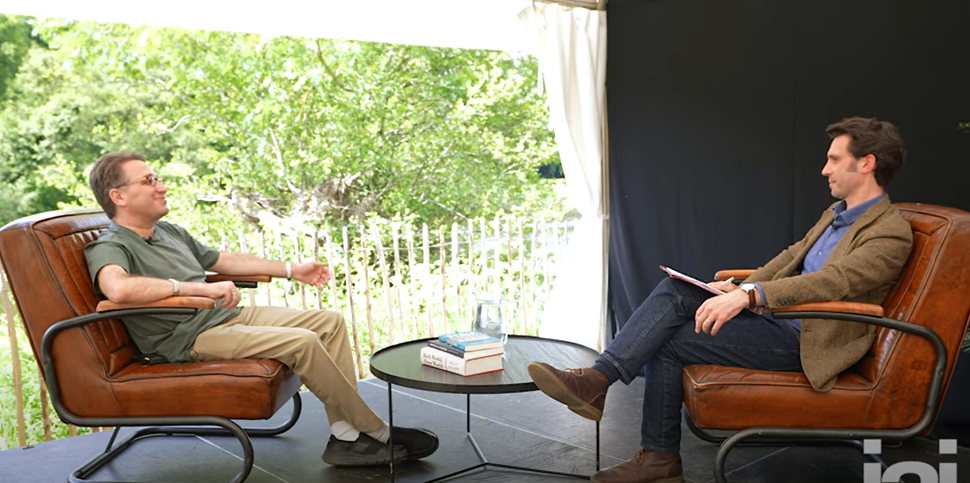
While primarily known as a thought-leader in quantum computing, Scott Aaronson — a Professor of Computer Science at The University of Texas at Austin— offered his expert views into the challenges and promises of AI in a recent interview with The Institute of Art and Ideas. Aaronson, also an expert on AI safety, spoke candidly about the nature of AI, its limitations and the potential dangers it poses.
When discussing the rapid advancements in AI, Aaronson acknowledged that “AI will continue to get better and better.” He compared the development of AI to the widespread adoption of the internet in the 1990s, predicting that soon, our interactions with computers will be as seamless as “just say[ing] in English what you want and it understands you and does that thing.”
However, Aaronson is cautious about the overestimation of AI’s capabilities. He pointed out that despite AI’s impressive progress, “we don’t know the answers to those questions yet” regarding its ultimate limits. He raised concerns about the diminishing returns as AI reaches the boundaries of available data and computational power. According to Aaronson, we might already be “scraping the bottom of the barrel” in terms of training data, a situation that could slow AI’s advancement.
A critical part of the discussion revolves around the nature of understanding and whether AI can truly “understand” in the same way humans do. Aaronson challenges the skeptics who downplay AI’s capabilities by arguing that such deflationary claims often “prove too much.” He questions why we shouldn’t apply the same reductionist arguments to human intelligence, noting, “at a higher level [AI] is thinking, it is understanding, it is learning, it is creative.”
Aaronson also touches on the ethical implications and safety concerns of AI development. He explained the precarious position researchers find themselves in, stating: “if no one in the west did it, you know at some point the Chinese government would do it.” This highlights the race to develop AI ethically before less scrupulous entities do. Despite the intentions, Aaronson acknowledges that the very act of developing AI might bring about the risks they aim to prevent.
In his work at OpenAI, Aaronson focuses on AI safety, particularly in understanding the inner workings of AI systems. He stressed the importance of interpretability, where researchers look “inside of the neuron nets” to determine whether AI systems are truthful or deceptive. This research is crucial as it allows scientists to assess whether AI systems are genuinely aligned with human values or if they are simply “biding their time until [they] can turn against the humans.”
Reflecting on the potential dangers of AI, Aaronson acknowledged that the threat is real and complex. He mentioned ongoing efforts in AI “gain of function” research, where scientists intentionally push AI systems to their limits in controlled environments to understand the risks better. This approach is essential to ensuring that AI remains a tool for good rather than a potential harbinger of catastrophe.
Aaronson provided a nuanced view of AI, balancing optimism about its capabilities with a sober assessment of the challenges and risks. His ideas are a reminder that while AI continues to advance, understanding its limitations and ensuring its safety are paramount to avoiding unintended consequences.
Featured image: Credit: The Institute of Art and Ideas