Insider Brief
- The Australian Renewable Energy Agency (ARENA) has awarded $4.9 million to Boston-based robotics firm Luminous as the first recipient of its $100 million Solar ScaleUp Challenge to reduce the cost of utility-scale solar power.
- Luminous will deploy five AI-powered LUMI robots that automate solar panel installation, aiming to accelerate construction, reduce labor demands, and lower overall project costs by up to 6.2%.
- The robots will be tested at two major Australian solar farms in New South Wales and Victoria, marking the first full fleet deployment of the LUMI system globally.
The Australian Renewable Energy Agency (ARENA) has awarded $4.9 million to robotics firm Luminous to deploy an AI-powered robots for lowering costs and speeeding up large-scale solar construction.
According to the Australian government, the funding is the first award from ARENA’s $100 million Solar ScaleUp Challenge, a national effort to drive innovation that reduces the cost of utility-scale solar power. According to ARENA, this challenge is central to achieving its goal of cutting installed solar costs to 30 cents per watt and reducing the levelized cost of electricity below $20 per megawatt hour—targets considered vital to making solar the backbone of Australia’s energy future.
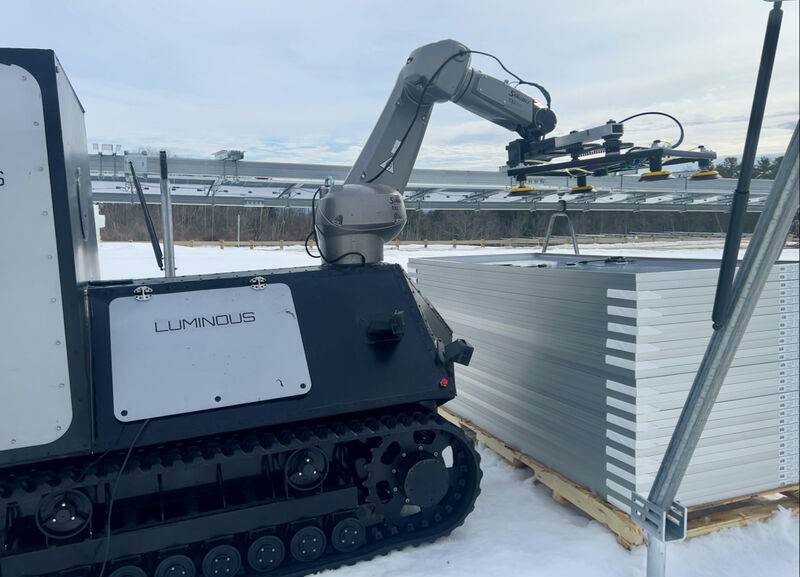
Luminous’ project centers on a robotic system known as LUMI, designed to automate one of the most physically demanding tasks in solar construction: the placement of photovoltaic panels onto metal racks. By using artificial intelligence and vision-guided controls, LUMI autonomously picks and places solar modules, leaving only the final securing steps to human workers. This semi-automated approach reduces manual labor, minimizes the risk of lifting injuries, and improves installation speed.
According to Luminous, tests of LUMI on solar farms in the United States showed the robot could help install panels up to 3.5 times faster than conventional methods, while lowering total construction costs by as much as 6.2%. The Australian trial will be the first global deployment of a full LUMI fleet, consisting of five units.
“With LUMI, we’re not just introducing a robot – we’re setting out to redefine the standard for how solar farms are built and help sites energise faster and safer,” Luminous CEO Jay M. Wong said in a statement. “Deploying our LUMI fleet in Australia will allow us to capture the data, performance insights and real-world impact needed to drive global adoption – the kind of scale and transformation we founded Luminous to achieve.”
The robots will be used on two high-capacity solar projects: the 440-megawatt Neoen Culcairn Solar Farm in New South Wales and the 250-megawatt Engie Goorambat East Solar Farm in Victoria, ARENA noted. Luminous is partnering with Equans, a global engineering and construction firm, to manage deployment and integration.
The method behind LUMI’s efficiency lies in its ability to handle repetitive tasks under variable field conditions. Using pre-mapped installation plans, the robots adapt to terrain and alignment changes on site. Each robot includes onboard navigation and adaptive gripping systems to place modules quickly without needing reconfiguration between sites.