
Insider Brief
- A review published in SmartBot by researchers from Nanyang Technological University and Harbin Institute of Technology finds that flexible electronics are overcoming key limitations of rigid hardware, enabling more adaptive sensing, decision-making and motion in robotic systems.
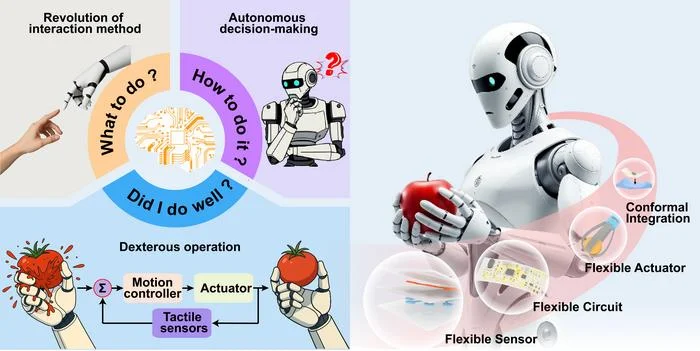
- The study, Flexible Electronics in Robotics Systems: From Devices to Applications, outlines advances in flexible sensors, circuits and actuators, as well as conformal integration techniques that embed high-density, bendable components directly onto curved robotic surfaces to improve perception and precision.
- Supported by multiple national and provincial research programs in China, the systematic review highlights manufacturing scalability, durability and integration with rigid components as ongoing challenges to broader commercial deployment.
Flexible electronics could redefine how robots sense, decide and move.
In a review published in January in SmartBot, researchers from Nanyang Technological University in collaboration with teams from Harbin Institute of Technology argue that bendable and stretchable electronic components are overcoming long-standing limits imposed by rigid hardware in robotic systems.
The study, titled Flexible Electronics in Robotics Systems: From Devices to Applications and published in SmartBot, was supported by the National Key Research and Development Program of China, the National Natural Science Foundation of China, the Natural Science Foundation of Chongqing, the Key Research and Development Program of Heilongjiang Province, the China Postdoctoral Science Foundation and the Postdoctoral Fellowship Program of the China Postdoctoral Science Foundation.
Conventional robots rely on hard electronic components that are difficult to mount on curved or irregular surfaces. Because these rigid parts cannot conform to a robot’s body, designers often face gaps in sensing and control. According to the authors, this limits active sensing, weakens the basis for autonomous decision-making and constrains precision manipulation.
Flexible electronics, by contrast, are built on bendable substrates and produced using techniques such as 3D printing, micro- and nano-fabrication, screen printing and inkjet printing. The researchers group these devices into three categories: flexible sensors, flexible circuits and flexible actuators. Each plays a different role in enabling robots to interact more effectively with their environments.
The review systematically assesses progress across these three areas. Flexible sensors can detect pressure, strain, temperature and even subtle physiological signals, offering robots richer environmental awareness. Flexible circuits allow signal processing and power distribution across curved surfaces. Flexible actuators provide controlled movement or force in response to electrical input, potentially improving dexterity and adaptability.
Beyond cataloging devices, the authors examine methods for conformal integration — how to mount flexible components directly onto complex robotic structures. They describe this as an underexplored but critical step. Without reliable integration, the performance advantages of flexible devices cannot be fully realized. The review outlines approaches for embedding high-density electronics into robotic skins and structural layers, enabling seamless incorporation into mechanical systems.
The paper frames robots as autonomous entities that must receive commands, interpret them and execute actions. Flexible electronics, the researchers report, influence each stage of that process. Enhanced sensing supports more accurate perception of human presence and environmental conditions. Improved signal pathways strengthen internal communication. Adaptive actuation refines motion control. Together, these capabilities support more sophisticated human-robot interaction and more reliable decision-making.
According to the authors, flexible sensors in particular have had a broad impact on robotic workflows, improving operational accuracy and enabling new forms of interaction. They conclude that flexible electronics are driving what they describe as an intelligent transformation in robotics, moving systems closer to integrated perception, cognition and action.
Methodologically, the study is a systematic review rather than an experimental report. The team analyzed recent advances in materials, fabrication methods and device architectures, as well as application case studies in robotic platforms. By synthesizing findings across multiple subfields, the authors aim to provide a structured overview of where flexible electronics research stands and where it is headed.
The review also acknowledges challenges. Manufacturing scalability, long-term durability under repeated bending, stable electrical performance and robust integration with rigid components remain active areas of investigation. In addition, translating laboratory prototypes into commercially viable robotic systems will require advances in reliability, cost reduction and standardization.
Looking ahead, the researchers suggest that deeper integration between flexible electronics and robotic architectures could accelerate the development of more autonomous and adaptive platforms. They argue that continued exploration of new application frontiers will be necessary to address remaining technical barriers.
Image credit: Harbin Institute of Technology