
Insider Brief
- A Northwestern University study published in Science Advances found researchers could rapidly design materials with specific properties on demand using a high-speed “megalibrary” platform, potentially speeding development in areas ranging from batteries to energy systems.
- The U.S. Department of Energy-funded research showed the platform could generate and test millions of material combinations simultaneously, identifying and engineering a new piezoelectric material in hours rather than through years of traditional trial-and-error methods.
- Researchers said the platform could also help solve a growing challenge in AI-assisted science by generating large experimental datasets needed to train machine-learning systems and accelerate future materials discovery.
A Northwestern University study suggests AI-driven materials discovery could move beyond searching for promising compounds and begin designing materials with specific properties on demand, potentially speeding development in areas ranging from batteries to energy systems.
According to Northwestern University, the research, published in Science Advances, found that a high-speed “megalibrary” platform can rapidly generate and test millions of material combinations while producing the large experimental datasets needed to train future AI systems.
The study, “High entropy 1D halide perovskite piezoelectrics discovered by megalibrary synthesis and rapid nonlinear optical screening,” was conducted by researchers at Northwestern University led by Chad Mirkin, working with collaborators including materials discovery startup Mattiq. The research, with funding from the U.S. Department of Energy, focused on expanding the capabilities of a platform known as a megalibrary, which condenses large-scale materials experimentation onto a single chip and allows scientists to test huge numbers of material combinations simultaneously.
Researchers noted they challenged the system to identify and then intentionally design a new piezoelectric material. Piezoelectric materials generate electricity when compressed, bent or stressed and are used in products ranging from sensors and ultrasound systems to energy harvesting technologies. According to the study, the platform first searched through thousands of chemical combinations to identify a promising material candidate and then engineered one designed to maintain performance at a specific operating temperature.
Northwestern’s Chad A. Mirkin, who invented and developed the platform with AI-driven materials-discovery startup Mattiq said the megalibrary format allows materials synthesizing at speeds never considered before.
The researchers said the process took hours rather than the months or years often associated with conventional trial-and-error materials development. By examining subtle changes in chemical composition, the team identified relationships between material structure and operating behavior, allowing them to tune performance characteristics directly. In one example, researchers designed a piezoelectric material intended to maintain functionality at temperatures up to 80 degrees Celsius.
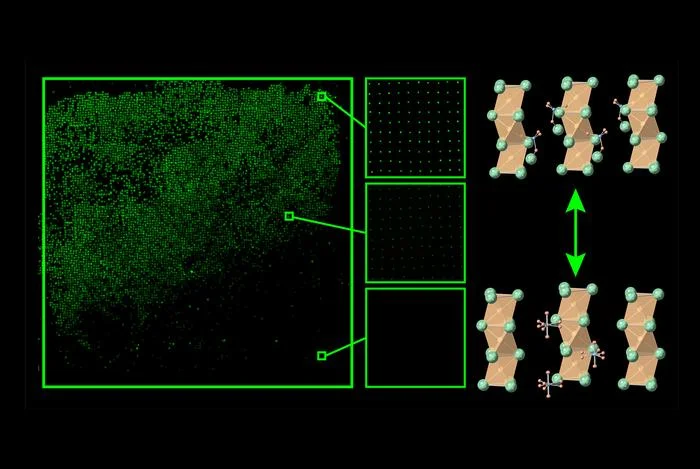
“We have developed a screening capability based on a technique called second harmonic generation (SHG) microscopy that allows researchers to review more than a million different material samples in less than 30 minutes,” Mirkin said. “In this study, we show we can not only build a library of a million different materials, but we also can interrogate them at the individual particle level. We’re about to witness the meteoric rise of materials discovery, and this is just the start.”
According to the university, the study also showed a challenge emerging in AI-assisted science, one of obtaining enough real-world data to train AI systems effectively. While robotics and automation increasingly allow researchers to generate material samples at scale, collecting detailed performance data remains a chokepoint. According to the researchers, the megalibrary platform could address that issue by generating large experimental datasets linking chemistry with measurable outcomes.
Unlike newer “self-driving labs,” which typically use robotics and AI in an iterative process that tests one experiment after another, the megalibrary system operates in parallel by generating and screening enormous numbers of candidates simultaneously. Researchers argued that approach could substantially accelerate both discovery and data generation.
“We’ve developed a screening capability that allows researchers to look at literally a million different materials, generating a million data points,” Jun Li, former Northwestern postdoctoral fellow who is now an assistant professor of mechanical engineering at the University of Colorado Boulder and the study’s co-first author, said. “We can use that data to train algorithms.”
The study was published May 22 in Science Advances. Researchers noted Mirkin and Northwestern University have financial relationships with Mattiq, a company involved in applying megalibrary technology to AI-driven materials discovery.
Featured Image: Using Second Harmonic Generation Microscopy to map megalibraries of nanoparticles swiftly reveals the location of piezoelectric, optically active non-centrosymmetric perovskites in complex materials spaces. (Credit: Chad Mirkin/Northwestern University)