

Artificial intelligence is restructuring medicine from the exam room to the lab bench. The companies doing it most consequentially are not just digitizing old workflows — they are replacing the underlying logic of how care gets documented, how drugs get discovered, how patients move through the system, and how clinicians access knowledge. From cardiothoracic imaging to whole-brain drug discovery platforms, AI-powered physical therapy to dental interoperability, these are the scale-ups building the healthcare infrastructure of the next decade.
Companies are listed in alphabetical order. This list is non-exhaustive.
1. BEXORG
Headquarters: New Haven, CT | Total Funding: ~$42.5M
Bexorg occupies a category that did not exist before it created it. Founded in 2021 by Yale neuroscientists Dr. Zvonimir Vrselja and Dr. Nenad Sestan — whose foundational research demonstrated that cellular and metabolic activity could be restored to postmortem brains hours after death, published in Nature — the company has built the world’s first integrated AI and whole-human brain drug discovery platform. The problem it is solving is not marginal: CNS drug development fails at a clinical trial rate exceeding 95%, primarily because cellular and animal models do not accurately capture human neurobiology. Bexorg’s BrainEx platform uses a perfusion system to maintain molecular and metabolic activity in donated postmortem human brains, generating petabyte-scale datasets that train its XO Digital AI engine — a closed-loop system where wet-lab experiments in living human tissue continuously refine in-silico predictions, and vice versa.
The company raised a $23 million Series A in October 2025 led by Engine Ventures with participation from Amplify Partners, Starbloom Capital, Connecticut Innovations, and E1 Ventures, bringing total funding to $42.5 million. It has already announced a multi-program research collaboration with Biohaven Ltd. targeting Parkinson’s disease and brain metabolism; a collaboration with Oxford and the UK Medical Research Council for neurological gene therapy; and a partnership with QurAlis on Fragile X syndrome. Its dataset now spans hundreds of whole-brain profiles across 18,000 gene perturbations and 3,500 drug fingerprints. For investors, the thesis is simple: Bexorg is not a single-asset biotech — it is becoming essential infrastructure for anyone who wants to discover drugs for the brain using human biology rather than approximations of it.
2. COGNIXION
Headquarters: Santa Barbara, CA | Total Funding: ~$29M
Over 14 million Americans live with chronic neurological conditions that severely limit or eliminate their ability to communicate. For most of them, the available solutions are letter boards and Tobii Dynavox tablets. Cognixion is building something fundamentally different: a non-invasive brain-computer interface (BCI) combined with augmented reality, designed so that patients with ALS, spinal cord injury, stroke, or traumatic brain injury can communicate through neural signals and eye gaze — without surgery, without implants, and without needing to own expensive specialized hardware.
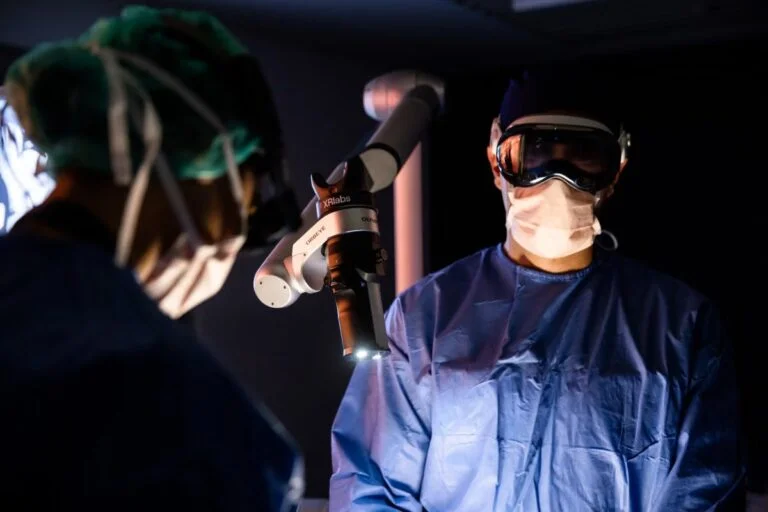
The company’s Axon-R headset and Nucleus bio-sensing hub, integrated with Apple Vision Pro’s accessibility framework, are the hardware core of a platform that combines EEG-based neural input with AI-mediated signal interpretation. Cognixion holds FDA Breakthrough Device Designation for its Axon-R platform and CMS accreditation as a Durable Medical Equipment provider — a combination that positions it for reimbursement pathways that most BCI companies have not yet navigated. The company closed additional funding rounds in 2025 and early 2026 from investors including Prime Movers Lab, the Amazon Alexa Fund, Northwell Health Ventures, Memorial Hermann Health System Ventures, and the ALS Association’s ALS Accel, bringing disclosed total funding to approximately $29 million. Its current feasibility study, integrating the Axon-R with Apple Vision Pro, ran through early 2026; a pivotal FDA trial targeting clearance is the primary goal for the year. The Wall Street Journal named Cognixion among its top tech predictions for 2026. For the patient population it serves, the market size is measured not in dollars but in the number of people who have spent years unable to tell their families they love them.
3. HEYDONTO
Headquarters: Knoxville, TN | Total Funding: ~$20M | Valuation: $200M
Dental data has been structurally excluded from the U.S. health information infrastructure for decades. Dental practice management systems speak a different technical language from medical EHRs, operate on proprietary formats incompatible with healthcare interoperability standards, and exist in a regulatory environment that has historically been siloed from the rest of medicine. The consequence is that physicians ordering medically necessary dental work cannot send referrals electronically, dentists cannot return clinical clearances in real time, and patients cannot see their dental records alongside their medical histories in a unified view.
HeyDonto’s Conduit platform is the first production-grade solution to that problem: an AI-powered dental interoperability exchange built on HL7 FHIR R4, SMART on FHIR, and TEFCA-aligned standards that connects dental PMS platforms, medical EHRs, payer systems, and patient-facing infrastructure. Its Axiomera semantic intelligence engine translates and normalizes fragmented dental and medical data into structured, standardized formats that downstream systems can actually use. The company raised $20 million in a seed round in April 2026 at a $200 million valuation, led by eight clinician-investors who are practicing dentists — a form of market validation that is harder to manufacture than a VC term sheet. The timing is not coincidental: the 2026 CMS Physician Fee Schedule includes incentives for primary care physicians to integrate oral health into their practices, and Medicare’s expanding coverage of medically necessary dental procedures requires exactly the kind of bidirectional data exchange that Conduit provides. HeyDonto is a founding member of the Oral Health Interoperability Alliance. The addressable market is every dental-medical interaction in the United States.
4. JIMINI HEALTH
Headquarters: New York, NY | Total Funding: ~$25M+
The mental health AI problem has two layers. The first is clinical: the shortage of therapists is acute and worsening, and the behavioral health system cannot serve the people who need it. The second is already happening regardless of whether the clinical system participates: more than 5.4 million U.S. adolescents and young adults are already using AI chatbots for mental health advice, and more than one million people per week have conversations with ChatGPT that include explicit indicators of suicidal planning. Character.AI and Google have already settled wrongful death lawsuits. The unregulated AI therapy market is not a future risk — it is an active one.
Jimini Health’s answer is Sage: the first patient-facing behavioral health AI designed from the ground up for deployment within large clinical organizations rather than as a consumer app. Sage integrates directly into EHR systems, follows the care plan defined by the supervising human clinician, engages patients continuously between appointments, and escalates to human clinical teams when warranted — with every interaction visible to the clinician. It is built to operate within the CMS ACCESS and FDA TEMPO programs announced in December 2025, which signal regulatory green light for technology-heavy care models that keep clinicians in control. The company raised $17 million in seed funding in March 2026 from M13, Town Hall Ventures, LionBird, Zetta Venture Partners, and OneMind, bringing total funding to over $25 million. CEO Luis Voloch previously co-founded Immunai, valued at over $1 billion. Former CMS Acting Administrator Andy Slavitt is an investor. The safety infrastructure was developed with clinical advisors from Harvard, Stanford, Yale, Dartmouth, and Google DeepMind. Jimini operates its own clinic with full-time licensed clinicians treating real patients on the platform before any model update is deployed at scale — a product discipline that consumer mental health apps have never been required to maintain.
5. JOYFUL HEALTH
Headquarters: New York, NY | Total Funding: ~$22M
U.S. healthcare providers lose more than $125 billion in earned revenue every year. Not because the care was not delivered. Not because the billing was not submitted. But because the financial data required to track a single claim from clinical encounter to bank deposit is scattered across electronic health records, billing platforms, clearinghouses, payer portals, and accounting systems that were never designed to share information with each other. The result is that roughly 15% of claims are denied, and nearly two-thirds of those denials are never resolved — revenue that providers earned and cannot find.
Joyful Health builds the financial operating system for healthcare providers: a platform that connects fragmented revenue cycle systems into a single structured foundation, maps the relationships between clinical encounters, payer rules, remittance data, and bank deposits, and then uses AI to automatically identify where claims break down, surface the highest-value recovery opportunities, and execute investigation workflows that previously required teams of specialists cross-referencing spreadsheets across half a dozen systems. Co-founded by CEO Eliana Berger, who grew up watching her family run a therapy practice, the company has processed more than $1.4 billion in transactions and delivers a 95%+ recovery rate across a wide range of specialties. It raised a $17 million Series A in April 2026 led by CRV, with Inflect Capital (the investment arm of Vituity, the largest physician-owned partnership in the U.S.) and Go Global Ventures participating, bringing total funding to $22 million. The economic logic is direct: every dollar of provider revenue that Joyful recovers is a dollar the U.S. healthcare system did not need to spend twice to collect.
6. KEEBLER HEALTH
Headquarters: Durham, NC | Total Funding: ~$23M
Risk adjustment in Medicare and Medicaid is a high-stakes process in which the accuracy of a provider’s reimbursement depends on the completeness of how patient conditions are documented and coded. The problem is structural: approximately 80% of clinically meaningful patient information exists in unstructured formats — provider notes, imaging reports, discharge summaries, faxes — rather than in coded fields, and even structured records are incomplete. One study found that only 59.4% of chronic conditions are consistently captured across EHR sources. The result is systematic revenue leakage and reimbursement inaccuracy for the value-based care organizations that depend on accurate risk capture.
Keebler Health is an LLM-native risk adjustment platform — not a legacy NLP tool retrofitted with AI, but a system built from the ground up on large language models to process raw clinical narrative at scale. It reviews entire patient histories, not samples; surfaces missed HCC coding opportunities with source-linked, audit-ready evidence; and embeds insights directly into existing clinical workflows. The company raised $16 million in a Series A in April 2026 led by Flare Capital Partners, with Sands Capital, Tau Ventures, and a broad syndicate participating, bringing total funding to $23 million. Founded in 2023 by CEO Isaac Park alongside co-founders Andrew Stickney and Kevin Hill, PhD, Keebler is already demonstrating that its LLM infrastructure can lift average Risk Adjustment Factor scores by a full point per patient for value-based care organizations — a financially meaningful result in a market where fractions of a point translate to millions in reimbursement. Its next frontier is AI-enabled RADV audit readiness, as CMS scrutiny of risk adjustment intensifies.
7. LAINAHEALTH
Headquarters: Dublin, OH | Total Funding: ~$35.7M
Sixty-five percent of physical therapy prescriptions go unfilled. The barriers are well known — four-to-six-week wait times, high out-of-pocket costs, transportation, scheduling friction — and they have persisted for decades because the structural economics of in-person PT have never changed. LainaHealth (formerly IncludeHealth) is changing them. The company pairs licensed Doctors of Physical Therapy with Laina, a proprietary WebAI assistant that delivers personalized exercise plans with real-time motion-tracking guidance through any web browser on any device — no hardware, no downloads, available to patients from 12 to 99.
The clinical and financial results across 45 states are difficult to argue with: a 74% reduction in cost per episode (averaging $300 versus $800+ for traditional care), a doubling of patient adherence compared to traditional PT, and 4x the engagement. Patients average 34 sessions per completed episode, compared to 8 in standard in-person care. LainaHealth’s outcomes data was highlighted in a Google web.dev case study as a reference implementation of AI-powered clinical computer vision at scale. The platform integrates with provider and payer networks and is HIPAA-compliant and FDA-registered. With roughly $35.7 million raised from investors including the Vercel AI Accelerator, JobsOhio Ventures, and AFWERX, LainaHealth is one of the most operationally validated companies in the virtual MSK space — a market where clinical outcomes and cost documentation are the competitive moat. Its differentiation is not that it automates PT; it is that it has demonstrated at scale that AI-augmented human clinicians outperform both the human alone and the automation alone.
8. PRENOSIS
Headquarters: Chicago, IL | Total Funding: ~$40M
Sepsis kills more people annually than all cancers combined. It is among the most time-sensitive conditions in medicine — every hour of delayed treatment measurably increases mortality — and it is also among the hardest to diagnose, because its early presentation is nonspecific and its progression is heterogeneous. The standard of care has been broad-spectrum antibiotics and one-size-fits-all protocols, because clinicians have lacked the tools to see what is happening inside an individual patient’s immune system in real time.
Prenosis changed that. Its Sepsis ImmunoScore — the first FDA-authorized AI diagnostic tool for sepsis, authorized via the De Novo pathway in April 2024 — evaluates a patient’s biological status through a combination of biomarkers and clinical data, stratifying sepsis risk into discrete categories within 24 hours of admission. It is integrated directly into hospital EMRs with transparent, interpretable outputs designed for clinical trust. In January 2026, the company announced a $20 million Series A led by PACE Healthcare Capital alongside a $20 million BARDA federal contract — $40 million in combined new capital — funding both commercial deployment of Sepsis ImmunoScore across up to 40 top academic medical centers and a randomized controlled trial of 800 patients evaluating an AI companion diagnostic to identify which critically ill patients will benefit from corticosteroid therapy. The goal is precision medicine for the ICU: not just who has sepsis, but how to treat each patient’s sepsis differently. Founded by CEO Bobby Reddy Jr. and Rashid Bashir, Prenosis has spent a decade building a proprietary biobank of over 100,000 blood samples from 25,000 patients — a data moat that compounds with every new deployment.
9. QUIVER BIOSCIENCE
Headquarters: Cambridge, MA | Total Funding: ~$2.15M (NIH grant) + equity
Developing drugs for the central nervous system is one of the most technically punishing exercises in pharmaceutical science. ASO (antisense oligonucleotide) therapeutics have shown genuine clinical promise for neurological disorders — think Spinraza for spinal muscular atrophy, Qalsody for ALS — but their development is hampered by the difficulty of predicting neurotoxicity in advance of lengthy and expensive animal studies. Quiver Bioscience is building the platform that makes ASO CNS drug development faster, safer, and more predictable.
The company’s approach integrates patient-relevant human neuronal models derived from disease-specific cells, all-optical electrophysiology (a non-invasive technique for capturing high-speed functional readouts of neuronal activity), and AI/ML analytics for large-scale toxicity modeling — a “Genomic Positioning System” for the CNS. Its dataset already spans more than 1.5 billion action potentials across 30 million individual neurons, 18,000 gene perturbations, and 3,500 drug fingerprints. In July 2025, Quiver received a $2.15 million NIH SBIR Phase II grant from NINDS to develop its Safe-OPTION predictive toxicity platform — work that aligns with the FDA’s push toward New Approach Methodologies and the replacement of preclinical animal studies with AI and human cellular systems. In February 2026 the company announced a strategic research collaboration and licensing agreement with Angelini Pharma for novel therapeutics in genetic epilepsies. Under CEO Graham Dempsey, PhD, appointed in June 2025, Quiver is advancing its lead program toward the clinic while expanding partnerships in the red-hot Nav1.7/1.8 pain space. For a field where every failed Phase II trial costs hundreds of millions of dollars, better prediction of CNS drug safety is not a research curiosity — it is a billion-dollar problem looking for a platform.
10. RIVERAIN TECHNOLOGIES
Headquarters: Miamisburg, OH | Total Funding: ~$23.25M
Every radiologist who has ever read a chest CT knows the problem: the lungs are wrapped in a dense tangle of vascular structure that makes it genuinely difficult to see what you are looking for. Riverain’s ClearRead suite uses deep learning to suppress vessels from chest X-rays and CT scans, remove machine noise, and surface the abnormalities — pulmonary nodules, pneumothorax, coronary artery calcification — that matter clinically. The result is measurably faster reads with meaningfully higher detection rates.
Founded in 2004 and headquartered in Ohio, Riverain has expanded to more than 400 customer locations globally and nearly 50 new customers in 2024 alone, now operating across eight countries. Its ClearRead CT CAC tool recently received Health Canada approval for opportunistic coronary artery calcification quantification, and its ClearRead Xray solution received FDA 510(k) clearance for portable chest X-rays, extending AI-assisted reading to ICUs and emergency rooms where specialist coverage is thinnest. In November 2025, Riverain announced a strategic partnership with VIDA Diagnostics, integrating its cardiothoracic AI suite into VIDA’s clinical trial imaging platform — positioning Riverain’s technology in pharmaceutical clinical development for respiratory and cardiovascular drugs. With new Medicare reimbursement code G0680 creating a payment pathway for AI-powered CAC scoring, Riverain enters 2026 with both clinical expansion and revenue tailwinds. For a company that has spent two decades perfecting one of the most clinically consequential forms of AI-assisted image reading, the moment is arriving.
11. RXANTE
Headquarters: Portland, ME | Total Funding: ~$47M
Non-adherence to prescription medications costs the U.S. healthcare system approximately $300 billion annually in avoidable hospitalizations, disease progression, and lost productivity. The problem is not that patients do not want to take their medications — it is that no one has been able to identify, at scale and in advance, which specific patients will stop taking which medications, and why. RxAnte has spent over a decade solving that exact problem.
The company’s predictive analytics platform uses machine learning to forecast medication non-adherence at the individual patient level — as early as the first filled prescription — and then identifies and coordinates the most cost-effective intervention for each patient. In 2026, RxAnte manages over 34 million lives in partnership with health plans, with peer-reviewed studies conducted with UPMC Health Plan demonstrating reduced hospitalizations and lower medical costs. In January 2026, the company received a strategic growth investment from Primus Capital, with continued support from long-term investor UPMC Enterprises, to scale its value-based pharmacy solutions and expand clinical services through its subsidiary Mosaic Pharmacy Service — a specialized in-home pharmacy care service for medically complex seniors. The investment reflects a maturing market thesis: in a value-based care environment where health plans are financially accountable for outcomes, AI that prevents the problem beats AI that documents it after the fact. RxAnte is one of the few companies in the medication adherence space with both the data scale and the longitudinal validation to prove that its predictions actually change behavior.
12. SURGICAL SAFETY TECHNOLOGIES
Headquarters: New York, NY | Total Funding: ~$15M
The operating room is the most consequential environment in a hospital and, historically, one of the least observed. Surgical errors, near-misses, workflow inefficiencies, and patient safety events have gone systematically undocumented not because anyone was indifferent to them, but because there was no neutral, objective system capable of capturing what actually happened inside the OR. Surgical Safety Technologies’ Black Box Platform changes that: an ambient, AI-driven clinical intelligence system that captures audiovisual and kinematic data from surgical environments, de-identifies it in real time, and translates it into structured insights for clinical quality improvement, training, and patient safety.
Founded by Dr. Teodor Grantcharov — the originator of the surgical black box concept — SST raised $15 million in a Series A in 2023 from U.S. Venture Partners and Santé Ventures and has been steadily expanding its platform capabilities since. In 2025, the company launched two mobile applications — Room State and Explorer — enabling surgical teams to interact with OR video content and operational data on any device. In July 2025, SST announced kinematic data integration for surgical proficiency assessment, adding motion-tracking to its audiovisual suite. In February 2025, SST joined the European Union AI Pact, committing to transparent and accountable AI deployment in healthcare — a positioning choice that reflects its ambition to lead international adoption as European health systems evaluate ambient OR intelligence. The company has also partnered with Mount Sinai and Kyabirwa Surgical Center to advance healthcare equity in surgical training. The addressable market is every procedure performed in every OR in the world.
13. SYNTHPOP
Headquarters: Cambridge, MA | Total Funding: ~$23M
Healthcare’s administrative burden is not merely an inconvenience — it is a patient safety issue. When a prior authorization takes weeks instead of hours, treatments are delayed. When referrals get lost in manual intake queues, patients fall out of care. When eligibility checks require staff to spend three hours on the phone with a payer, that staff time is not spent on anything clinical. Synthpop was founded in 2023 by Elad Ferber (previously co-founded Spry Health, acquired by ZOLL Itamar) and Jan Jannink, PhD (Stanford AI faculty, co-founder of VoiceBase) to build the agentic AI system that replaces that entire administrative layer.
The platform combines document intelligence, payer-aware reasoning, and conversational voice agents into a single coordinated system that automates up to 80% of healthcare business processes — referrals, prior authorizations, eligibility verification, claims follow-up, and patient access workflows — integrating directly with eight major EHR, billing, and e-prescribe platforms. Workflows that historically took 40 minutes of staff time are now completed in under one minute at five times lower cost than human labor. The company raised a $15 million Series A in February 2026 led by Ansa Capital, with participation from Defy.vc, Peterson Ventures, Storm Ventures, and former Humana CEO Bruce Broussard as a strategic investor, bringing total funding to $23 million. To date, the platform has processed over 2 million patients. The key insight distinguishing Synthpop from the crowded prior-auth point-solution market is architectural: agentic AI that orchestrates multi-step, non-linear workflows across every administrative domain is categorically different from a tool that automates one task. Healthcare administration rarely breaks down in one place at a time.
14. VISTA AI
Headquarters: Palo Alto, CA | Total Funding: ~$42M
MRI is among the most information-rich diagnostic tools in medicine and among the most practically constrained. Demand for MRI far outstrips the supply of trained technologists, scans require specialist expertise that most facilities outside major academic centers cannot staff, and the resulting backlogs mean patients wait weeks for imaging that should be available next day. Vista AI builds the software that allows any trained technologist to deliver high-quality, consistent MRI scanning — including cardiac MRI, historically among the most technically demanding exam types — by automating the scanning process itself.
The company’s FDA-cleared cardiac MRI platform guides technologists through scan acquisition in real time, eliminating the variability that separates expert practitioners from generalists. At Brigham and Women’s Hospital, Vista AI enabled 50% more cardiac MRI scan slots while eliminating a 28-day backlog without adding staff, scanners, or operating hours. At Radiology Regional in southwest Florida, scan times were cut by more than 50%, and technologists without prior cardiac MRI experience could reliably deliver high-quality exams. In January 2026, Vista AI raised a $29.5 million Series B from an unusual syndicate: new investors Cedars-Sinai Health System, Intermountain Health, University of Utah Hospital System, Temple University/Fox Chase Cancer Center, and Tampa General Hospital, alongside existing investor Khosla Ventures, bringing total disclosed funding to approximately $42 million. The presence of five major health systems as equity investors — not just customers — is a market signal. Vista is now expanding into brain, prostate, and spine MRI, and building remote scanning services that extend expert-level imaging to sites that have never had access to it. The staffing crisis in radiology is not going to resolve through hiring.
15. XELLAR BIOSYSTEMS
Headquarters: Cambridge, MA (with operations in China) | Total Funding: ~$24M+
Drug discovery has spent decades sacrificing biological accuracy for experimental convenience. Standard cell culture and animal models are tractable and reproducible — but they are approximations of human biology, not the thing itself, which is why 90%+ of drug candidates that look promising in preclinical testing fail in human trials. Xellar Biosystems is building the platform that closes that gap using what it calls “Wet-AI”: microfluidic organ-on-chip systems that replicate the multi-cellular environment of human organs, combined with AI and machine learning for large-scale data analysis, creating a closed-loop system where high-dimensional biological data trains predictive models and predictive models design new experiments.
The company’s EPIC platform integrates microfluidics, disease organoids, high-throughput imaging, and generative AI for mechanism-level drug profiling across pharmacokinetics, blood-brain barrier penetration, and organ-specific toxicity. Xellar is one of the few organ-on-chip companies collaborating with both the FDA and China’s CDE on regulatory validation of new alternative methods — a position that matters as both regulators actively shift away from animal testing requirements. The company has raised approximately $24 million across two rounds, including a strategic investment from XtalPi (the quantum physics-based AI drug discovery firm) to jointly advance AI-organ chip-integrated drug screening, and a 200 million RMB round in early 2026 led by China Life Equity Investment. Its selection as the only Chinese company in the FDA’s program to validate new alternative methods to animal testing is both a regulatory credential and a competitive moat. The shift away from animal models in drug development is a regulatory trend with a decade of momentum behind it. Xellar is building the infrastructure that makes the alternative real.
This was a brief overview of the rapidly evolving AI healthcare and life sciences landscape. If there’s a company you think belongs on this list, reach out to our editorial team and we will make sure they are included on the next one.