
Insider Brief
- Physical AI startup RLWRLD will showcase its Robotics Foundation Model, RLDX-1, at Nvidia GTC Taipei 2026, highlighting a humanoid robot AI system focused on dexterous manipulation and built on Nvidia’s robotics and AI software stack.
- RLWRLD said RLDX-1 achieved leading results across eight public robotics benchmarks, including a score of 70.6 on RoboCasa Kitchen, while using roughly 20% of the training compute required by Nvidia’s earlier GR00T N1.5 model.
- The company uses Nvidia technologies across simulation, training, inference and deployment, and said it plans to expand RLDX-1 through partnerships with robotics hardware companies across Asia while advancing toward a broader “4D+ World Model” for long-horizon robotic planning and reasoning.
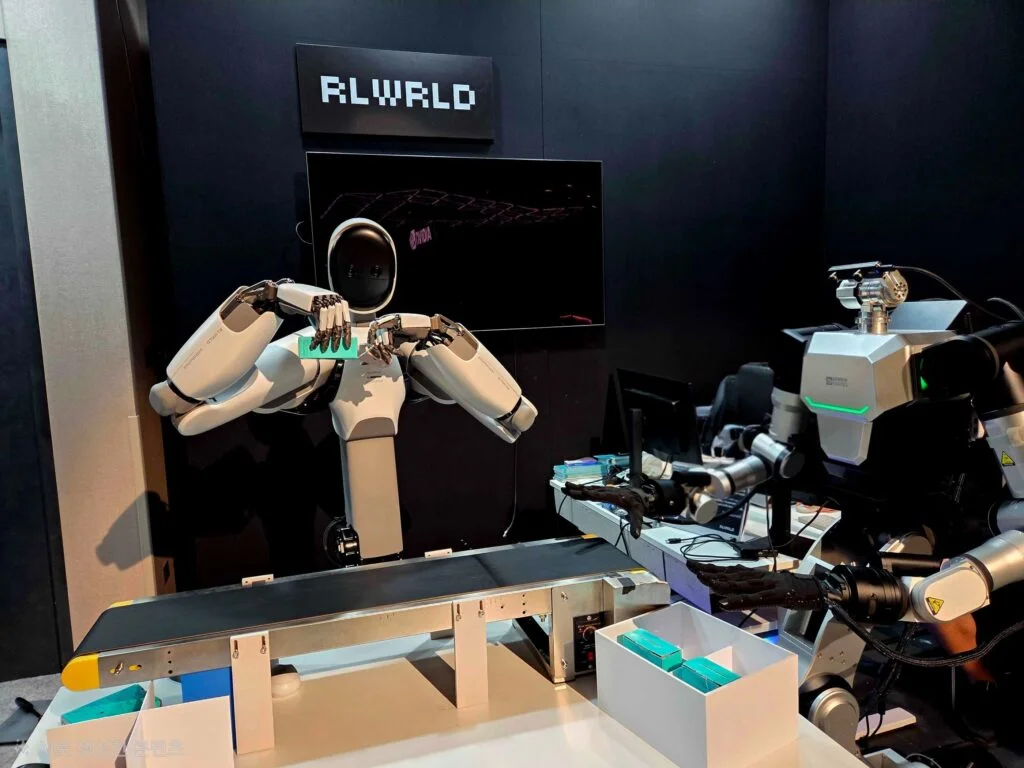
PRESS RELEASE – RLWRLD (CEO: Junghee Ryu), a physical AI company, announced that it is participating in NVIDIA GTC Taipei 2026, held in Taipei, Taiwan from June 1 to June 4, where it will showcase its proprietary Robotics Foundation Model (RFM) ‘RLDX-1’ alongside the RFM development and operation pipeline built on the NVIDIA ecosystem.
RLDX-1, officially unveiled on May 7, is a “Dexterity-First” foundation model purpose-built to give five-fingered humanoid robotic hands human-level dexterous manipulation capabilities. On RoboCasa Kitchen, RLDX-1 scored 70.6 — outperforming the next-best model, NVIDIA GR00T N1.6 (66.2), by 4.4 points — and surpassed all prior state-of-the-art (SOTA) results across all eight public benchmarks on which it was evaluated. Notably, RLDX-1 achieved this performance with roughly 20% of the training compute used by NVIDIA GR00T N1.5, demonstrating the strength of its architecture and data engine design rather than sheer scale.
An RFM Built on the NVIDIA Ecosystem
RLWRLD leverages the NVIDIA ecosystem throughout both the development and operation of RLDX-1. For RFM development, the company uses NVIDIA Isaac GR00T, NVIDIA Isaac Lab and NVIDIA Isaac Sim, and NVIDIA cuRobo. For compute across cloud and edge, it uses NVIDIA H100 and NVIDIA A100, NVIDIA Jetson AGX Thor and NVIDIA Jetson Orin, and NVIDIA TensorRT.
Built on this NVIDIA cloud-to-edge stack, a single backbone model trained in large-scale GPU environments runs on edge devices without retraining — a structural advantage that makes RLDX-1 immediately deployable in industrial settings.
From ‘Dexterity Night’ to GTC Taipei: A Continuing Partnership with NVIDIA
The collaboration between RLWRLD and NVIDIA extends beyond infrastructure use into ecosystem-level engagement. Amit Goel, Senior Director, Product Management at NVIDIA, attended RLWRLD’s ‘Dexterity Night’ event in San Francisco on May 13 and highlighted that RLDX-1 was developed leveraging NVIDIA’s full simulation, training, and inference stack, and called RLWRLD “one of the key partners in the physical AI ecosystem NVIDIA is building.” RLWRLD previously won the foundation model category at the Nebius Robotics & Physical AI Awards, sponsored by NVIDIA, in December 2025, and is also a member of the NVIDIA Inception program.
Taiwan is home to many of the world’s core semiconductor and robotics hardware supply-chain leaders, including NVIDIA. Together with Korea and Japan — where RLWRLD has accumulated deep industrial data and RX (Robotics Transformation) experience with leading manufacturers and logistics partners — Taiwan completes the Korea–Japan–Taiwan corridor that anchors much of East Asia’s manufacturing, robotics, and semiconductor industries. Through GTC Taipei, RLWRLD plans to connect RLDX-1 directly with humanoid and industrial robotics hardware partners across the Asia-Pacific region, accelerating the expansion of its RFM-centric physical AI ecosystem.
RLDX-1 Is the First Milestone — From RFM to a 4D+ World Model
RLWRLD plans to advance from RLDX-1 toward its next-generation technology vision: the ‘4D+ World Model.’ The goal is to model the entire physical world along the temporal axis and predict future visual observations conditioned on language commands and actions — extending beyond dexterity (manual skill) toward long-horizon planning and reasoning for the next generation of robotics intelligence.
Junghee Ryu, CEO of RLWRLD, said, “RLDX-1 is an achievement made possible on top of NVIDIA’s powerful compute infrastructure and robotics stack. GTC Taipei 2026 marks the expansion of the collaboration that began with RLDX-1 into a broader global partnership. Together with NVIDIA and other global partners, we will build the long roadmap toward a 4D+ world model that handles not only dexterity, but also time and space.”
Image credit: RLWRLD