Insider Brief
- Nvidia is expanding its physical AI footprint in South Korea through new partnerships with Doosan Group and LG Group focused on industrial robots, autonomous equipment, robotics training data and AI-powered manufacturing systems.
- Doosan Robotics is integrating Nvidia’s Isaac robotics frameworks, Cosmos world models, Newton physics engine and Jetson Thor platform into an Agentic Robot OS for industrial automation, while Doosan Bobcat is applying physical AI technologies to construction, agriculture, landscaping and material-handling equipment to enable more autonomous operation.
- LG is combining Nvidia’s robotics, simulation and world-model technologies with its manufacturing expertise to develop humanoid, logistics and industrial robots, while also building a physical AI data factory that uses synthetic data generation to train robotics and industrial AI systems.
Nvidia is expanding its physical AI footprint in South Korea through new partnerships with Doosan Group and LG Group, with the collaborations spanning industrial robots, autonomous equipment, robotics training data and AI-powered manufacturing systems.
According to the companies, the collaborations extend beyond traditional factory automation and focus on building the software, simulation and computing infrastructure needed to develop and deploy increasingly autonomous machines.
“Robotics is going to be the next major sector here in Korea — this is a great opportunity for Korea to invest in AI,” Nvidia founder and CEO Jensen Huang said Friday during a visit to Seoul.
Nvidia and Doosan Group
At Doosan, that effort centers on robotics and industrial equipment.
According to the companies, Doosan Robotics is integrating Nvidia’s Isaac robotics frameworks, Cosmos world models, Newton physics engine and Jetson Thor platform into an Agentic Robot OS designed for industrial tasks such as depalletizing and sanding.
The companies are also extending physical AI technologies to Doosan Bobcat equipment used in construction, agriculture, landscaping and material handling, where specialized world models are being developed to enable more autonomous operation in changing environments.
“Korea is a manufacturing center of the world, and physical AI is the next growth opportunity for industries that build, move and power the world,” Huang said. “By combining Nvidia DSX and physical AI with Doosan’s energy, robotics and advanced materials businesses, Doosan can unlock new growth across intelligent robots, autonomous industrial equipment and next-generation infrastructure for the AI era.”
Beyond robotics, the partnership includes support for Nvidia’s AI factory ecosystem through Doosan Enerbility’s power technologies, including gas turbines, small modular reactors and hydrogen fuel cells, as well as advanced printed circuit board materials from Doosan Corporation Electro-Materials BG for next-generation AI data center infrastructure.
“Building on our manufacturing capabilities developed over many decades, Doosan Group continues to advance technologies needed for the AI era across energy, robotics and advanced materials,” LG chairman Jeongwon Park said in the announcement. “Our collaboration with Nvidia will help us explore new ways to apply AI across our businesses and identify new opportunities in the AI factory era.”
Nvidia and LG Group
LG Group’s collaboration with Nvidia is similarly centered on robotics, but extends further into data generation and manufacturing.
The companies said they will combine LG’s manufacturing expertise and operational data with Nvidia’s Isaac robotics platform, Omniverse simulation software and Cosmos world models to develop more autonomous manufacturing systems and advance humanoid, logistics and industrial robots.
“Together with Nvidia CEO Jensen Huang, we had a very in-depth and inspiring discussion on strategic cooperation that will transform future industries,” pointed out chairman and CEO Kwang Mo Koo. “The blueprint for the AI ecosystem envisioned by NVIDIA aligns with LG’s future direction of creating meaningful changes in customers’ daily lives and global industrial sites.”
The collaboration also includes LG CNS integrating Nvidia’s Isaac, Cosmos and GR00T robotics technologies into its PhysicalWorks industrial robot platform, while LG Innotek is developing sensing and optical components for robotics systems. Beyond robotics, the partnership extends to AI factory infrastructure, autonomous driving technologies and LG’s EXAONE AI models, with the companies working together on data centers, mobility systems and enterprise AI applications.
One of the more notable elements of the partnership is LG’s effort to build what it describes as a physical AI data factory. Using Nvidia Cosmos world foundation models, the initiative is intended to generate synthetic data that can be used to train robots and industrial AI systems, addressing one of the biggest challenges in physical AI development: obtaining large amounts of real-world training data.
“Korea is extraordinary at manufacturing, mechatronics and AI, and the fusion of these strengths will make robotics and physical AI a major growth sector for the country,” Huang added. “With Nvidia DSX and physical AI platforms, LG can extend its leadership from homes and vehicles to factories and AI infrastructure, creating new growth opportunities across the intelligent systems that will shape daily life and industry.”
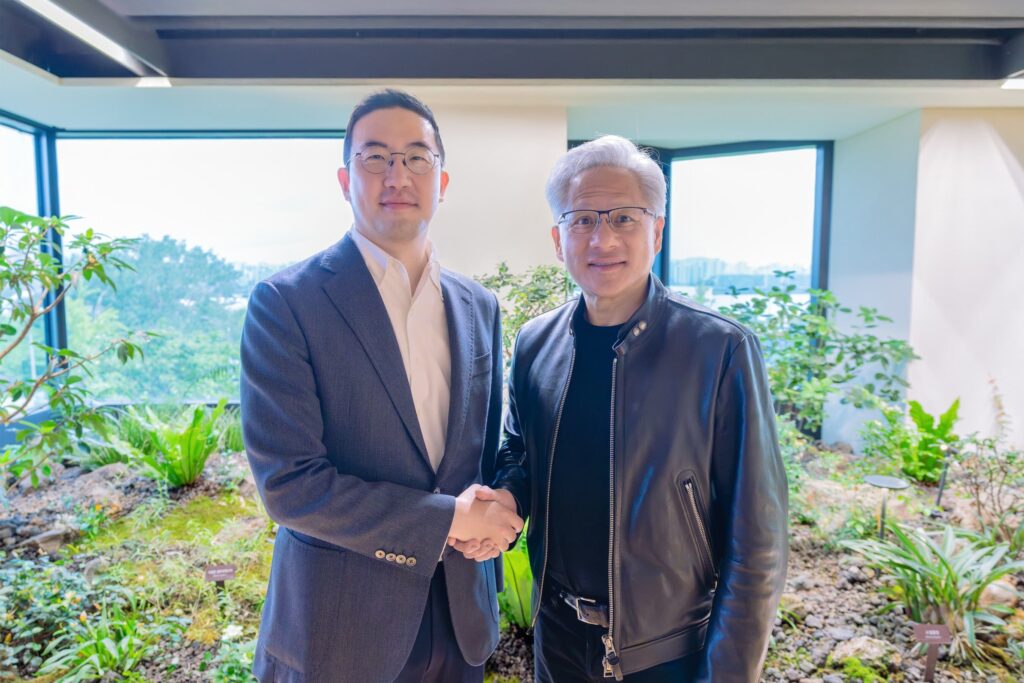
Featured image: On the 8th of June, Kwang Mo Koo, Chairman and CEO of LG Corp. (left) and Jensen Huang, founder and CEO of NVIDIA (right), pose for a photo at the LG Twin Towers in Yeouido, Seoul. (Credit LG Group)