Insider Brief
- Built Robotics and the University of Pennsylvania’s Safe Autonomous Systems Lab (xLAB) have launched a research collaboration focused on developing safer physical AI systems for construction, combining real-world jobsite data with expertise in safety-critical autonomous systems.
- The first phase will deploy Built Robotics’ AI-powered personnel-detection technology on autonomous survey robots operating at utility-scale solar projects, with the resulting data used to improve AI models and expand them to additional construction vehicles and applications.
- According to the companies, the partnership aims to address the challenge of translating autonomous systems from controlled testing environments to active construction sites, while advancing AI systems designed to operate safely in changing real-world conditions.
Built Robotics is collaborating on physical AI research with the University of Pennsylvania’s Safe Autonomous Systems Lab, known as xLAB, to develop autonomous construction systems that can safely operate in the real world.
According to Built Robotics, the collaboration brings together that company’s experience deploying autonomous systems on construction sites with xLAB’s research in safety-critical autonomous systems. The lab, led by Penn Engineering professor Rahul Mangharam, has worked on software and control systems for autonomous vehicles, medical devices and other safety-sensitive applications.
Mangharam said that consruction is a frontier for safe autonomous systems.
“The fundamental challenge is bridging the gap between validation in controlled environments and robust performance under operational conditions,” noted Mangharam. “Our collaboration with Built will give us access to active jobsites with high-fidelity mapping data and real-world operational parameters, enabling us to build practical autonomous systems solving a real-world need.”
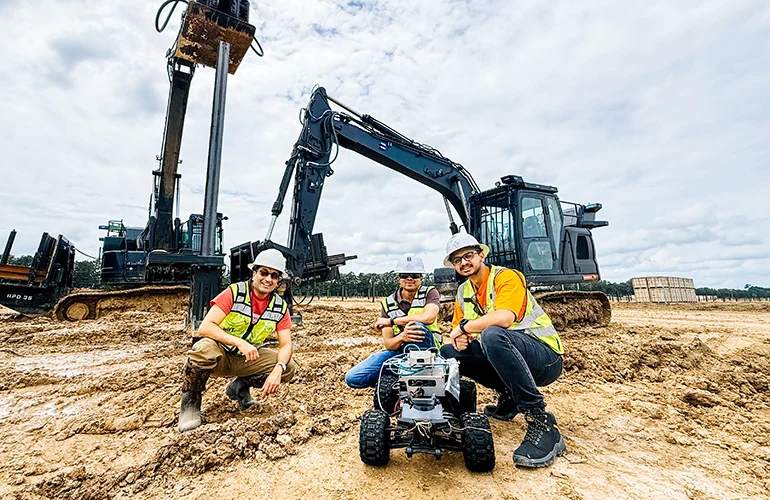
The first phase of the project will deploy the Built’s edge AI personnel-detection system on a fleet of autonomous construction survey robots operating at utility-scale solar projects. The company said the robots will collect sensor data from active jobsites, which will be used to improve existing AI models and expand them to additional construction vehicles and applications.
Built Robotics has developed autonomous construction equipment primarily for the solar industry, where its systems are used to automate repetitive site preparation and infrastructure installation tasks. The company said its personnel-detection technology has been trained using data collected from active construction projects involving large workforces and expansive job sites.
For xLAB, the partnership provides access to real-world operational environments and construction data that can be used to evaluate autonomous systems outside the laboratory. The researchers plan to use mapping data and operational information from active jobsites to study how AI systems perform under changing field conditions.
“What xLAB has built in safety architecture is precisely the kind of rigorous foundation that physical AI demands,” said Built CEO and Penn alumnus Noah Ready-Campbell said in the anouncement. “Our proprietary edge AI model for personnel detection has been refined across some of the most demanding operational environments in the industry — active construction sites with hundreds of employees stretching over thousands of acres.”
Image credit: Built Robotics