
- Florida Atlantic University researchers developed a prosthetic-hand control system that uses a custom 3D-printed sleeve, soft magnetic sensors and individualized AI models to learn each user’s muscle patterns.
- The system was tested with 10 participants, including three upper-limb amputees, and classified 19 hand and wrist gestures in real time, according to FAU.
- The study found there was no single best sensor setup for all users, with some participants achieving more than 90% accuracy across multiple gestures only when sensor placement was tailored to their residual muscles.
Florida Atlantic University researchers say they have developed a prosthetic-hand control system that learns the muscle patterns of each user in what would be a step toward robotic hands that are less dependent on one-size-fits-all control methods.
According to the university, the system combines a custom 3D-printed wearable sleeve, soft magnetic sensors and an individualized AI model to translate forearm muscle movement into commands for a robotic hand. The work was published in IEEE Transactions on Neural Systems and Rehabilitation Engineering, according to FAU.
The Challenge
The research addresses the problem with upper-limb prosthetics in that users differ widely in anatomy, injury history and remaining muscle function, while many prosthetic systems still rely on generalized designs. That mismatch can make control difficult and can force users to adapt to the device rather than the device adapting to them, researchers pointed out.
FAU said the approach begins with a 3D scan of a person’s residual limb. Researchers then use that scan to create a custom wearable sleeve with flexible magnetic sensors placed against the skin and it is those sensors that detect changes in muscle shape and pressure as the user attempts hand and wrist movements.
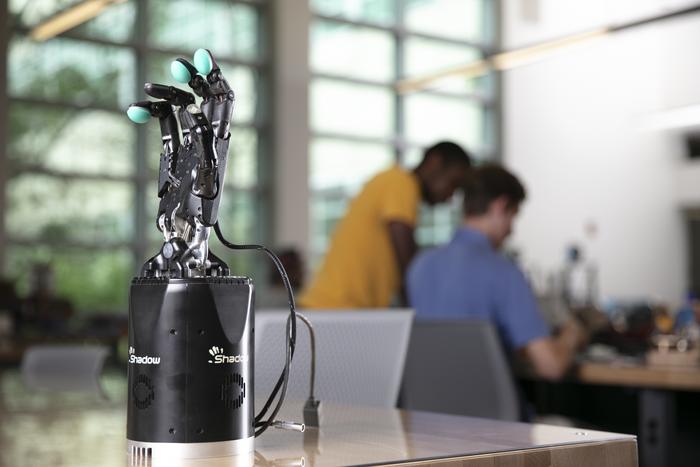
The sensor data is then paired with an AI model trained on that person’s own movement patterns. The model converts those signals into real-time commands that control a dexterous robotic hand.
The study, published in IEEE Transactions on Neural Systems and Rehabilitation Engineering, was led by Erik Engeberg, a professor in FAU’s College of Engineering and Computer Science, with appointments in ocean and mechanical engineering and biomedical engineering. Engeberg is also affiliated with the FAU Stiles-Nicholson Brain Institute and the FAU Center for Complex Systems.
“Prosthetic control is not one-size-fits-all,” noted Engeberg, senior author. “Every individual brings a distinct movement signature shaped by their anatomy, injury history and how their remaining muscles function. If we want these systems to truly work in everyday life, they have to be custom fit. By combining 3D-printed wearable sensors with individualized AI models, we’re moving closer to prosthetic systems that can respond naturally and in real time to a person’s intent, rather than forcing users to adapt to the limitations of the device.”
The Study
In testing with 10 participants, including three upper-limb amputees, the system classified 19 hand and wrist gestures in real time, according to FAU. The researchers reported that the system performed consistently under repeated use.
The study also tested sensor durability. Researchers applied more than 7,500 robotic force cycles over several hours while measuring how the sensors responded. FAU said the sensors maintained a stable relationship between applied force and output, with clear signals and no meaningful drift or degradation.
That durability matters because prosthetic control signals can change during daily use. Sweat, skin movement and other conditions can make muscle signals harder to interpret, creating a gap between what the user intends and what the prosthetic hand does.
The researchers used sensor arrays with either 18 or 24 modules, depending on limb size and anatomy. The AI model was also individualized, learning each user’s muscle patterns rather than relying only on a broad dataset. FAU said the research team also produced a shared dataset from all participants, including amputees and non-amputees, to support further work by other scientists.
The Findings
The study’s central finding was that customization improved control. FAU said there was no single best sensor layout for all users. Some participants performed better with fewer sensors, while others needed more. The optimal configuration depended on anatomy, injury history and remaining muscle function.
In several cases, participants achieved more than 90% accuracy across multiple gestures only when the sensor layout was tailored to their residual muscles, according to the researchers.
“Our results highlight that prosthetic performance is highly dependent on how well sensor placement and quantity are matched to the individual,” added Engeberg. “This suggests a future in which prosthetists can fine-tune sensor configurations much like a prescription, balancing both function and comfort for each user.”
The study addresses a large and growing need. FAU cited estimates that about 2.1 million people in the U.S. are living with limb loss and that about 185,000 amputations occur each year. Globally, more than 50 million people are affected, with the number expected to grow because of diabetes, vascular disease, trauma and conflict-related injuries.
The study, as described by FAU, was limited in scale. It involved 10 participants, including three upper-limb amputees, and the release does not describe long-term home use or testing across a larger amputee population. It also does not report whether the system was tested across a wide range of daily tasks outside the lab.
Study co-author Wen-Yu “Marty” Cheng, a graduate student and Ph.D. candidate in FAU’s College of Engineering and Computer Science, contributed to the work.
Image credit: Alex Dolce, Florida Atlantic University