

Insider Brief
- Holiday Robotics raised $105 million in Series A funding to develop dexterous humanoid robots for industrial work, with Maeil Business reporting it is the largest Series A round for a South Korean startup.
- Existing investors Stone Bridge Ventures, Atnum Investments, Intervest and Spring Camp participated, while new backers included IMM Investment, SL Investment, KB Investment, Bon Angels Venture Partners, Premier Partners, Ulmus Investment, SJ Investment Partners, Dasung Ventures, Atinum Capital Partners and Goodwater Capital.
- Holiday said the funding will support hiring, manufacturing readiness and continued development of Friday, its 64-degree-of-freedom humanoid robot built for manufacturing and industrial automation tasks.
Holiday Robotics has announced raising $105 million in Series A funding to develop dexterous humanoid robots for industrial work.
South Korean business newspaper Maeil Business, or MK, reported that the round is the largest Series A investment for a South Korean startup and the largest single funding round for a South Korean humanoid robot company.
Existing investors Stone Bridge Ventures, Atnum Investments, Intervest and Spring Camp participated in the round, according to MK. New investors included IMM Investment, SL Investment, KB Investment, Bon Angels Venture Partners, Premier Partners, Ulmus Investment, SJ Investment Partners, Dasung Ventures, Atinum Capital Partners and Goodwater Capital.
MK also reported that financial institutions including Korea Development Bank and Industrial Bank of Korea participated in the round, giving the company a broader base for future growth funding.
According to the company, founded in 2024, the funding will support a sharper focus on reducing repetitive physical labor in manufacturing and other industrial settings. Holiday Robotics said it will use the capital to grow its research and engineering teams, strengthen manufacturing readiness and continue developing the systems behind its humanoid robot, Friday.
“We started from one conviction: what the factory floor needs is not a more impressive robot demo, but a robot that can be put to work quickly,” CEO Kiyong Song wrote in a post announcing the funding. “For us, the challenge is to turn robotic capability into deployed, dependable work — fast. That is the problem we set out to solve.”
The company stressed that manufacturers requires robots that can work safely near people, handle repetitive physical tasks and improve through deployment.
It’s in the Hands
The company’s approach starts with hands. Holiday said humanoid robots create industrial value through grasping, placing, adjusting, sensing contact and repeating precise movements. Those tasks are difficult to automate because they involve friction, weight, alignment, surface changes and other physical variation.
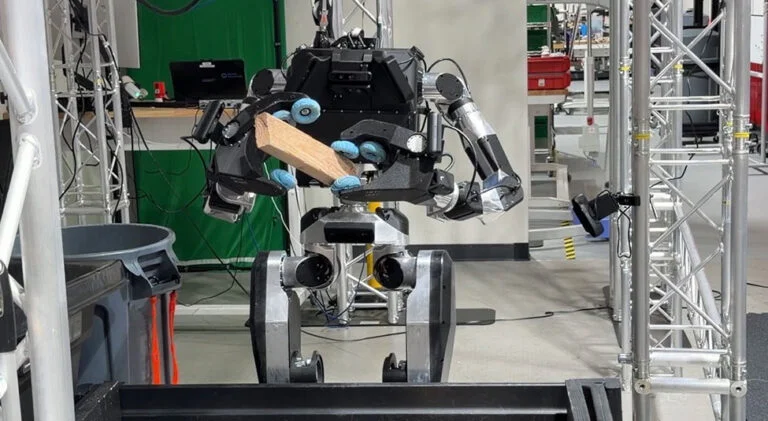
Friday has 64 degrees of freedom, with 40 dedicated to its hands. The robot is built around high-dexterity hands, tactile sensing across the hand and force-aware control that allows it to feel contact and adapt to it,” according to Holiday. Friday is designed for existing industrial settings and uses a wheel-based mobile base to move through factories, a dexterous upper body for manipulation and hot-swappable batteries to support full-shift operation.
The company said safety is built into the robot’s hardware. Friday has lightweight hands with low inertia, fully backdrivable hand and arm joints, and 360-degree perception using multiple cameras and LiDARs.
Vision-Language-Skills Platform
Also, Holiday is developing its software and deployment stack in-house. The company said reliable robot deployment will depend not only on larger models or better demonstrations, but on how task execution is structured.
Its system is built around what the company calls Vision-Language-Skill, or VLS. In that approach, vision and language help define what a robot should do, while reusable skills define how the robot performs the task. Holiday Robotics said the goal is to make complex tasks easier to diagnose, measure and improve.
The company’s full-stack system includes:
Friday: The dexterous humanoid robot built to perform reusable skills in manufacturing environments.
Holiday Sim: A simulation environment used to test robots, skills and work settings before deployment.
Holiday Lab: A system for turning demonstrations, simulation rollouts and real-world failures into reusable robot skills.
OASys: A deployment system designed to make robots easier to put into real-world settings and feed deployment experience back into development.
The company pointed out that it is taking a field-first approach, starting with repetitive work where the need is clear and the value of automation can be measured. Its current focus areas include manufacturing and industrial automation, including automotive, semiconductor and logistics environments.
Holiday said it is working through private proofs of concept with industrial partners to understand the demands of real deployment, including safety, reliability, dexterity, repeatability and operational fit.
“We are not building just one robot — we’re building a platform that gets better with every task and every site,” Song added.
Image credit: Holiday Robotics