
Insider Brief
- HII plans to award up to $900 million in shipbuilding work to Path Robotics and GrayMatter Robotics over seven years to expand physical AI and automation across U.S. Navy shipbuilding programs.
- The performance-based agreements are part of HII’s HYPR program and will move through development and delivery stages covering automated welding, grinding, blasting, painting, assembly, inspection and other fabrication work.
- HII said the technologies must meet Navy shipbuilding requirements and cost, schedule and quality targets before production work expands from small steel structures to larger units and modules.
HII plans to award up to $900 million in shipbuilding work to Path Robotics and GrayMatter Robotics over seven years under agreements aimed at expanding physical AI and automation across U.S. Navy shipbuilding programs.
The performance-based production agreements cover work supporting aircraft carriers, submarines, destroyers, amphibious ships, future frigates and unmanned surface vessels, according to HII. Awards will depend on the two robotics companies meeting technology, manufacturing-readiness and performance milestones established in the agreements.
Eric Chewning, executive vice president of maritime systems and corporate strategy at HII, said the collaboration is meant to strengthen the U.S. shipbuilding industrial base, expand production beyond its shipyards, improve the flow of materials and work to its facilities and workforce, and increase manufacturing efficiency as the Navy expands its fleet.
“We are committed to making generational investments to develop new shipbuilding capability and to expand capacity,” Chewning said. “Together, we are defining a new approach to robotics in shipbuilding: automation that can adapt to extreme levels of complexity, mix, and size.”
The deals are part of HII’s High-Yield Production Robotics, or HYPR, program, which brings together HII, Path and GrayMatter to develop and deploy advanced automation for shipbuilding.
“For years, we’ve believed physical AI could fundamentally change manufacturing,” Path co-founder and CEO Andy Lonsberry said in the announcement. “HYPR is a powerful validation of our vision — that physical AI can scale shipbuilding capacity in one of the world’s most demanding production environments.”
The agreements are divided into a Navy-grade development stage and a delivery stage.
Development Stage
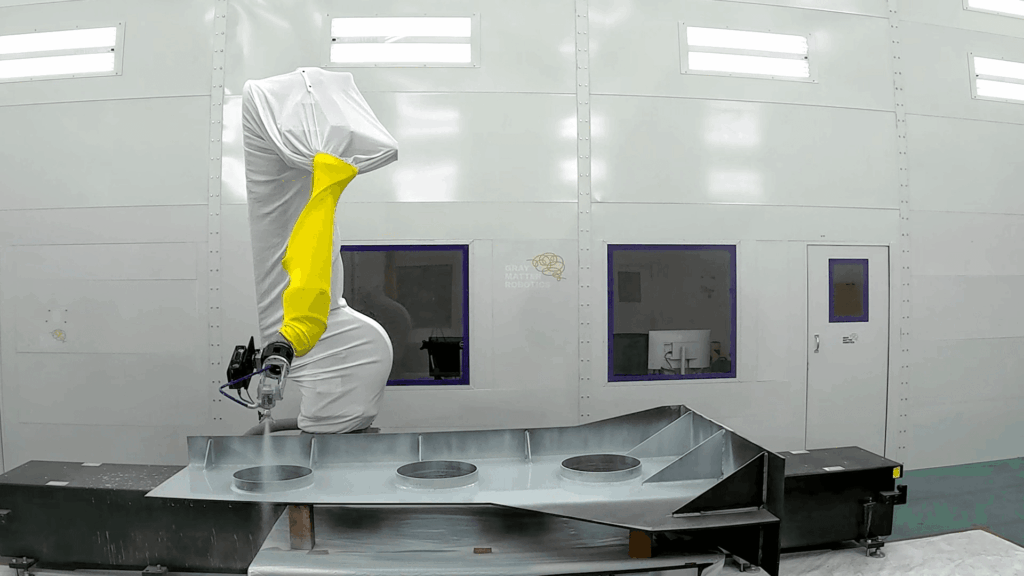
During development, Path and GrayMatter will work with HII to develop, validate and qualify automated production methods for welding, grinding, blasting, painting, assembly, inspection and other fabrication processes. Those capabilities are intended to be combined into an autonomous production line.
HII indicated the technologies will go through testing, qualification and oversight according to U.S. Navy shipbuilding requirements before moving into production.
Delivery Stage
The delivery stage would allow HII to begin sourcing shipbuilding work through the new production line if the systems hit cost, schedule and quality targets. The work is expected to begin with small steel structures and later expand to larger units and modules.
The arrangements are meant to supplement HII’s distributed shipbuilding strategy, which shifts some production to outside partners before components are brought to its shipyards for final assembly, according to the company.
Long-Term Focus
HII said the longer-term production commitments are designed to give Path and GrayMatter enough demand visibility to invest in robotics, autonomous systems, facilities and workers needed to support larger-scale production.
The company plans to outsource more than 2.5 million hours of shipbuilding work in 2026, a 30% increase from 2025, while continuing to expand its network of structural assembly partners.
GrayMatter CEO and co-founder Ariyan Kabir said the agreement will bring “the company’s “Factory SuperIntelligence” technology into HII’s shipbuilding operations while supporting efforts with HII and Path Robotics to expand U.S. industrial production for national-security needs.
“By combining physical AI with autonomous production systems, we’re helping create manufacturing that learns, adapts, and improves over time, making complex shipbuilding faster, more resilient, and more scalable,” Kabir said.
Image credit: HII