Insider Brief
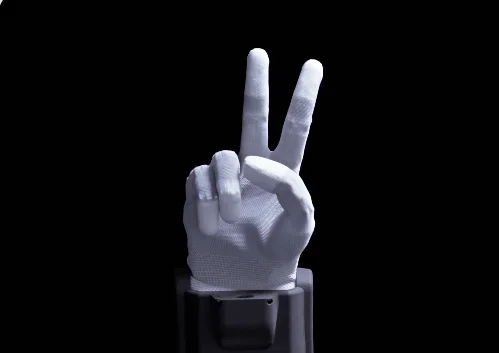
- mimic robotics unveiled a full-stack system for industrial dexterous manipulation, combining the mimic hand M1, the mimic wearable U1 and a custom software stack.
- The M1 is a tendon-driven robotic hand with 15 actuated degrees of freedom and 21 joints, designed to match key human-hand capabilities while using forearm-based actuators for durability and force feedback.
- The U1 wearable lets people generate robot training data by performing tasks with their own hands, giving mimic a way to collect demonstrations without relying on robot teleoperation fleets.
mimic robotics unveiled a full-stack system with a robotic hand and a wearable training device designed to help industrial robots learn dexterous tasks from human hand movements.
The Zurich- and San Francisco-based physical AI company introduced the mimic hand M1 and the mimic wearable U1, also called umimic. Both products are designed and manufactured in-house and are paired with the company’s custom software stack.
mimic said it is deliberately avoiding a humanoid-first approach. The company’s view is that many hard-to-automate industrial tasks require hands, not legs, torsos or faces.
“Fundamentally, Mimic has always been a very focused company that wants to solve dexterity and manipulation,” CTO Elvis Nava told AI Insider. “In a sense, our scope is very broad because we want to do it in a general purpose way. We essentially have our own frontier AI approach to solving dexterity and manipulation and we’re also full-stack –- we develop also the hardware of the hands.”
mimic M1
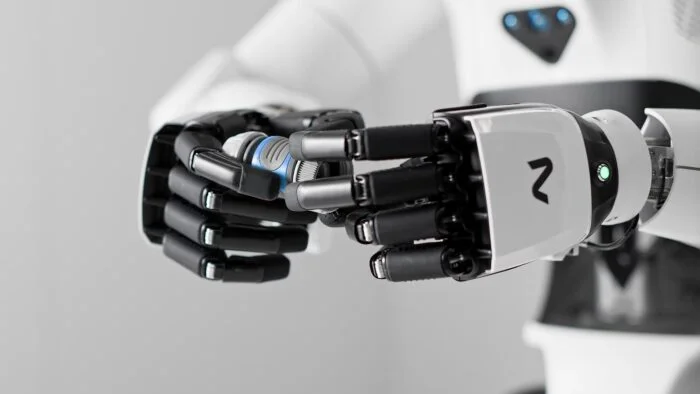
The mimic hand M1 is a tendon-driven robotic hand built for industrial automation. It has 15 actuated degrees of freedom and 21 joints, including an opposable thumb and abduction, or side-to-side finger movement. The company pointed out the hand is highly backdrivable, meaning its joints can move in response to outside forces. That allows the actuators to function as force sensors, giving the system feedback from contact with objects rather than simply carrying out commands.
The M1 uses actuators in the forearm rather than motors packed into the hand. mimic said that tendon-driven design is intended to support both heavier payloads and fine manipulation while improving durability for industrial use.
“The motors in the fingertips approach has other weaknesses,” Nava pointed out, noting it would have meant making the robotic hand much bigger than a real human hand and that would have implication for the data collecting wearable. “It would not be as easy to convert the data the human modalities to the robot if it had a different shape than the human.”
Having the motors in the hand instead of the forearm would also require minituarization that would limit the hands functionality and durability. “The real estate of the fingers is fully available for fingers,” Nava added.
The company’s core argument is that robots do not yet have anything like the internet-scale datasets that trained large language models. For hand-based work, mimic said the largest practical source of real-world behavior is video of people using their hands.
mimic U1 ‘umimic’
The mimic wearable U1 is an exoskeleton-style device that lets people teach the robot by performing tasks with their own hands. It includes tactile sensors, encoders and a wrist camera designed to match the robot’s sensing and movement.
“The goal is really to collect robot data without needing the robot,” noted CPO Stephan-Daniel Gravert. “Fundamentally robot teleoperation just does not scale. That’s why we have developed our wearable device.”
The U1 is designed to collect robot training data without requiring a robot to be present. mimic said traditional teleoperation can be hard to scale because it requires robot fleets in target environments and can be affected by latency and mismatched motion between the operator and robot.
The wearable is meant to avoid those issues by limiting the wearer’s hand to the same motions the M1 can perform. In that setup, human demonstrations can be recorded in a form that is easier to transfer to the robot.
The platform is also tied to mimic’s work on Video-Action Models, which are AI models intended to connect video demonstrations with robot actions. The company said it will release more details on that work later while a video following the research can be found here.
Image credit: mimic robotics