
Insider Brief
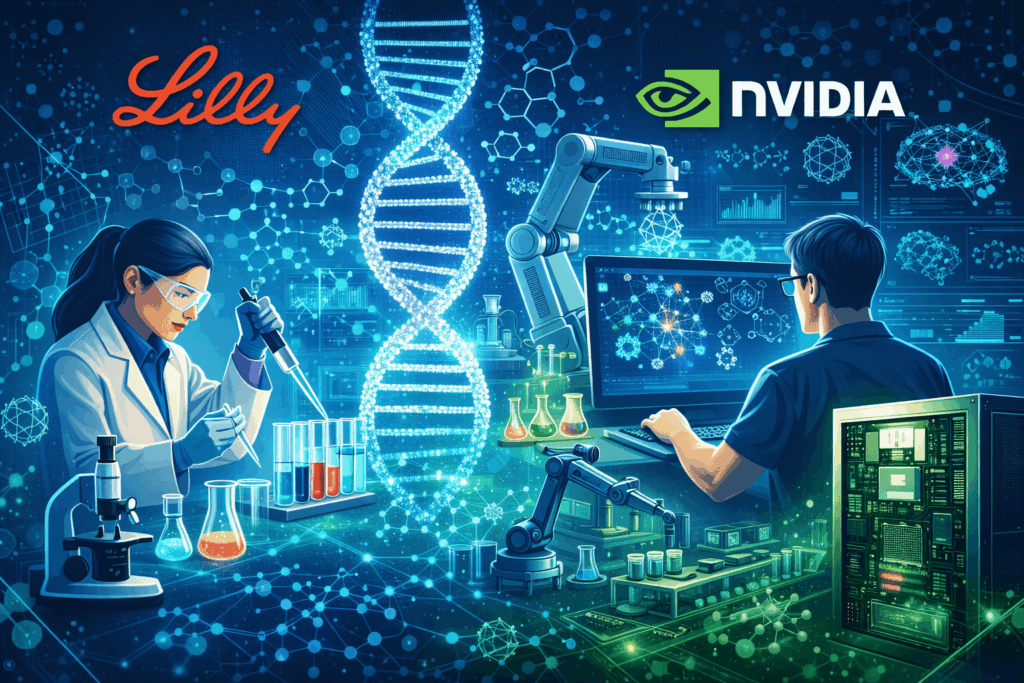
- Eli Lilly and Company is launching a joint AI co-innovation lab with Nvidia, committing up to $1 billion over five years to apply advanced computing and machine learning to drug discovery, development, and manufacturing.
- The San Francisco Bay Area lab will pair Lilly scientists with Nvidia AI engineers to generate large-scale biological and chemical data and build models on Nvidia’s BioNeMo platform, with an initial focus on tightly linking wet-lab experimentation and computational modeling in a continuous learning loop.
- Lilly said the collaboration builds on its existing high-performance computing investments and will also explore AI applications across clinical development, manufacturing optimization, and supply chain planning as part of a broader effort to embed AI across its operations.
Eli Lilly and Company announced it is launching a joint “AI co-innovation” lab with Nvidia to apply advanced computing and machine learning to drug discovery, development, and manufacturing. The companies plan to invest up to $1 billion over five years in talent, infrastructure, and compute to support the effort, according to Lilly.
The lab, based in the San Francisco Bay Area, will bring together Lilly researchers in biology, chemistry, and medicine with Nvidia engineers and AI model developers. According to Lilly, the goal is to generate large-scale biological and chemical data and build models that can accelerate early-stage research, with Nvidia’s BioNeMo platform serving as the core technical foundation.
“AI is transforming every industry, and its most profound impact will be in life sciences,” Nvidia founder and CEO Jensen Huang said in a statement. “Nvidia and Lilly are bringing together the best of our industries to invent a new blueprint for drug discovery — one where scientists can explore vast biological and chemical spaces in silico before a single molecule is made.”
The initial focus will be on linking laboratory experimentation with computational modeling in a continuous learning loop, allowing data from wet labs and simulations to inform one another. Lilly said the approach is intended to support round-the-clock, AI-assisted experimentation and model refinement, rather than replacing human scientists.
The initiative builds on Lilly’s previously announced investments in high-performance computing, including an in-house AI supercomputing system designed to train large biomedical models. Lilly said the collaboration will also explore applying AI beyond discovery, including in clinical development, manufacturing optimization, and supply chain planning, using digital twins and simulation tools.
“For nearly 150 years, we’ve been working to bring life-changing medicines to patients,” David A. Ricks, chair and CEO of Lilly, noted in the announcement. “Combining our volume of data and scientific knowledge with Nvidia’s computational power and model-building expertise could reinvent drug discovery as we know it. By bringing together world-class talent in a startup environment, we’re creating the conditions for breakthroughs that neither company could achieve alone.”
Work at the new lab is expected to begin in South San Francisco later this year, with Lilly positioning the partnership as part of a broader strategy to embed AI more deeply across its research and operations.