
Insider Brief
- Philips said the €21.5 million SHERPA project, co-funded by the European Union’s Innovative Health Initiative and industry partners, has launched seven clinical studies to validate AI- and robotics-assisted workflows for minimally invasive brain aneurysm and liver tumor treatments.
- The four-year public-private consortium spans 16 partners across seven European countries, integrating medical technology firms, academic hospitals and research organizations to address physician shortages and rising procedural complexity.
- Over the next three years, SHERPA will evaluate AI-driven aneurysm detection and risk prediction tools (RADAR, Aneurysm@risk, ASSIST, INTERACT, SAFO) and advanced imaging and robotics-assisted tumor interventions (MISTRAL, RHODES) to measure impact on patient outcomes, physician workload and procedural efficiency.
A €21.5 million European research effort backed by public and private funding is moving into clinical validation.
According to Philips, the four-year SHERPA project has initiated seven clinical studies aimed at validating AI– and robotics-assisted workflows for minimally invasive treatment of brain aneurysms and liver tumors — procedures where staffing shortages and technical complexity are straining healthcare systems.
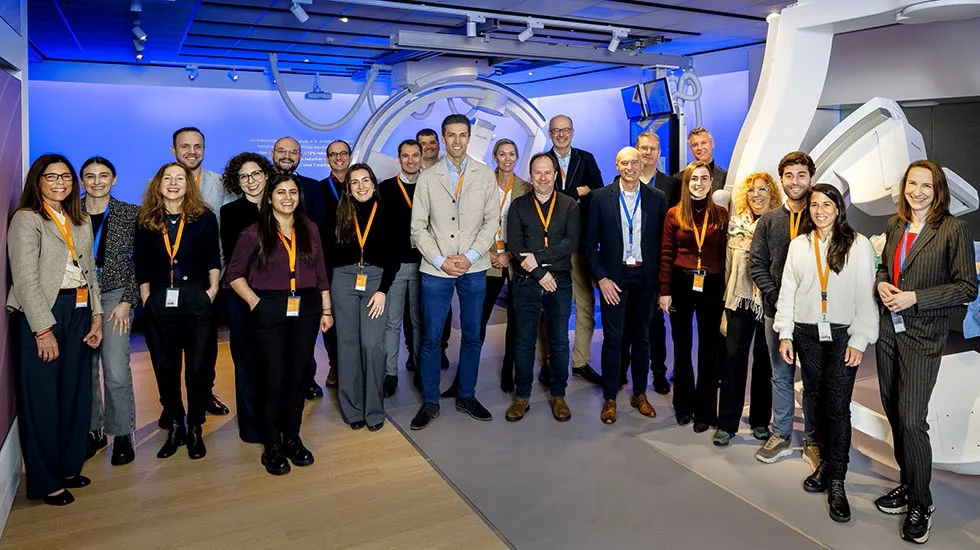
SHERPA, which stands for Smart Human-centred Effortless support for Professional clinical Applications, is co-funded by the European Union’s Innovative Health Initiative (IHI) and industry partners, with Philips serving as coordinator. The consortium includes 16 partners across seven European countries, spanning medical technology companies, academic medical centers and research organizations.
The SHERPA public-private partnership brings together 15 core organizations across industry, academia and research associations.
Industry participants include Philips, Medtronic, Sim&Cure, Interventional Systems and Barco.
Academic medical centers involved in the project are University Medical Center Utrecht, University Medical Center Hamburg-Eppendorf, Hôpital Bicêtre AP-HP, Hospital de la Santa Creu i Sant Pau and St Antonius Hospital.
Research and medical association partners include the European Institute for Biomedical Imaging Research, the Cardiovascular and Interventional Radiological Society of Europe, the European Society of Minimally Invasive Neurological Therapy, Eindhoven University of Technology and Human-Factors-Consult in Germany.
Philips said the SHERPA consortium has developed AI algorithms for aneurysm detection and risk prediction, therapy planning for liver tumor ablation, robotic-assisted precision tools and software to confirm treatment success. These components have been integrated into end-to-end workflows designed to automate repetitive tasks and support clinical decision-making.
What are the SHERPA Project Clinical Studies
Over the next three years, SHERPA partners will conduct a series of clinical studies to refine AI- and robotics-assisted workflows and measure impact on patient experience, physician workload, satisfaction and procedural performance.
Brain Aneurysm Studies (AI-driven detection, risk prediction and planning)
- RADAR: AI-based aneurysm detection using CT and MR imaging.
- Aneurysm@risk: Algorithm to predict aneurysm growth and rupture risk.
- ASSIST: AI-supported device selection and positioning guidance.
- INTERACT: Automated collimation and projection angle optimization for imaging guidance.
- SAFO: Digital remote follow-up platform for standardized monitoring and coordinated post-procedure care.
Liver and Lung Tumor Studies (Imaging and robotics-assisted precision)
- MISTRAL: Evaluation of advanced Cone Beam CT workflows to optimize imaging for percutaneous liver ablation.
- RHODES: Comparison of robotic-assisted versus free-hand lung biopsies, focused on operability and device efficiency.
The World Health Organization has projected a shortfall of 600,000 physicians in the European Union by 2030, with interventional radiology among the most affected specialties, Philips noted. The initiative reflects a broader push to use AI and robotics to offset workforce shortages while improving procedural precision and training. SHERPA will be featured at the European Congress of Radiology on March 4, where researchers will outline early progress and next steps in clinical validation.
Image credit: Philips