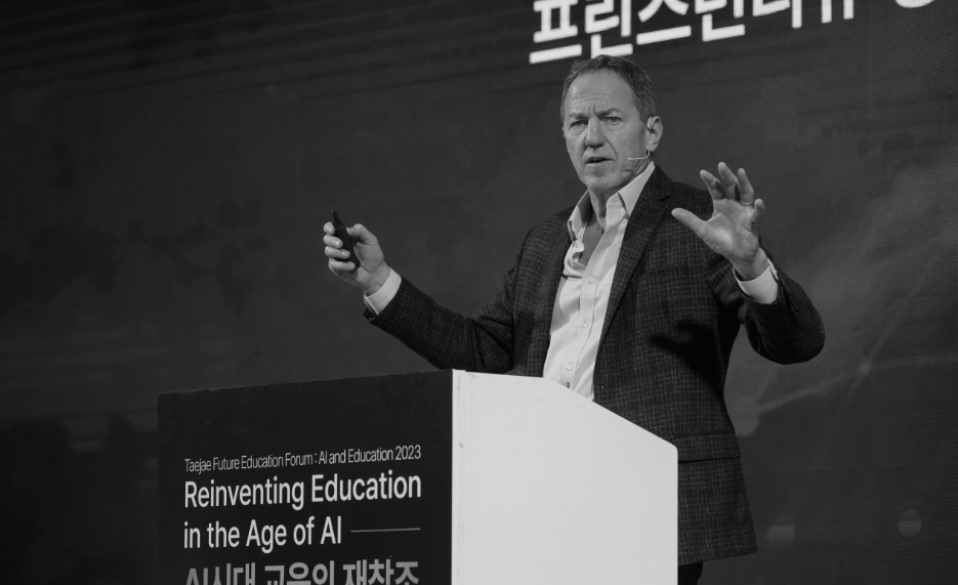
A pioneer in education technology from the United States, John Katzman — co-founder of The Princeton Review — was interviewed last week by The Korea Herald. In the interview, he shed light on the profound impact of artificial intelligence (AI) on the education sector, emphasizing its potential to democratize learning opportunities, especially for the underprivileged.
Bottom of the Class
“AI appears to be most useful to people who aren’t really good. If you’re a great writer, using AI to write your article (wouldn’t be helpful). But AI can help the bottom of the class and, arguably, you can make a case that will make education more fair,” said Katzman while, at the same time, expressing reservations about AI’s capability to mitigate the cutthroat competition associated with admissions to prestigious universities.
Katzman points to South Korea’s impending transition to AI-enhanced digital textbooks in 2025 as a significant step towards interactive and personalized learning. This shift underscores the essence of AI in education, propelling students towards autonomous learning, and adaptable to their individual schedules.
“(AI education) should be different for every student because it’s not about what happens in the textbook. It’s not about how (teachers) should get (students) ready for a class on Thursday,” he said.
Transformative Power
Katzman, an advocate for AI in education, elucidates the transformative power of digitalized lessons, driving students towards active learning by presenting problems for them to solve, subsequently instilling in them a desire to find solutions. Nevertheless, he predicts that the reliance on private academies by students and parents will persist, regardless of AI learning tools’ ability to offer tailored one-on-one lessons and intelligent tutoring.
“It’s not just saying ‘you go learn stuff’ to students in a lecture. Keeping schools the same as they were 50 years ago when the rest of society is changing just means it’s less relevant,” said Katzman.
Further elaborating on the challenges within the education sector, Katzman criticizes the prevailing “grades matter” mentality, asserting that it detracts from holistic learning and pushes students to focus solely on grade optimization to stand out in college applications. He proposes a paradigm shift, urging universities, particularly in Korea, to reconsider their admissions criteria which currently overemphasize academic excellence, leading to grade inflation. Katzman argues for a more diverse student body, encouraging students to engage in varied activities beyond academics, ultimately enriching their learning experience and personal growth.
“We still need teachers, and they can be more effective because they’re backed by AI tools. I don’t know why it would be any different in the tutoring world,” he said.
He also highlighted The Princeton Review’s role in augmenting tutoring efficiency through enhanced teaching tools, while debunking the misconception that AI’s streamlining of teaching methods would lead to a reduction in tutoring.
“They did exactly the same amount and got more out of it. If it’s more efficient, then students will just learn more,” said Katzman, adding that the adoption of AI-enhanced digital textbooks won’t necessarily deter students from seeking additional resources in the private sector.
Inclusive, Equitable
In closing, Katzman calls for a recalibration in university admissions, aiming to dismantle the existing grade-centric approach, and in doing so, foster a more inclusive and equitable educational landscape.
“Why work hard? We want you to have a life. What gives you joy? Where do you want to spend your time? If you’ve got extra energy, spend it elsewhere, not memorizing like crazy. But students don’t see that. All they see is ‘I got in’ or ‘I didn’t get in,’” said Katzman before saying AI alone cannot rectify the intense rivalry within education, especially at the upper echelons, due to misplaced incentives and that focusing solely on the influence of AI on textbooks overlooks a significant aspect of the narrative.
Featured image: John Katzman addressing an AI education forum on 17/10/23 at Yonsei University in Seoul, an event organized by Taejae University. Credit: Taejae University.