Insider Brief
- In 2025, artificial intelligence shifted from experimentation to integration as companies embedded AI systems into core workflows rather than treating them as standalone tools.
- Adoption focused on practical deployments — including autonomous agents, sector-specific applications, and data-driven decision systems — rather than headline-grabbing model releases.
- Investment, policy, and talent strategies increasingly reflected AI’s role as foundational infrastructure, with emphasis on data quality, governance, and long-term operational impact.
Artificial intelligence in 2025 crossed a line from promise to practice, from experimentation to integration as the technology continued its fast-paced move from what was once just an academic curiosity to the machinery of daily business.
Over the course of the year, coverage on The AI Insider traced a clear shift: AI was no longer defined by novelty demos or speculative debates, but by quieter, more consequential changes in how organizations work, invest, and compete.
We will look at some of the key trends that The AI Insider reported on during 2025.
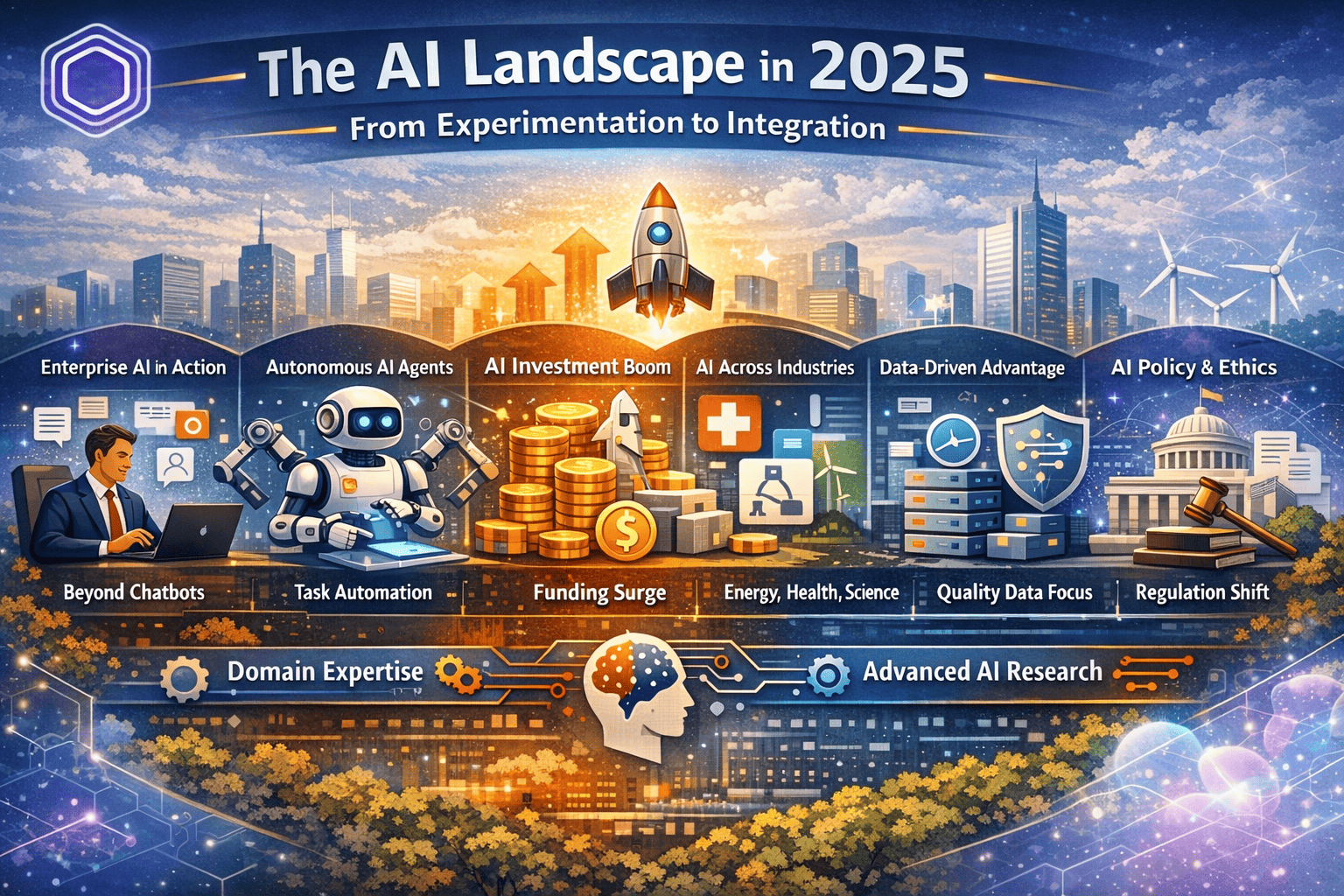
Enterprise Implementation Beyond Chatbots
In 2025, interest in large language models (LLMs) shifted from exploration to real-world enterprise deployment across sectors like finance, healthcare, legal services, and logistics. Organizations embedded LLMs into core workflows rather than treating them as standalone toys — affecting search, summarization, decision support, customer service, and automated coding tasks.
Companies embedded LLMs into core systems that search internal knowledge, draft and review documents, assist programmers, and support complex decision-making.
The conversation shifted from “what model should we use?” to “where does this fit into the workflow?” The result was less spectacle, but more impact. Productivity gains appeared not as dramatic leaps, but as cumulative improvements spread across thousands of everyday tasks.
Agentic and Autonomous AI Growth
Agentic AI — software that can plan, execute tasks, and coordinate across tools with minimal human prompting — rose in prominence in 2025. Studies highlighted how embedding agentic capabilities directly into workflows dramatically increased productivity and adoption among senior workers, pointing to a broader shift beyond passive generation toward active task execution. AI Insider
Even though doubts remain on just how effective and just how independent Agentic AI can be, these systems quietly took on responsibilities such as scheduling, monitoring data pipelines, managing internal requests and even initiating actions based on predefined goals. Rather than replacing workers outright, they often acted as force multipliers, especially for experienced employees who understood how to supervise and constrain them.
Heavy Funding and Capital Activity
Investment in AI remained strong in 2025, but it became more targeted.
Another important trend in 2025 was the record investments in AI ecosystems, like Canada’s SCALE AI funding surge supporting healthcare, energy, infrastructure and vision systems.
Capital flowed not only to foundation model developers, but increasingly to applied AI companies working in healthcare, energy, robotics, infrastructure and scientific research. Governments also stepped in with larger, more structured funding efforts, framing AI as strategic infrastructure rather than a consumer technology trend.
The tone of investment coverage shifted accordingly, emphasizing deployment readiness, compute access, and integration costs over raw model performance.
Expanded AI Application Across Sectors
Across sectors, The AI Insider tracked stories of how AI’s role was becoming more specialized — and almost every company became an AI company.
For example, customer service systems evolved beyond scripted responses, using context-aware models that could anticipate problems rather than simply react to them. In energy and infrastructure, AI was deployed to manage complex systems tied to decarbonization and grid resilience. In materials science and engineering, AI-driven simulations became routine, accelerating discovery while exposing new bottlenecks in compute capacity and data availability.
These stories shared a common thread: AI delivered value when paired with deep domain knowledge, not when applied as a generic solution.
Regulation & Policy Momentum
Policy debates also intensified. In the United States and abroad, governments moved from abstract discussions about AI ethics toward concrete plans focused on competitiveness, workforce development, and national security.
Regulation did not disappear, but it increasingly ran alongside industrial policy aimed at ensuring domestic access to data, talent, and computing resources.
The regulatory conversation became less about stopping AI and more about shaping where and how it is built and deployed.
Shift Toward Data-Driven Competitive Edges
Underlying all of these developments was a growing recognition that data, not models, defined competitive advantage.
By 2025, access to capable AI models was widespread, but high-quality, proprietary data was not. Companies that invested early in data governance, integration, and ownership found themselves better positioned to extract real value from AI systems.
This reality reshaped hiring priorities as well, increasing demand for professionals who could bridge technical AI tools with sector-specific expertise.
Ongoing Research & Advanced Models
Research continued to push forward with The AI Insider diving into a range of studies that explored how AI systems mirror human biases in markets, how models reason under uncertainty, and how AI could be paired with advanced computing systems to tackle problems beyond today’s scale.
While these efforts rarely dominated headlines, they set the direction for the next phase of development.
2026, ready or not, here we come.