Insider Brief
- Harbinger has launched its Harbinger Praesidia unmanned hybrid-electric vehicle platform for military and government applications, designed for missions including logistics, troop transport, field communications, perimeter security and counter-drone operations, while also announcing a strategic investment from In-Q-Tel.
- The autonomous-ready platform is built on Harbinger’s commercial hybrid vehicle architecture and features drive-by-wire controls, teleoperation capabilities, multiple chassis configurations and payload capacities of up to 18,000 pounds, according to the company.
- Harbinger said the hybrid-electric system provides more than 500 miles of range, can export power to external equipment and supports remote operation through radio and satellite communications, with the platform intended to serve as a foundation for future autonomous and uncrewed military systems.
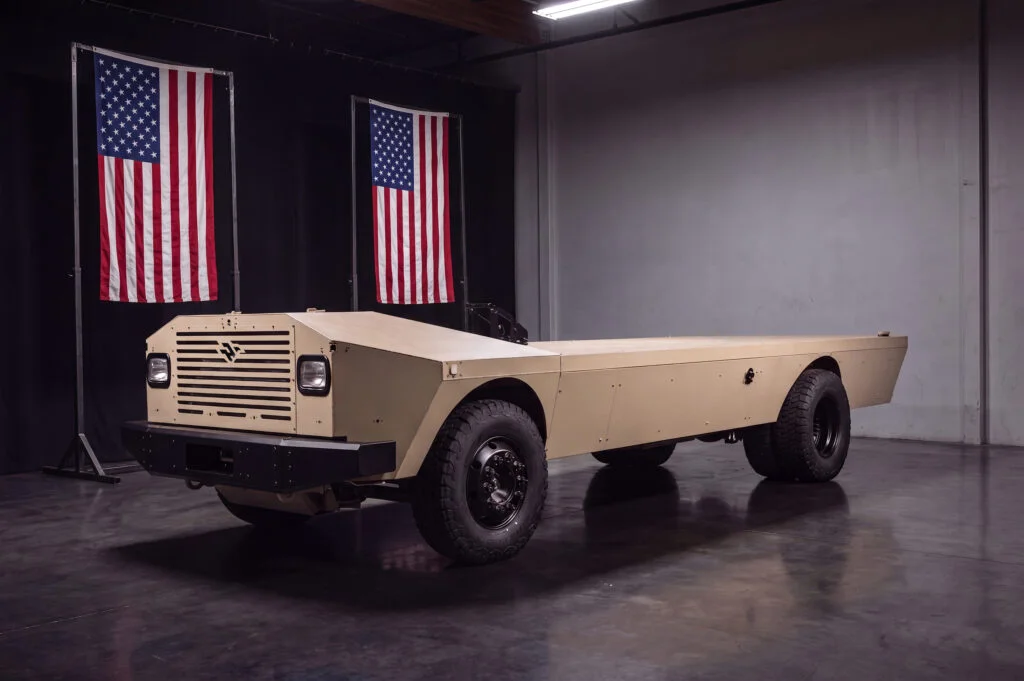
Harbinger has launched an unmanned hybrid-electric military vehicle platform and working with government customers and defense contractors through a new business unit called Harbinger Praesidia.
The company also announced a strategic investment from In-Q-Tel (IQT), the nonprofit investment organization that supports the U.S. national security community and allied governments. Harbinger said the investment will help support its expansion into government and defense markets.
“The government needs robust vehicles that can support a wide range of use cases without forcing operators to compromise on payload, range, exportable power or durability,” co-founder and CEO John Harris said in the announcement. “Our American designed, engineered and assembled vehicles fulfill this need while supporting domestic manufacturing capacity, which is itself a national security asset. At the same time, these unmanned vehicles are engineered to help keep soldiers out of harm’s way without compromising on performance.”
The Platform
According to the company, the platform can be to configured for a range of missions, including logistics and cargo transport, troop movement, field communications, perimeter security and counter-drone operations. Harbinger also announced a strategic investment from In-Q-Tel, the nonprofit investment organization that supports the U.S. national security community and allied governments.
The Praesidia platform is built on the same medium-duty plug-in hybrid chassis that underpins Harbinger’s commercial vehicles. According to the company, the vehicles are designed to be autonomous-ready and fully teleoperable through Harbinger’s proprietary software interface. The chassis, battery systems, software, drivetrain and drive-by-wire technology are designed and assembled in-house in the United States.
According to Harbinger, the Praesidia platform incorporates steer-by-wire, brake-by-wire and accelerator-by-wire technology, along with redundant systems designed to support teleoperation and advanced autonomous functions. A six-camera system provides a 360-degree view around the vehicle for situational awareness.
Range, Power and Performance
The platform uses a series hybrid-electric powertrain that combines an electric drivetrain with a gasoline-powered generator, allowing it to operate for more than 500 miles in hybrid mode or approximately 105 miles on battery power alone. Harbinger said the vehicle can also export up to 350 kilowatts of power to external equipment and systems, including 48 kilowatts of continuous power from the onboard generator, while reaching speeds of up to 65 miles per hour.
The company said the battery system serves as both a propulsion source and onboard energy reserve, allowing the vehicle to operate in electric-only mode, remain stationary while powering mission equipment and recharge through its onboard generator, external EV charging infrastructure or bi-directional power systems.
Communications and Mission Systems
The company said the platform includes several features designed for military operations:
- Stealth mode that disables lights, acoustic warning systems and the onboard generator
- Remote and teleoperated operation in hazardous or contested environments
- Remote control of auxiliary equipment, including liftgates, pallet systems and power export functions
- Dual-network communications using radio and satellite connectivity
- Integrated range-extending power generation
- AC power export from the high-voltage battery system
According to Harbinger, the platform incorporates mesh radio systems capable of supporting teleoperation at distances of up to five kilometers within line of sight, while satellite communications enable beyond-line-of-sight operations.
The announcement follows Harbinger’s recent partnership with American Rheinmetall to develop robotic and uncrewed ground vehicles for military modernization programs. Harbinger said the Praesidia platform is intended to provide a flexible vehicle foundation that can be adapted for a variety of defense and government missions while leveraging technologies already deployed in its commercial vehicle lineup.
Image credit: Harbinger