
Insider Brief
- Rice University and NASA Johnson Space Center launched an open-source simulator for developing robots that could work inside spacecraft and space habitats.
- Rice said the iMETRO Dynamic Simulation is a digital twin of NASA Johnson’s iMETRO facility and was debuted at the 2026 IEEE International Conference on Robotics and Automation in Vienna.
- The project, funded by NASA, Rice and the National Science Foundation, is designed to let researchers remotely create, test and validate robotic software before moving it to NASA’s physical test bed.
A Rice University and NASA Johnson Space Center project has produced an open-source simulator for developing robots that could work inside spacecraft and space habitats.
According to Rice, researchers from the university and NASA Johnson launched the iMETRO Dynamic Simulation, which it described as the world’s first open-source dynamic simulation environment for intravehicular space robotics.
The team debuted the platform at the 2026 IEEE International Conference on Robotics and Automation in Vienna and the project was funded by NASA, Rice and the National Science Foundation.
The NASA team includes Nathan Dunkelberger, Erik Holum, Emma Zemler and Shaun Azimi, who leads NASA Johnson’s Dexterous Robotics team. The Rice team includes Nikki Hart, a doctoral student and NASA Pathways intern, and Lydia Kavraki, a University Professor at Rice and professor of computer science, electrical and computer engineering, mechanical engineering and bioengineering.
“By developing a full-featured, high-fidelity dynamic simulation of a NASA space operations test facility, this new modeling tool makes research in space robotics accessible to the global robotics community,” noted Kavraki.“The new digital twin simulation environment can serve as a virtual open-source testbed to develop and validate proposed solutions, significantly advancing research and development in intravehicular space robotics.”
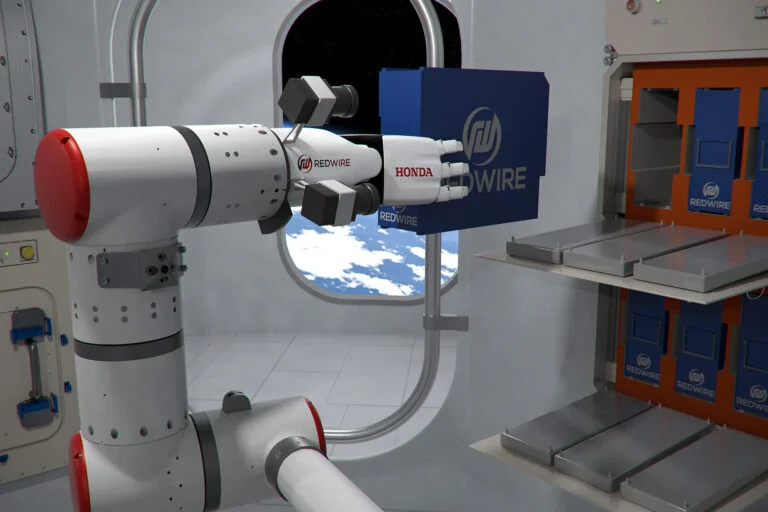
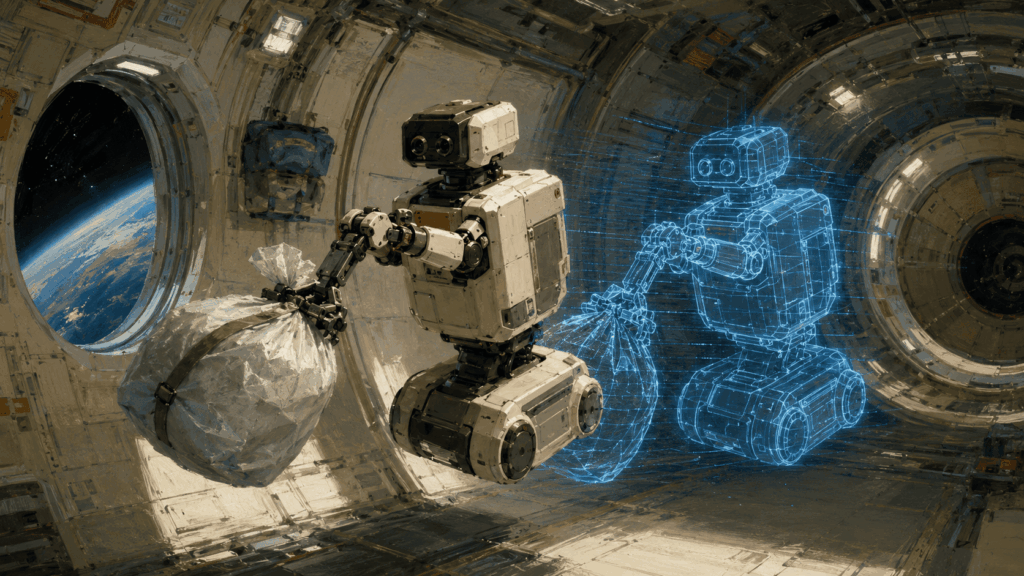
The simulator is a digital twin of NASA Johnson’s iMETRO facility, a physical test bed with full-scale mockups of future space vehicles and lunar habitats, along with custom robotic platforms. The goal, Rice indicated, is to give researchers a way to design, test and validate robot software before moving it to physical hardware.
The project tackles the practical problem of making the most of astronauts’ time during long-duration spaceflight. Azimi noted that crew members spend about a third of their time on routine maintenance work, including moving trash bags or cargo from resupply capsules. Robots that can handle some of those tasks could free astronauts to focus more time on science and exploration, according to Rice.
Developing those robots remains difficult because space habitats create manipulation challenges that differ from Earth-based settings, including low- and zero-gravity conditions. The broader robotics community has lacked accessible open-source tools for simulating those conditions and testing robot behaviors for space interiors, according to Rice.
In the paper presented at ICRA, the Rice-NASA team described how it developed and validated the iMETRO Dynamic Simulation software. The researchers also used the simulator to build and deploy an application that can remotely operate robots at NASA’s physical iMETRO facility.
Rice reported that the team was able to move a newly developed application from the simulation environment to the NASA Johnson facility and have it operating in less than a day.
“For the first time, this simulation will allow researchers around the world to remotely create and test a new robotic software and validate how it integrates with and performs with various hardware configurations and operational paradigms at NASA’s physical test bed,” added Hart.
The work was funded by the NASA Johnson Space Center Engineering Innovation Fund, the Ken Kennedy Institute at Rice University, Rice University’s School of Engineering and Computing, the U.S. National Science Foundation and Rice University.