Insider Brief
- MIT researchers developed VLASH, a method that lets robots plan their next movements while completing current actions, cutting pauses and doubling task speeds in some tests.
- The system predicts a robot’s future state so vision-language-action models can prepare the next action sequence without relying on stale observations, accelerating reaction times more than 30-fold.
- VLASH maintained 90% accuracy in a cube-sorting test, sped training fivefold without added computing overhead and is being extended with world models for more dynamic environments.
Research backed by the MIT-IBM Computing Research Lab, Amazon, the National Science Foundation and Nvidia has produced a method that lets robots plan their next action while completing the current one, reducing pauses and doubling execution speeds in several tests.
The technique, developed by researchers at MIT and collaborating institutions, allows an AI model to forecast where a robot will be after its current movement ends. According to MIT, the model can then prepare the next movement before the robot reaches that position, producing smoother motion and faster reactions.
MIT said the approach, called VLASH, accelerated robotic reaction speeds more than 30-fold by eliminating much of the delay between planned groups of actions. In a cube-sorting test, the system finished the task twice as fast as leading comparison methods while maintaining a 90% success rate.
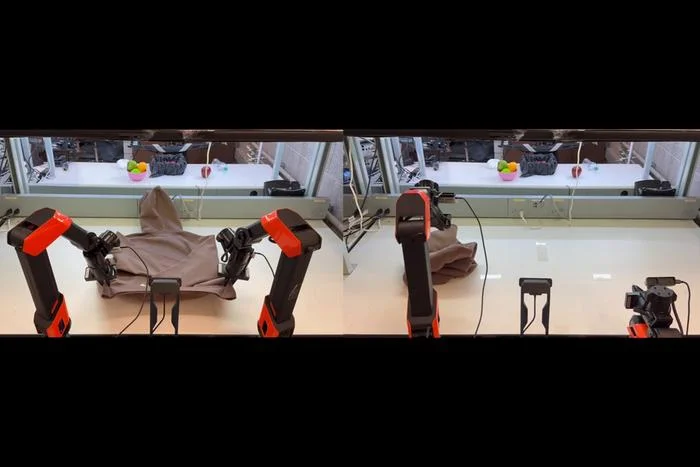
The researchers also tested VLASH on robotic arms performing stacking, sorting and pick-and-place work, as well as faster activities such as table tennis and whack-a-mole. The method could eventually support robots working in emergency response, search and rescue, manufacturing and other settings where delays can reduce performance or create safety problems.
The work was led by Song Han, an associate professor in MIT’s Department of Electrical Engineering and Computer Science, with MIT graduate student Jiaming Tang and Tsinghua University student Yufei Sun. Researchers from Nvidia, the University of California at Berkeley, the University of California at San Diego and Caltech also contributed. The paper is scheduled to be presented at the Intelligent Robots and Systems Conference.
Planning From a Future Position
Researchers point out that any advanced robots are controlled by vision-language-action models, or VLAs. These AI systems process camera images and task instructions, then produce a short sequence of physical movements for the robot to perform.
The robot typically completes that sequence before asking the model to calculate the next one, but the robot may stop or hesitate between movements. since the model requires time to analyze the scene and generate another set of actions.
On the surface, a simple solution would be having the robot plan the next action while it is still moving, but that creates another problem. The robot and its surroundings may have changed by the time the new plan is ready. A plan based on the earlier camera image can therefore be misaligned with the robot’s actual position.
Researcehers say VLASH addresses that problem by estimating the robot’s future state. The system knows the robot’s current location and the movements it is about to execute and that can allow it to predict where the machine should be when the current action sequence ends.
The researchers’ AI model uses that estimate, rather than an outdated observation, to calculate the next group of movements.
“Our motivation was to overlap the thinking process with the execution process to make the reaction speed faster,” Tang noted. The method is also designed to work across different robotic platforms rather than requiring one specific machine.
Larger Steps Increase Speed
The researchers combined future-state planning with a method called action quantization, which groups movements into fewer and larger steps along the same general path.
That adjustment allowed robots to complete tasks two to three times faster, according to MIT. It also caused a small decline in accuracy, illustrating a trade-off between speed and precision that could matter in industrial or safety-sensitive applications.
The researchers found that simply giving a robot’s future position to an existing VLA model was not enough to produce stable control and that it had to be trained to use predicted future states instead of relying only on current observations.
To do that, the team reorganized and reused existing training data. MIT reported the training method cut fine-tuning time by a factor of five without increasing computing requirements.
In simulation and physical-hardware experiments, VLASH generally moved faster than baseline systems while maintaining similar accuracy. Its gains were especially noticeable in tasks requiring continuous movement or rapid responses.
Next Steps
“Even though there is a very large model working in the background, VLASH lets the robot react and execute its actions very fast, much more like a human would,” Tang said. “This could help to make robots for all sorts of dynamic tasks more effective.”
MIT indicated the researchers plan to combine VLASH with world models better to predict how an entire environment will change. They suggest a stronger environmental forecast could help robots respond to moving objects, recover from errors and carry out more complex tasks outside controlled settings. This would improve speed, but also could open robots up for new uses.
Image credit: MIT/Song Han, Jiaming Tang, et al.