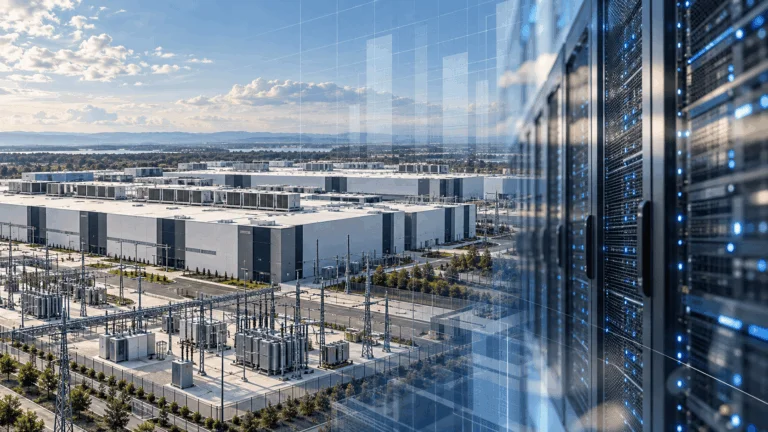


The question defining the next decade of AI may have less to do with which company builds the smartest model and more to do with who can finance and build the physical and digital infrastructure sitting beneath it. Capital is now flowing at unprecedented speed into data centers, semiconductors, networking, cloud capacity, and electricity systems, and governments increasingly treat AI compute as a strategic national asset rather than a purely commercial one. What follows is a look at the forces reshaping AI infrastructure investment, geography, and design over the coming years.
THE INVESTMENT STORY HAS MOVED PAST VENTURE CAPITAL
For the past few years, AI investment headlines centered on venture funding for frontier model developers. That story has changed. Global AI venture capital investment reached $430 billion in the first half of 2026 alone, already surpassing the full-year 2025 total of $254 billion, but a growing share of that capital is now aimed squarely at the infrastructure underneath enterprise AI adoption rather than at model developers themselves. AI data center infrastructure spending is projected to reach $2.9 trillion between 2025 and 2028, a figure that would have triggered serious bubble concerns just two years ago and today barely raises eyebrows given how thoroughly the market has priced in sustained infrastructure investment alongside continued strong earnings from leading tech companies.
Sovereign wealth funds have become a major new source of that capital. State-backed investors deployed $66 billion into AI and digitalization projects in 2025, underwriting major data center projects and domestic AI capability, with investment on track to surpass $100 billion in 2026. New financing structures are emerging too, including large structured platforms built specifically to fund high-end chip purchases through partnerships between private equity, chipmakers, and asset managers.
THE SOVEREIGN AI RACE IS RESHAPING WHERE INFRASTRUCTURE GETS BUILT
Nowhere is the sovereignty trend clearer than in Europe, where the European Union has assembled a coordinated set of initiatives, including an AI Continent Action Plan, an Apply AI Strategy, and a network of AI Factories and Gigafactories backed by a €20 billion InvestAI facility, all aimed at building domestic AI infrastructure and narrowing the gap with the United States and China. The plan calls for 19 AI Factories, 13 so-called Antennas, and as many as five AI Gigafactories, alongside a doubling of annual AI research funding under the Horizon Europe program. Early results suggest the push is gaining traction: direct funding into European AI enterprises reached €21.3 billion in the first five months of 2026 alone, already surpassing the full-year 2025 total, with AI companies now accounting for roughly 40 percent of all venture transactions across the continent.
That sovereignty logic increasingly shapes where individual countries can compete. Ireland, for instance, effectively paused new data center construction from 2021 onward after its energy regulator blocked new grid connections around Dublin, only lifting the moratorium in late 2025 under a policy requiring operators to bring their own on-site generation or battery storage capable of meeting their full electricity demand. Countries with existing talent pools, energy infrastructure, and research ecosystems are positioning themselves as regional AI hubs precisely because the infrastructure layer, not model access, has become the binding constraint on national AI competitiveness.
DENSITY AND EFFICIENCY ARE REPLACING RAW SCALE AS THE MEASURE OF PROGRESS
For years, the assumption behind AI infrastructure was straightforward: build more data centers, install more chips, and growth would follow. That calculus is shifting toward a harder question of efficiency. Rather than simply adding more physical capacity, the next wave of infrastructure investment is increasingly about packing computing power more densely across distributed networks and routing workloads dynamically so that no capacity sits idle. The comparison often used is air traffic control for AI workloads: computing power gets packed more densely and routed in real time, so that if one job slows, another moves in instantly and no cycle or watt goes to waste. The result is a new generation of linked AI “superfactories” designed to drive down the cost of intelligence per unit of output rather than simply the cost of raw compute capacity.
That efficiency mindset extends to the chip layer as well. Enterprises adopting AI at scale are increasingly favoring domain-specific and cost-efficient accelerators such as ASICs and chiplet-based architectures over uniformly deploying the most powerful, most expensive chip available for every task, mirroring the same logic that has pushed enterprises toward multi-model strategies that route simple requests to smaller models and reserve frontier compute for genuinely hard problems.
THE PHYSICAL FOOTPRINT IS EXPANDING INTO NEW ENVIRONMENTS ENTIRELY
As land-based data centers run into power, water, and permitting constraints, infrastructure planners are exploring environments that would have sounded implausible just a few years ago. China brought the world’s first wind-powered underwater data center project into operation off the coast of Hainan Province in June 2026, a facility built with roughly $235 million in investment and 24 megawatts of power capacity, designed to comprise around 100 modular units across nearly 70,000 square meters. The appeal is straightforward: ocean water offers free, constant cooling for heat-intensive AI racks, cutting both the energy and fresh water that land-based cooling systems consume, while offshore wind can supply the facility with electricity that never touches a constrained regional grid.
Orbital computing is drawing similar interest, with several ventures now planning satellite-based data center networks that would use the cold vacuum of space and continuous solar exposure to process AI workloads without drawing on terrestrial power or water at all. Whether that concept scales into a genuinely transformative layer of AI infrastructure or remains a technically impressive niche will likely come down to a familiar tension: the economic, environmental, and regulatory costs of large-scale deployment weighed against the very real land, water, and power constraints these projects are designed to escape.
GOVERNANCE AND SECURITY ARE BECOMING INFRASTRUCTURE, NOT AN ADD-ON
As AI agents take on a larger share of daily enterprise work, security experts increasingly argue that every agent needs the same kind of identity, access controls, and monitoring traditionally reserved for human employees, precisely so autonomous systems don’t become unchecked liabilities inside an organization. That shift is already showing measurable returns. Companies that have implemented AI governance frameworks are pushing roughly twelve times more AI projects into production than those without them, and organizations using dedicated evaluation tools get nearly six times more projects across the finish line. Governance spending itself has become one of the fastest-growing categories in enterprise AI budgets, expanding sevenfold in under a year, evidence that trust and oversight infrastructure is now viewed as a prerequisite for scaling AI rather than a compliance afterthought bolted on at the end.
THE COMPUTE LAYER IS STARTING TO CONVERGE WITH QUANTUM
Looking further out, several major technology providers now describe quantum computing as entering a “years, not decades” timeline toward practical advantage on specific classes of problems that classical computers handle poorly. Rather than replacing classical AI infrastructure, the emerging model is hybrid: quantum systems handle certain optimization and simulation problems, classical supercomputers run large-scale simulations, and AI systems find patterns across both, combined into unified quantum-centric supercomputing architectures. Several major chipmakers and cloud providers are already exploring joint quantum and AI hardware roadmaps, treating quantum readiness as a long-horizon infrastructure investment rather than a speculative side project.
WHAT SUCCESS WILL ACTUALLY REQUIRE
Executives surveyed across sectors describe an environment where technology plans risk becoming outdated before they’re even implemented, and where returns on AI infrastructure investment vary dramatically depending on governance discipline, execution quality, and organizational agility rather than sheer spending. Most large organizations report bold plans to raise their technology maturity in 2026, even as tech debt, cost pressures, and talent shortages continue to hold many of them back. High-performing organizations expect roughly half of their technology teams to remain permanent human staff even as AI-augmented systems take on a growing share of the work, suggesting the winning model over the next decade isn’t full automation but a smaller, durable human core orchestrating much larger AI-augmented infrastructure and workflows around it.
THE OUTLOOK
None of these trends point toward a single, tidy endpoint. Infrastructure investment is scaling into the trillions of dollars even as sovereignty concerns fragment where and how that capacity gets built, efficiency and density are starting to matter as much as raw scale, and organizations are being forced to build governance and security directly into their infrastructure rather than adding it later. What ties all of it together is a shift in how the industry defines progress. For much of the past decade, more compute simply meant more capability. Over the next one, the organizations and countries that actually capture AI’s value will be the ones that treat infrastructure not as a cost of doing business but as the strategic layer that determines everything built on top of it.
References
Young, G. “How Infrastructure Is Shaping the Next Phase of AI Investment.” EY, August 26, 2026. https://www.ey.com/en_ie/insights/strategy-transactions/how-infrastructure-is-shaping-the-next-phase-of-ai-investment
“From Orbit to Ocean: The Future of AI Infrastructure.” ISPI, June 30, 2026. https://www.ispionline.it/en/publication/from-orbit-to-ocean-the-future-of-ai-infrastructure-240529
“The Trends That Will Shape AI and Tech in 2026.” Spherical Insights, May 2026. https://www.sphericalinsights.com/blogs/the-trends-that-will-shape-ai-and-tech-in-2026
“KPMG Global Tech Report 2026: Leading in the Intelligence Age.” KPMG International, January 2026. https://kpmg.com/xx/en/our-insights/ai-and-technology/global-tech-report.html
Cvetko, J. “What’s Next in AI: 7 Trends to Watch in 2026.” Microsoft Source, December 10, 2025. https://news.microsoft.com/source/emea/features/whats-next-in-ai-7-trends-2026/