
Insider Brief
- BlackRock says stablecoins, tokenized assets and blockchain payment protocols could help AI agents buy data, services and computing capacity in an increasingly automated economy.
- The report identifies emerging tools such as Coinbase’s x402 and payment protocols from Stripe, Google and Visa as early efforts to enable authorized, machine-to-machine transactions.
- BlackRock also sees a potential future market for standardized claims on compute capacity, though it says technical, regulatory and market-design hurdles remain.
Crypto could become part of the payment and settlement infrastructure behind a growing artificial intelligence (AI) economy, according to a new BlackRock report examining how autonomous software agents may buy data, services and computing power.
The white paper, The Machine-Native Economy, makes the case that artificial intelligence and digital assets are moving from parallel technology trends toward more of a shared economic system. AI supplies the intelligence to interpret information and make choices while blockchains and tokenized assets could provide the programmable money, ownership records and settlement mechanisms needed when machines transact with other machines, according to BlackRock.
The thesis depends generative AI systems becoming increasingly being designed not simply to produce text, images or code, but to carry out multi-step tasks using outside tools. These “agents” — as they’re called — could compare prices, call paid software interfaces, reserve computing capacity, arrange travel or complete a purchase within limits set by a human user.
However, existing financial rails work well for most consumer and business transactions, but BlackRock suggests they can be less suited to an economy of always-on, high-volume and very small machine-to-machine payments. Stablecoins, tokenized real-world assets and blockchain-based payment protocols may offer an alternative for some uses, particularly where transactions need to be automated and settled around the clock.
The report does not say this system has arrived, but, rather, describes agentic payments and markets for tokenized computing capacity as early-stage developments. The company does, however, position them as potential sources of demand and utility for digital assets beyond trading and speculation.
AI Agents Need a Way to Transact
The central idea is that an AI agent cannot operate independently in the economy if it cannot pay for what it needs.
A travel-planning agent, for example, may need to query airline, hotel and mapping services, some of which charge for data or software access. A business agent may need to purchase market data, use a specialized model or rent additional computing power to complete a task. Each interaction could require a payment, sometimes for only a fraction of a cent.
Traditional payment systems can automate significant portions of this process. Yet card networks, bank accounts and automated clearinghouse transfers often involve account setup, credential checks, merchant fees and settlement processes built for human customers and conventional businesses. Those features can make them less economical or less flexible for thousands of small, recurring transactions generated by software.
BlackRock points out that blockchain-based instruments are designed differently. Stablecoins are digital tokens intended to maintain a stable value against a reference currency, usually the U.S. dollar. They can be transferred through software rules known as smart contracts, which are programs that carry out a transaction when defined conditions are met.
That combination could allow an agent to pay for a service, verify that payment and receive the requested data or resource with limited human involvement. The report identifies stablecoins as the likely leading payment instrument because their more stable value makes them more practical for pricing and settlement than volatile cryptoassets.
The opportunity is not entirely theoretical, as BlackRock cites data showing that stablecoins had more than $300 billion in circulating market capitalization as of September 2026. Adjusted stablecoin transaction volume exceeded $11 trillion in 2025, according to the report. It’s necessary to add that these figures are not directly comparable with card-network volumes because each system measures activity differently.
The report said adjusted stablecoin volume grew at an 80% compound annual rate from 2020 through 2025, compared with roughly 8.5% for the ACH network. It noted that adjusted measures attempt to filter out internal transfers, exchange flows, bots and other activity that can inflate blockchain transaction totals.
That does not establish that stablecoins have become a mainstream consumer-payment system. ACH transferred about $93 trillion in 2025, BlackRock reports, and cards remain deeply embedded in commerce. But the growth of stablecoin use and the development of clearer rules in the U.S., Europe, Hong Kong and Singapore could give the technology a larger role in cross-border and automated transactions.
The Protocol Layer for Machine Commerce
The report’s argument is not that a chatbot will automatically be handed a crypto wallet and allowed to spend freely. A functional system would need authorization, identity checks, transaction limits, fraud controls and records that show what the user permitted the agent to do.
Several emerging protocols are intended to address parts of that stack.
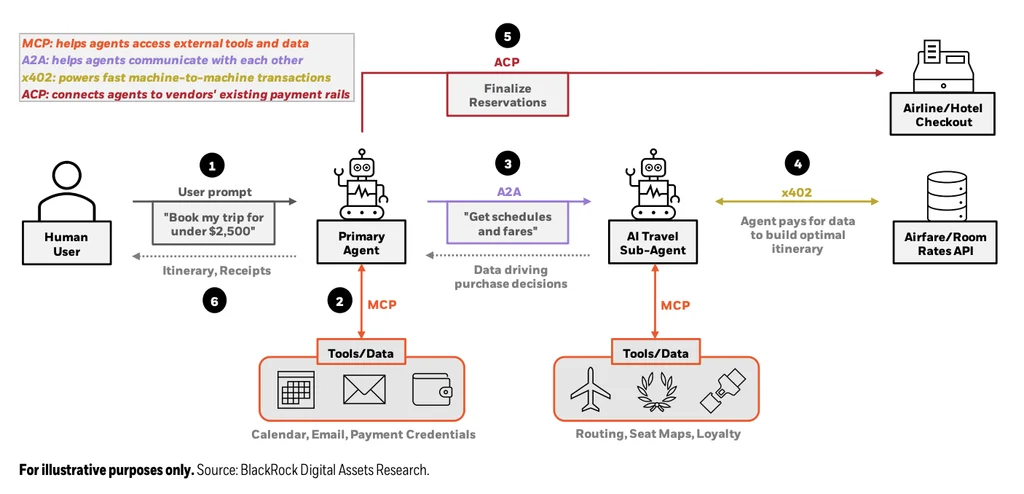
Model Context Protocol, or MCP, helps AI applications connect to outside data and tools. Google’s Agent2Agent protocol, known as A2A, is designed to help separate agents communicate and coordinate. These standards can enable an agent to access calendars, inventory systems, software services or specialized agents that handle particular tasks.
Payment protocols add a commercial layer, according to the report. BlackRock highlighted x402, an open protocol developed by Coinbase that uses the HTTP 402 “Payment Required” web status code. In a basic use case, a data provider can require payment before releasing an API response or other digital resource. The agent pays using a supported digital currency, potentially a stablecoin, and receives access after payment is confirmed.
The report also cited the Machine Payments Protocol from Stripe and Tempo, which can support payment for APIs and web resources using stablecoins or more traditional payment methods. Stripe and OpenAI’s Agentic Commerce Protocol is aimed at helping agents complete programmatic checkouts while merchants retain their existing commerce infrastructure.
Other projects are approaching the problem from the authorization side. Google’s Agents Payment Protocol uses cryptographic mandates and audit trails to document user permission, while Visa’s Trusted Agent Protocol is designed to help merchants verify agents and receive payment credentials securely.
These standards remain fragmented and young. Their adoption will depend on whether merchants, financial institutions, AI developers and regulators accept common rules for liability and customer protection. The question is particularly important when an agent is permitted to make a purchase but misunderstands a request, uses compromised credentials or takes action beyond its assigned budget.
BlackRock acknowledged that anti-money-laundering, know-your-customer and emerging know-your-agent checks would generally take place off-chain. In other words, blockchains may record and enforce a verified transaction, but regulated institutions and identity systems would still need to determine who is behind an account or agent and whether the transaction is allowed.
Compute Could Become a Digital Asset Market
The report’s more ambitious argument concerns computing capacity itself.
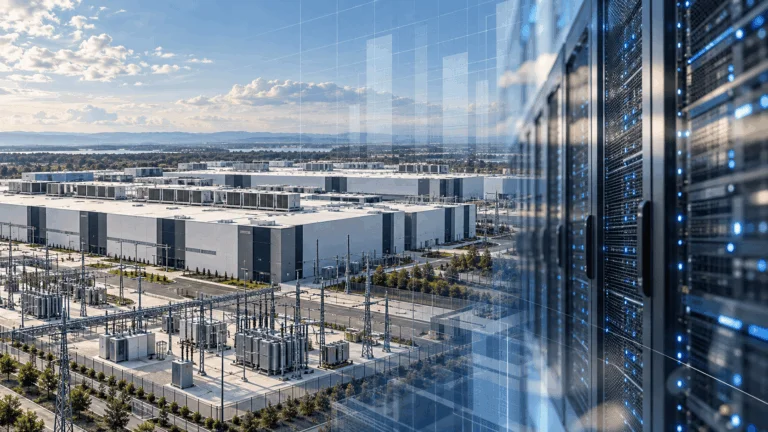
AI systems require enormous amounts of processing power and electricity. The early AI investment narrative has focused largely on the capital cost of data centers, chips and power infrastructure. BlackRock contends that the operating market for compute—the ability to access and use those resources—may become an important economic resource in its own right.
The firm used revenue estimates for Amazon Web Services, Microsoft’s Intelligent Cloud segment and Google Cloud as a broad indicator of the opportunity. Consensus analyst estimates compiled by Bloomberg, according to the report, imply combined revenue of about $1.1 trillion by 2030, up at a 29% compound annual growth rate from 2025 levels.
As AI agents become more widely used, they may need to select compute based on price, location, speed, available hardware and the requirements of a particular task. An agent carrying out a low-cost summarization job might choose one model and one server provider. An agent running a more demanding scientific, financial or coding task might need more powerful graphics processing units, or GPUs, and may pay a different rate.
BlackRock says that could eventually lead to more standardized claims on computing capacity. Such claims could potentially be transferred, used as collateral, financed or settled through programmable systems. In that scenario, a company could reserve a certain amount of GPU time, hedge exposure to changing compute prices or finance new infrastructure against long-term usage agreements.
The analogy is to other large resource markets, where standardized contracts help buyers and sellers manage price risk and improve liquidity. But the report also identifies major obstacles. Compute is not a uniform commodity. A newer chip may deliver far more useful work than an older one. Electricity costs vary by region. Network latency, data-center reliability, model compatibility and local regulation can affect the value of a computing resource.
Those differences make a universal compute contract difficult to design. BlackRock suggests that region-specific and hardware-specific contracts, along with mechanisms such as contracts for difference and basis markets, could help address the problem over time.
For now, the market is still taking shape. The report pointed to GPU-backed financing and long-term, usage-linked compute financing as early evidence that investors and infrastructure providers are treating access to advanced compute as a distinct economic asset.
BlackRock’s report offers a plausible framework for how crypto may support the AI economy, but it should not be read as a forecast that blockchains will replace banks, card networks or cloud providers.
The clearest near-term opportunity may be narrow: software agents paying for digital services, data and compute where speed, automation and small transaction sizes matter. Stablecoins could fit those cases because they are programmable, available at all hours and designed for direct digital transfer.
The broader vision — liquid markets for tokenized compute capacity and autonomous agents provisioning resources across providers — will require far more than a payment rail. It will require trusted identity systems, compliance rules, technical standards, reliable data about service quality and clear recourse when something goes wrong.