
Insider Brief
- A Deutsche Bank Research Institute report says history shows that technology forecasts often misjudge the timing, adoption and social effects of new tools, a pattern relevant to today’s AI debate.
- The report cites failed predictions involving the internet, smartphones, radiology and autonomous vehicles to show that technical progress does not automatically lead to rapid, broad real-world use.
- It argues that AI’s effects will depend on factors including cost, regulation, workflow integration, safety, public trust and the decisions of companies and governments.
Whether you’re a doomer or a zoomer, a new report outlines how technology forecasts can often get the destination right while badly missing the route.
Warnings that artificial intelligence (AI) could erase jobs, remake the economy or ultimately threaten human survival have become a central part of the technology debate. So have equally sweeping claims that the systems will cure disease, lift productivity and solve problems that have resisted conventional computing.
A report from the Deutsche Bank Research Institute reports that both camps should be more cautious about confident forecasts. History shows that scientists, executives and investors have repeatedly struggled to predict not only what a technology can do, but when it will be widely used and how it will change daily life.
AI concerns aren’t unimportant as AI systems already raise practical questions involving fraud, deepfakes, cyberattacks, intellectual property, energy use and the concentration of power in a small number of companies. The report’s point, however, focuses on how specific predictions about a technology’s social and economic effects are usually less reliable than they appear.
It’s an idea that can help guide the debate over AI as it increasingly turns on forecasts rather than demonstrated outcomes. Some researchers and executives warn that increasingly capable systems could become difficult to control. Others argue that the immediate danger is overstated and that attention should remain on harms that are already visible.
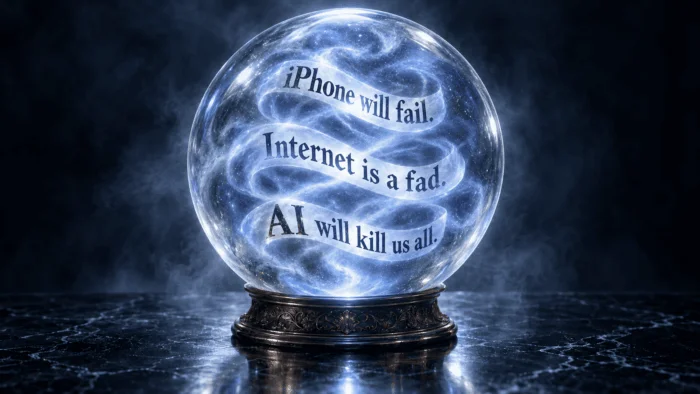
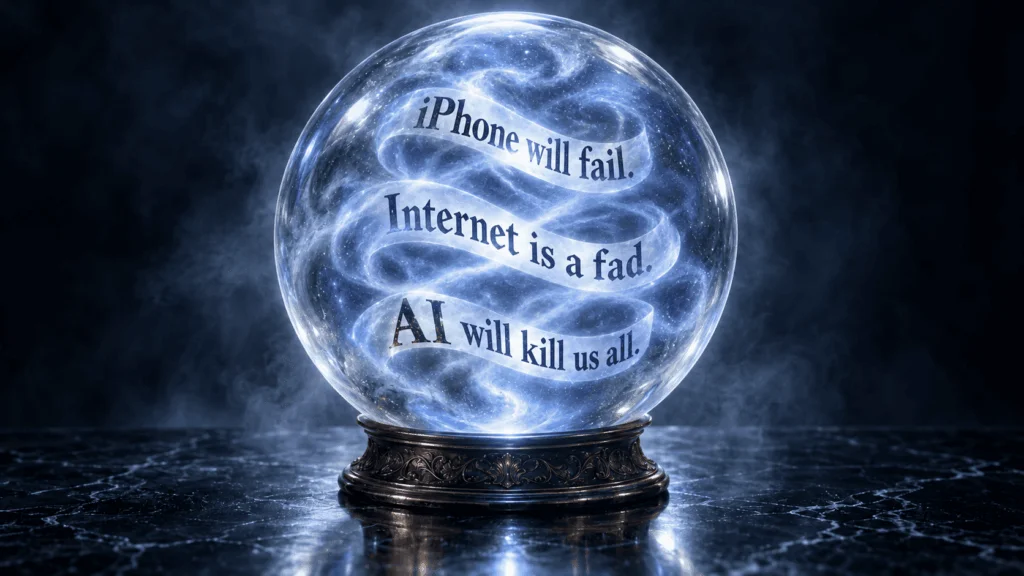
The Deutsche Bank report places that dispute in a longer history of mistaken technology predictions. In 1995, Ethernet co-inventor Bob Metcalfe predicted that the internet would collapse under its own weight the following year. After it did not, he publicly blended a copy of his article and drank it at a conference.
Other predictions failed in the opposite direction. Microsoft Chief Executive Steve Ballmer dismissed the iPhone in 2007 as unlikely to gain significant market share. Geoffrey Hinton, one of the researchers most associated with modern AI, said in 2016 that people should stop training radiologists because AI would soon outperform them at reading medical images.
It turns out that radiology did change, but not as Hinton predicted. AI tools have been incorporated into some parts of medical imaging, while radiologists continue to perform work involving diagnosis, communication with patients and physicians, clinical judgment and responsibility for treatment decisions. Technology has become a helper, not a usurper, in other words.
The analysts write: “Technologists are not immune from making category errors, mistaking the most visible, automatable component of a job for the job itself. For example, radiologists, a favourite case study for believers in a jobs apocalypse, do much more than looking at images and making binary diagnoses. Much of their value lies in interpretation, judgement, communication and clinical decision-making.”
Capability Is Not Adoption
The gap between a working technology and a widely adopted one is where many predictions fail.
Autonomous vehicles offer a familiar example. The technology has made measurable progress and commercial robotaxi services now operate in limited areas. Yet the broad replacement of human drivers has been delayed by difficult conditions on the road, safety requirements, liability questions, local regulation and public trust.
The same factors could shape AI’s impact on office work. A model may summarize documents, write software code or answer customer questions. But deploying it across a large company requires managers to decide where it can be trusted, how its output will be checked, who is responsible when it makes an error and whether the savings justify the cost.
The report suggests that the future of AI may depend less on the release of another model with somewhat stronger performance than on whether companies can integrate the systems into workflows that people will pay for and use.
That is a less dramatic story than an AI takeover or an immediate economic boom and, as the analysts point out, it’s is also the pattern that has shaped many previous technologies.
Computers were once described as a threat to clerical workers. Pocket calculators were said to risk making students dependent on machines. Cloud computing drew widespread concerns about privacy and security before businesses placed much of their core infrastructure on remote servers.
Those worries were not necessarily irrational. Each technology created new problems as well as new uses. But the final result was determined by choices made by companies, workers, customers and governments, not by technical capability alone.
Why the Forecasts Go Wrong
The report identifies several reasons predictions are unreliable.
One is the tendency to treat complex systems as though they move in straight lines. AI capability can improve rapidly as companies add computing power, training data and engineering work. But adoption involves interacting variables: labor markets, regulation, prices, corporate priorities and public response.
Another is the tendency to focus on the most visible part of a job and mistake it for the whole job. Reading an X-ray is part of a radiologist’s work. It is not the entirety of what a radiologist does. The same problem applies to forecasts about lawyers, teachers, programmers, financial analysts and other knowledge workers.
A third problem is that people often judge a new technology using the business model and habits of the old one. Ballmer’s assessment of the iPhone did not account for the role that carrier subsidies would play in making a high-priced device more accessible to consumers, according to the report.
AI forecasting carries an additional difficulty because current systems can produce convincing language, images and software while also making basic mistakes, fabricating information or failing when conditions change. That makes it hard to draw a direct line from an impressive demonstration to reliable use in medicine, finance, defense or other high-consequence settings.
Incentives for dire predictions and hopeful hype can also cause forecasts to go off track.
The analysts write: “Most participants have incentives to amplify the stakes. Founders need belief, investors need momentum, incumbents need gravitas, consultants need urgency, policymakers need relevance, executives need a narrative and journalists need drama. This is not a criticism of individuals or organisations, or even of the likely revolutionary impact of AI.”
What this means is that measured assessments often receive less attention than more dramatic claims about AI’s promise or danger.
Risk Still Requires a Response
The analysts make sure to note that a record of bad predictions is not an argument for ignoring risk.
AI tools can already make phishing and impersonation campaigns cheaper to run. They can produce realistic false images and audio. They raise legitimate questions about surveillance, data rights, labor displacement and whether a handful of companies should control systems with broad economic and political influence.
Those problems do not require a belief that an AI system will become superintelligent or cause human extinction. They are present-day governance questions that can be investigated, measured and addressed through technical safeguards, laws and organizational controls.
The larger claims deserve scrutiny, too. Researchers who warn about catastrophic AI risks are raising questions about whether systems could be given too much autonomy, access to critical infrastructure or the ability to help users develop dangerous biological or cyber capabilities.
But scenarios should not be confused with forecasts. A possibility is not a timetable, and a technical advance is not proof that a particular social outcome will follow.
The Deutsche Bank report quotes computer scientist Roy Amara’s observation on tech predictions: “We overestimate the impact of technology in the short-term and underestimate the effect in the long run.”