Nvidia Expands South Korean Physical AI Work With Samsung, LG and Kakao Mobility
 By Greg Bock · · 3 min read
Insider Brief
- Nvidia is expanding its collaborations with Samsung Electronics, LG Electronics and Kakao Mobility to apply AI and accelerated computing to semiconductor engineering, industrial robotics and autonomous driving in South Korea.
- Samsung reported a roughly 1,600-fold speedup in one semiconductor simulation using AI and GPU acceleration, reducing processing time from about 18 hours to 41 seconds with a less detailed simulation grid.
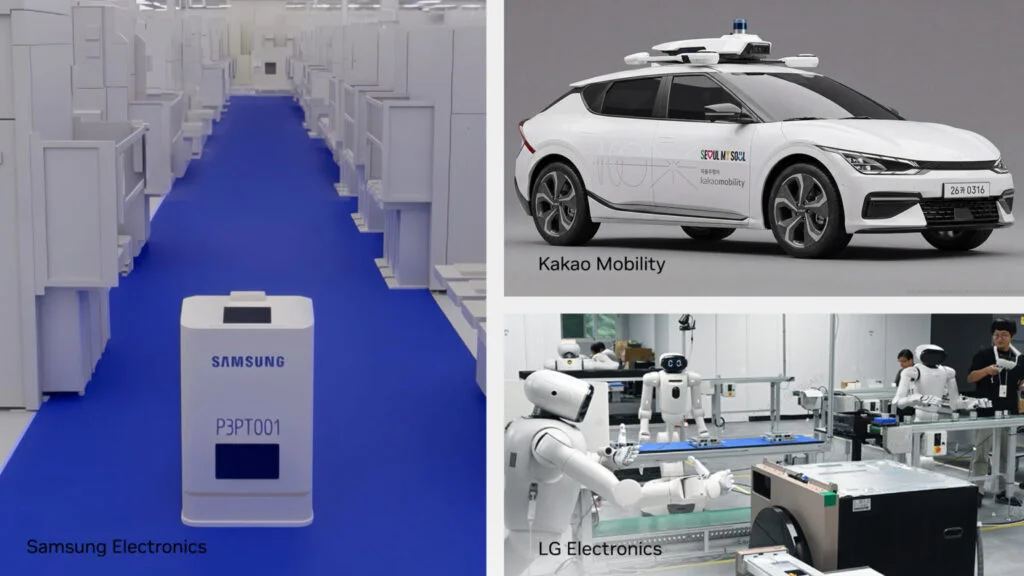
- Kakao Mobility plans to integrate Nvidia technology into a Level 4 autonomous driving system, while LG demonstrated manufacturing tasks using its CLOiD robot powered by Nvidia’s Isaac GR00T models.
Nvidia is working with three major South Korean companies to apply physical AI and accelerated computing to semiconductor manufacturing, autonomous driving and industrial robotics.
According to Nvidia, the projects involve Samsung, LG Electronics and Kakao Mobility, which are using different parts of Nvidia’s computing, simulation and AI software platforms. The work ranges from speeding up chip design calculations to training robots for manufacturing tasks and developing self-driving vehicles.
Samsung Speeds Up Semiconductor Engineering
Samsung Electronics is using Nvidia computing tools to improve semiconductor research and engineering, including materials analysis, manufacturing process simulations and device development.
The companies are working with Nvidia’s cuISS and cuDSS software libraries to speed up complex calculations used in semiconductor design and engineering. Their collaboration also includes GPU acceleration for manufacturing process and optical simulations.
In materials research, Samsung’s sMOL platform completed selected quantum chemistry calculations up to five times faster using Nvidia cuEST, according to the announcement. Samsung is also exploring cuEquivariance to accelerate calculations used in training and running AI models that analyze materials at the atomic level.
Another project focuses on how semiconductor devices respond to heat and mechanical stress. Using Nvidia PhysicsNeMo, Samsung combined AI-predicted material properties with a less detailed simulation grid and GPU acceleration. Nvidia reported that the approach reduced one analysis from approximately 18 hours on a 32-core CPU to 41 seconds on a GPU, a roughly 1,600-fold speedup.
The comparison involved different simulation methods and resolutions. The CPU performed a detailed calculation, while the GPU used a coarser grid and AI-generated material estimates. Nvidia said its Agent Toolkit could eventually connect the simulation tools and AI models, allowing future engineering agents to run analyses and compare design options.
Kakao Mobility Develops Level 4 Autonomous Driving
Kakao Mobility plans to combine its autonomous driving software with Nvidia’s vehicle computing and safety technologies to develop a Level 4 self-driving system. The South Korean company will draw on its experience operating in Seoul’s Gangnam district while incorporating Nvidia Hyperion, a reference platform for vehicle sensors and computing powered by the DRIVE AGX Thor processor.
Kakao also plans to use Nvidia Halos to support safety testing and validation throughout development. Initial work will focus on Kia purpose-built vehicles equipped with Kakao Mobility’s driving software and Nvidia technology. The companies intend for the project to support future Level 4 mobility services in Korea.
LG Demonstrates Robot Learning in Factory Operations
LG Electronics and Nvidia have demonstrated robotic manipulation and manufacturing tasks using LG’s CLOiD robot in an actual manufacturing environment. The demonstration used Nvidia’s Isaac GR00T robotics AI models and a process that connects data collected from physical operations with model training and simulation.
According to Nvidia, the companies used its Cosmos technology to augment real-world training data before using that information to train GR00T models. The system also incorporates Nvidia Jetson AGX Thor for onboard computing.
Simulation-based evaluations allow the teams to assess the robot’s performance as they refine its capabilities.
LG and Nvidia are using the demonstration to develop a repeatable process for collecting data, training models and evaluating CLOiD’s performance on manufacturing tasks.