Swiss Robotics Startup coprod Raises $6M in Pre-Seed Funding to Simplify Custom Robot Hardware Development
 By Greg Bock · · 3 min read
Insider Brief
- Swiss robotics startup coprod has raised $6 million in pre-seed funding to develop compatible hardware and software that help engineers build customized humanoid and other robots faster and at lower cost.
- Founderful and Prototype led the round, with proceeds supporting a new prototyping facility in Lausanne and the commercial launch of coprod’s co:system platform and modular hardware components in early 2027.
- coprod claims its technology could reduce custom robot development from two to three years to several months, and its components are already being used in Swiss robotics projects, including a humanoid developed by the ETH Robotics Club.
Swiss robotics startup coprod has raised $6 million in pre-seed funding to help developers build customized hardware for humanoid and other robots, using compatible components to reduce development time and costs.
Founderful and Prototype led the round, with participation from General Catalyst, Pace Ventures, Tiny Supercomputer Investment Company, Kima Ventures, SDAC, Unruly Capital and Venturekick, according to coprod. Angel investors included Thomas Wolf, founder of Hugging Face, the Dassault family and Florent Perrichon. The Lausanne-based company indicated it will use the funding to establish a hardware prototyping facility and bring its first components to market in early 2027.
Addressing Integration Hell
A problem in the robotics industry coprod referred to as “integration hell” is the lengthy and expensive process of making components from different suppliers work together. Motors, sensors, power systems and other hardware often use different communication protocols, requiring engineers to develop custom electronics and software connections. Each interface must be tested and validated before the robot can operate reliably.
To tackle the issue, coprod combines compatible hardware modules with a common software interface and configuration tool. The system standardizes communication between components while maintaining the real-time performance required for robotic operations.
Its technology, called co:system, combines compatible hardware modules, called co:products, with a common software interface that allows engineers to design robots with physical configurations tailored to specific tasks. The lineup includes co:power, co:battery, co:sensor and co:motion. Each module can operate within the complete system or be integrated individually into other robotic platforms.
“We believe that a robot with purpose-built hardware designed for a specific task will do that task faster, cheaper and more reliably than any general-purpose robot ever could, regardless of which model runs on it,” co-founder and CEO Loïc Delineau said in the announcement. “We see robotics as just another tool that humans should be able to leverage to improve their daily lives. This starts by empowering them to build those robots by abstracting away complexity, and coprod is offering this fertile ground.”
According to coprod, developing a robot with custom hardware typically requires two to three years and dozens of specialized engineers. The company claims its approach could reduce that process to several months using smaller teams, with individual design iterations costing between $5,000 and $25,000.
The company said its components are already being used in several Swiss robotics projects, including what it describes as the country’s first student-built humanoid robot, developed by the ETH Robotics Club. The robot recently took its first steps in Zurich.
Humanoid development is one area where specialized components are in demand, the company noted, citing a McKinsey analysis estimating that the market for humanoid actuators, sensors and control systems could reach $28 billion by 2030.
What’s Next?
The planned Lausanne facility will include machining, electronics assembly and testing equipment. coprod expects it to shorten its internal prototyping cycles from two weeks to 24 hours. Testing equipment will also help the company provide detailed specifications and digital models of its components, allowing engineers to compare simulated designs with physical hardware performance.
By the end of 2027, coprod plans to have its full component lineup commercially available and certified, and large-scale production is planned for Shenzhen, China, and Texas, with headquarters and research operations remaining in Switzerland.
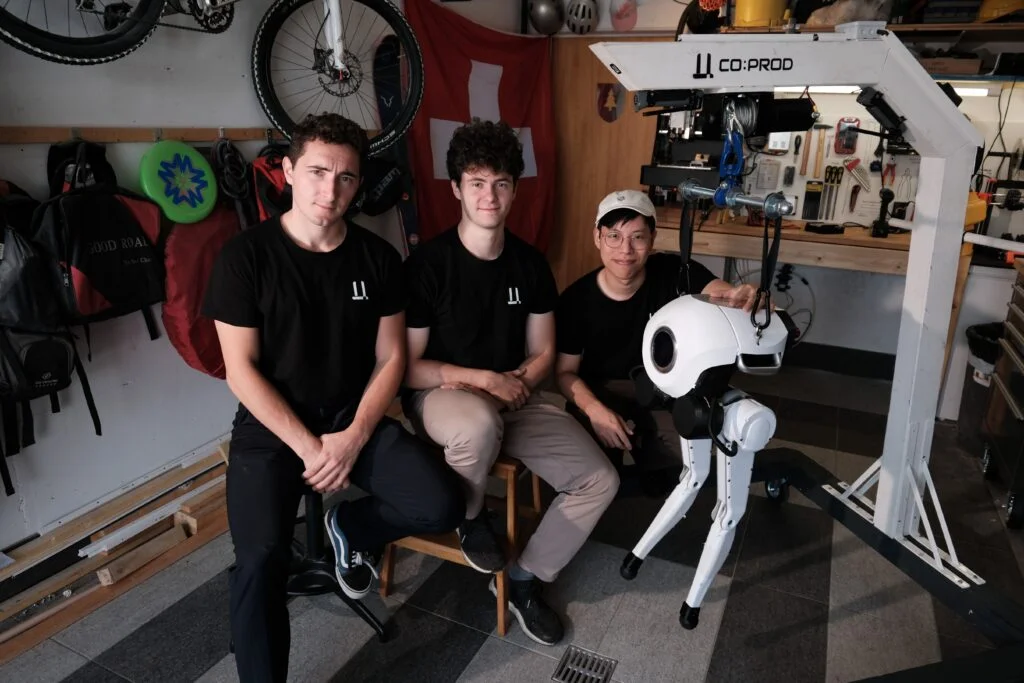
Founded in late 2024 by graduates of the École Polytechnique Fédérale de Lausanne, coprod began by building a bipedal robot demonstrator to test its hardware approach.