
Insider Brief
- Tesla is building a dedicated Optimus production line in Fremont, Calif., with initial output expected later this year, though CEO Elon Musk said scaling the humanoid robot will be harder than any manufacturing program the company has attempted.
- The company is developing Optimus to perform generalized tasks from spoken instructions or demonstrations, using the same end-to-end AI approach as Full Self-Driving and training data from internet video, factory workers and its planned Optimus Academy.
- Tesla is building much of the supply chain from scratch, with suppliers including Samsung, TSMC, Panasonic and Micron supporting chips, batteries and memory, while the company has discussed eventual annual capacity of 1 million Optimus 3 units and 10 million Optimus 4 units.
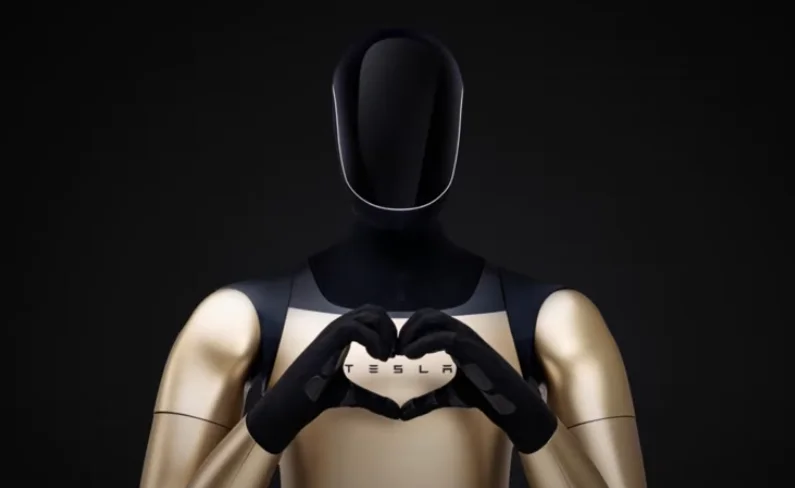
Tesla is building a dedicated line for its Optimus humanoid robot in Fremont, Calif., with production later this year, but CEO Elon Musk warned that scaling the system will be harder than any manufacturing program the company has attempted.
Musk told investors during Tesla’s Wednesday earnings call that Optimus is the company’s most ambitious project and could ultimately become Tesla’s largest product, but sought to temper expectations about the pace of the rollout. The company must work out the robot’s intelligence, mechanical design and supply chain at the same time before it can move from limited production to large-scale deployment.
Musk warned that while Optimus will follow a typical S-curve as far as production, “the initial portion of the S-curve will be be quite flat and long,” because unlike Tesla’s vehicles, Optimus cannot rely on an established supply chain for most major components.
“This is going to be the hardest to scale in manufacturing that we’ve ever made at Tesla because everything on the robot is new and the difficulty of scaling the production ramp is proportionate to the newness of the parts of the robot,” Musk said.
Tesla wants Optimus to complete work after receiving a spoken instruction or watching a demonstration, without requiring task-specific programming. Musk said the company’s goal is to move beyond controlled demonstrations and produce a robot that can perform useful, generalized tasks in factories and homes.
“You’ve probably seen lots of impressive demonstrations of robots on the internet, but those demonstrations you see are pre-programmed or remote controlled, so there is no humanoid robot that can actually do generalized tasks,” Musk said. “Optimus will be the first one that is capable of doing that. Where it’s not just a demo, it’s genuinely useful in day-to-day life.”
The robot is being designed with human-level hand dexterity, with Tesla eventually targeting capabilities beyond those of a person. The company must also ensure Optimus can withstand extended use without frequent breakdowns or unpredictable behavior, Musk said.
As far as the AI software Optimus will require, Musk said he is confident..
“And it’s the same team that produced FSD, you know, the 12, 13, 14 and now the V15 software,” Musk said. “That now works on Optimus as well. Hence, I’m extremely confident that Optimus will be an extremely capable robot.”
The Optimus Supply Chain
Karn Budhiraj, Tesla’s vice president of supply chain, pointed out that the company has brought a substantial amount of production in-house while working with suppliers on specialized components including metal-injection-molded parts, flexible printed circuits and other technologies outside the traditional automotive supply chain.
Tesla is also relying on major suppliers to support the program. Musk pointed out that Samsung and TSMC are expanding semiconductor capacity in Texas and Arizona respectively, while Panasonic also has invested “many billions” in increasing battery cell prduction. Micron has also provided Tesla with future memory allocations.s.
“Also wanted to thank Micron for giving us memory allocation,” Musk said. “They’ve got to make some very tough decisions on memory allocation and we appreciate Micron making room for Tesla in years to come and giving us very significant allocation on reasonable terms given the pretty insane pricing of memory these days.”
The company noted the Fremont Optimus line is being installed in space previously used for Model S and Model X production. Musk also discussed eventually reaching annual production of 1 million Optimus 3 units, while a more vertically integrated Optimus 4 program planned for Austin, Texas, could target 10 million units a year.
Training Optimus
Ashok Elluswamy, Tesla’s vice president of AI, said the robot will use the same end-to-end strategy as the company’s driving software, converting camera inputs directly into physical actions. The long-term goal is for users to assign a complete task and allow Optimus to carry it out without additional guidance.
Tesla is taking an approach similar to its Full Self-Driving program to train the robot. Optimus will learn from internet video, demonstrations performed by Tesla factory workers and higher-quality examples collected by a dedicated data team.
The company indicated it also plans to have large numbers of robots practice tasks in what it calls the Optimus Academy. Data from successful and failed attempts would feed a reinforcement-learning loop intended to improve performance over time.
“The data from the bots experiencing the task themselves will be invaluable and help us close any minor form factor gaps that may exist between the bot and the humans,” Elluswamy said. “This is also when the reinforcement learning loop kicks in where the bot initially attemts some task, fails sometimes, learns from both the successes and failures of those tasks and eventually learns to master those tasks at perhaps a superhuman level.”
Tesla shares fell about 14% the day after earnings and a total of 18% for the week to close Friday at $313.03, its worst weekly decline since 2022, after second-quarter adjusted earnings of 33 cents a share missed the 51-cent LSEG estimate despite revenue of $28.24 billion topping expectations. Net income fell 5% to $1.11 billion, gross margin narrowed to 16.8% and operating margin dropped to 1.4%, while free cash flow swung to negative $1.09 billion as capital spending surged 142% to $5.79 billion.
Musk noted that Tesla is pursuing an extraordinary number of construction and growth projects simultaneously, describing the effort as potentially the fastest industrial scale-up in the U.S. since World War II. He added that the company’s capital-expenditure efficiency has remained exceptionally strong despite the scale of the expansion.
Image credit: Tesla
From the earnings report:
Robotics
We have decommissioned the manufacturing lines for Models S & X at our Fremont Factory and
are installing the first-generation lines for Optimus, where we expect to start production soon.
The initial Optimus builds will be used in our Optimus Academy for training data collection and
further functionality development. Additionally, we continued site development at Gigafactory
Texas with building construction now in full swing.
Robotaxi
We started production of Cybercab, our purpose-built autonomous EV designed to be the
workhorse of our Robotaxi fleet. Engineering test drives of production Cybercabs on public roads
also began during the quarter, and we began offering employee rides in Cybercabs on our
Gigafactory Texas campus in July, both important precursors to Cybercab deployment in our
Robotaxi fleets.
We expanded the unsupervised operation area in Austin and launched unsupervised rides in
Miami, Orlando and Tampa in July. Preparation for expansion of our Robotaxi service to additional
U.S. metros continued, including testing, permitting and first responder training.
Elon Musk