Insider Brief
- Humanoid robotics is moving from prototypes toward real-world industrial testing in 2026, with record funding, expanding production and growing factory and warehouse deployments, but the industry still has to prove the machines can work reliably and cheaply enough to compete with workers and simpler automation.
- Investment has accelerated well ahead of deployment, with Dealroom reporting $8.7 billion in humanoid robotics venture funding through July, while companies including Neura Robotics, Apptronik, Humanoid and Robotera raised major rounds and manufacturers such as Figure, Agibot and Tesla pushed to scale production.
- The sector is increasingly being shaped by industrial trials and partnership networks rather than hardware alone, as companies such as BMW, GXO, Hyundai and Schaeffler test humanoids in the field and developers including Boston Dynamics, Google DeepMind, Nvidia, Humanoid and Apptronik tie together AI models, training data, components, safety systems and manufacturing capacity.
Long just a staple of sceince fiction or lab demonstration, humanoid robots are making their mark in the real world in 2026. With the $905 million Shanghai stock market debut of Unitree Robotics dominating the headlines this week, the U.S. ban on sales of new foreign-made robotics last month, hardly a week goes by without news about the companies, partnerships and policies shaping humanoid robotics.
Humanoid robotics entered 2026 with record investment, expanding production and a growing list of factory trials. The industry is also confronting a harder test of proving that two-legged machines can perform useful work reliably and cheaply enough to compete with people, conventional robots and simpler mobile systems. The International Federation of Robotics said humanoid developers are moving beyond prototypes, but industrial adoption will depend on cycle times, energy consumption, maintenance costs, safety, dexterity and productivity.
In a May report, Morgan Stanley forecasted about 930 million humanoid robots will be used for repetitive industrial and commercial work by 2050, with China leading at 302.3 million units and the U.S. at 77.7 million, up from its previous U.S. forecast of 63 million. The firm expects only about 80 million humanoids in homes by then and projects prices in high-income countries could fall from about $200,000 in 2024 to $50,000 by 2050.
Smart Analytics Global reported earlier this month that global humanoid robot shipments reached about 19,100 units in the first half of 2026, up 272% from 5,100 a year earlier, with Agibot overtaking Unitree for the top spot at 44% of shipments versus 31%. Industrial and commercial applications accounted for more than 70% of shipments, up from about half a year earlier, while SAG expects full-year shipments to approach 60,000 units and industry revenue to reach roughly $1.6 billion.
The commercial argument starts with the workplace itself as factories and warehouses were built around the reach and movement of people. A robot with arms and a humanlike body could theoretically use existing tools, move through aisles and shift between tasks without requiring a company to rebuild its facility. Yet the IFR’s assessment of humanoid robots is measured, indicating that Humanoids are more likely to complement existing industrial robots than replace them. Fixed robot arms remain faster, more precise and more reliable for high-volume tasks that rarely change.
That leaves humanoid robotics in a validation phase since the central question is no longer whether a machine can walk, lift a container or complete a chore in a demonstration. Customers need to know how often it succeeds, how many times a person must intervene, how long it runs between failures and whether its cost per completed task beats other forms of automation.
Funding Accelerates Ahead of Deployments
Investors are financing companies as though the market could become a major new automation category with Dealroom reporting humanoid robotics startups had raised $8.7 billion in venture funding through July, already nearly double the total for all of 2025.
The clearest example of how funding is outpacing deployments and revenue is Unitree, which closed its first day of trading with a market value of roughly 358 billion yuan, or $53 billion, about 210 times its 2025 revenue of 1.7 billion yuan, or $252 million, Forbes reported. The company earned 278 million yuan, or about $41 million, in net profit last year, while its IPO was initially priced at 219 times earnings before its shares rose roughly sixfold.
In Europe, Germany’s Neura Robotics announced a Series C of up to $1.4 billion in June, while U.S.-based Apptronik raised another $520 million in February, bringing its extended Series A to more than $935 million. Britain’s Humanoid followed with a $152 million Series A at a $1.35 billion post-money valuation in July.
As far as the U.S., Figure raised more than $1 billion at a $39 billion post-money valuation in 2025. Apptronik later expanded its Series A financing to more than $935 million, with plans to increase production of its Apollo robot, build data-collection facilities and expand industrial deployments.
Capital is also spreading beyond the largest U.S. developers. The U.K.’s Humanoid raised $152 million at a $1.35 billion valuation, while China’s Robotera announced more than $200 million to expand logistics and industrial deployments. Smaller companies are pursuing narrower approaches. Avatar Robotics raised $6.5 million for a system in which remote workers operate robots while generating data that can gradually improve autonomy.
Manufacturing is beginning to scale alongside the investment. Figure AI announced in late April that it had increased production of its Figure 03 from one robot a day to one an hour in less than four months, producing more than 350 units, while China’s Agibot reported its 10,000th humanoid robot had rolled off the production line in March. Tesla, meanwhile, is building a dedicated Optimus line in Fremont, Calif., with initial output expected this year, although CEO Elon Musk has warned that scaling the robot will be more difficult than any manufacturing program the company has attempted.
However, scaling production to make robots is just one part of the equation and finding customers to deploy humanoid robots in the real world remains in the early stages.
Factories and Warehouses Become the First Test
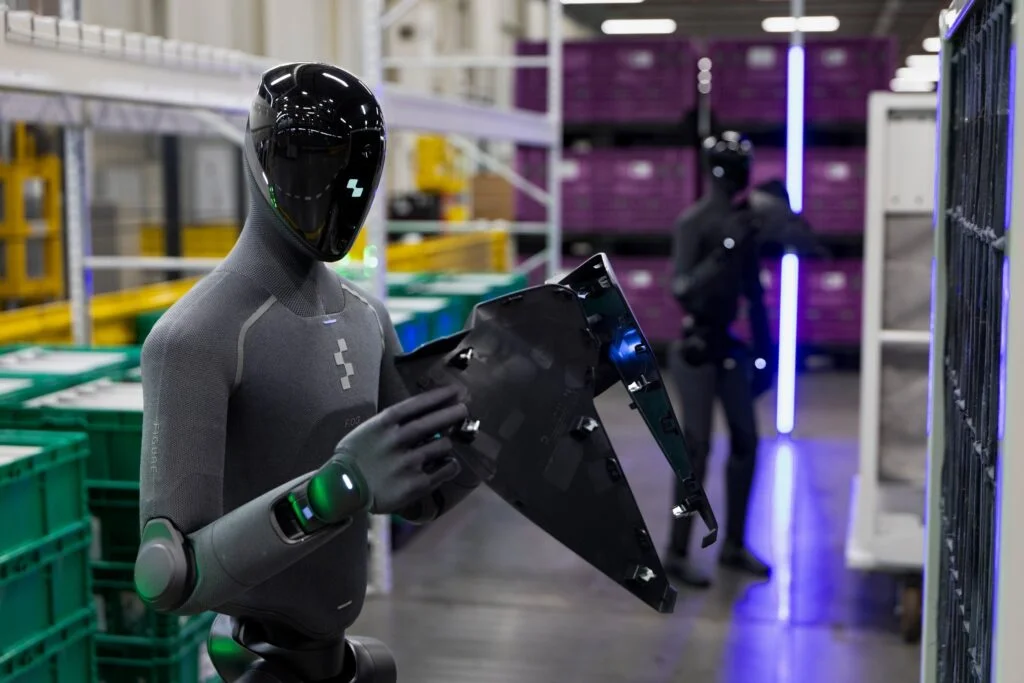
The strongest commercial evidence is emerging from controlled industrial settings. BMW and Figure are now testing the newer Figure 03 on logistics work involving component sorting and cart handling, AI Insider reported. This is following a 2025 deployment that saw its second-generation robot operating for more than 1,250 hours at BMW’s Spartanburg, S.C., plant, where its humanoid robot loaded more than 90,000 sheet-metal parts and contributed to the production of more than 30,000 vehicles., according to the company. The work was narrow and repetitive, but it took place on an active assembly line rather than in a laboratory.
Agility Robotics reported in late 2025 that its Digit robot moved more than 100,000 totes at a GXO fulfillment facility under a multiyear robots-as-a-service agreement. This year, Agility has also announced commercial relationships with Toyota Motor Manufacturing Canada and Mercado Libre. Unlike a demonstration or nonbinding partnership, those arrangements create a clearer path toward repeat deployments and measurable customer economics.
Apptronik is targeting manufacturing and logistics with Apollo. Mercedes-Benz entered a commercial agreement to pilot Apollo in manufacturing, while Jabil agreed to build the robots and test them on tasks including sorting, kitting, inspection and subassembly. Apptronik is also using its Robot Park facilities and customer sites to collect real-world training data for future systems.
Hyundai is taking a more vertically integrated approach with Boston Dynamics’ Atlas. The automaker, which owns Boston Dynamics, says Atlas will begin work at Hyundai Motor Group Metaplant America in Georgia in 2028, initially on parts sequencing, with assembly applications targeted for 2030. Hyundai said it is targeting for capacity to manufacture 30,000 robots annually by 2028, and while those are significant plans they remain plans rather than evidence of a 30,000-unit deployed fleet.
China is operating from a different manufacturing base. Research from the Mercator Institute for China Studies, or MERICS, points to the country’s huge industrial-robot installed base, electric-vehicle supply chain and government support for embodied AI. Companies including Unitree, UBTech, AgiBot and Fourier Intelligence are pushing hardware costs lower and putting machines into research and industrial trials.
AI Insider has examined that advantage in its reporting on China’s robot manufacturing ecosystem and the IFR’s World Robotics 2025 report found that China installed 295,000 industrial robots in 2024, accounting for 54% of worldwide installations, and operated more than two million factory robots. The U.S. installed 34,200 industrial robots during the same year and continued to import most of its machines from Japan and Europe.
That nation’s industrial base also gives Chinese humanoid companies access to dense networks of suppliers for motors, gearboxes, sensors, batteries and electronics. The Mercator Institute for China Studies estimates that roughly 150 Chinese companies are developing humanoids and that China produced about 12,800 of the machines in 2025. Most went to research centers, training facilities and limited industrial applications rather than large autonomous workforces. MERICS also noted that UBTech described its Walker S2 robots as no more than half as efficient as human workers at the beginning of 2026 and pointed out that Chinese humanoids still lack precision and dexterity and are generally performing limited tasks or working in site-specific trials.
China’s manufacturing advantage is now colliding with a growing U.S. policy barrier. In July, the Federal Communications Commission added foreign-produced “advanced robotic devices” to its Covered List, effectively blocking new models of humanoid robots, quadrupeds and other mobile robots made outside the U.S. from receiving the equipment authorization needed to be imported, marketed or sold in the country. The restriction applies broadly to foreign-made robots rather than China alone, but Chinese manufacturers are likely to feel much of the impact because of their growing share of the market.
Partnerships Build the Humanoid Robotics Ecosystem
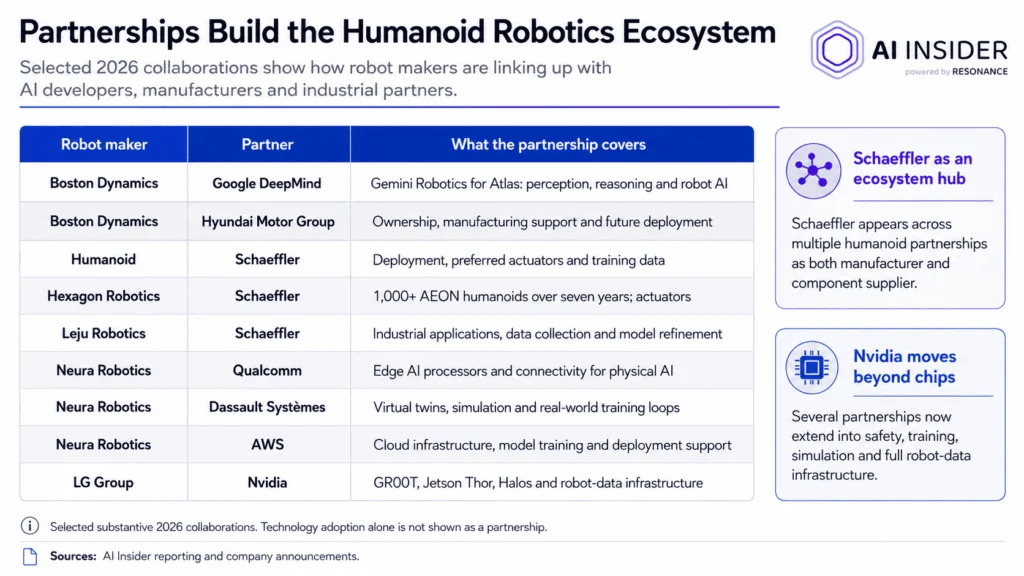
The move into real-world deployments is also changing how humanoid robots are developed. Rather than building every part of the technology themselves, robot makers are increasingly forming partnerships that connect AI models, components, manufacturing, training data and industrial customers.
One of the clearest examples came in January, when Boston Dynamics and Google DeepMind announced an AI partnership around Atlas. DeepMind is bringing its Gemini Robotics foundation models and vision-language-action technology to the project, while Boston Dynamics remains responsible for Atlas hardware, locomotion and system integration. The collaboration is part of a broader strategy at Hyundai Motor Group, Boston Dynamics’ majority owner, which is combining robot development with its manufacturing operations and partnerships with DeepMind and Nvidia. Boston Dynamics said its 2026 Atlas deployments were already committed to Hyundai and Google DeepMind.
Schaeffler taking another approach as both a humanoid customer and supplier. Its partnership with Humanoid combines factory deployments with actuator development and the collection of training data through teleoperation and synthetic-data generation. The companies expanded that relationship in May with plans to deploy a four-digit number of Humanoid robots across Schaeffler facilities by 2032, while Schaeffler is expected to supply more than half of the actuators needed for Humanoid’s wheeled platforms through 2031.
That model is extending across Schaeffler’s robotics strategy. In April, the company struck a similar agreement with Hexagon Robotics to supply rotary actuators and deploy at least 1,000 AEON humanoids across its factories over seven years. Schaeffler has also partnered with China’s Leju Robotics and Germany’s Neura Robotics, giving the industrial supplier a role in robot components, deployment and the factory data used to improve physical-AI systems.
Nvidia Expands Its Role Beyond Robot Computing
Nvidia is also moving deeper into humanoid development through partnerships that extend beyond supplying the chips and software used to run robots.
“Physical AI has arrived — every industrial company will become a robotics company,” Nvidia founder and CEO Jensen Huang said at Nvidia GTC 2026.
One of the broadest came in June, when Nvidia and LG Group announced a physical AI partnership covering humanoid, logistics and industrial robots. The companies plan to combine LG’s manufacturing expertise and operational data with Nvidia’s Isaac robotics platform, Omniverse simulation technology and Cosmos world models. LG is also developing a physical AI data factory that will use synthetic data to train robotics and industrial AI systems, addressing the difficulty and expense of collecting enough real-world robot data.
Nvidia is taking a different role with Hyundai Motor Group. The companies are developing a Robot Reference Platform that combines their physical AI technologies into a standardized hardware and software environment for universities, research institutes and startups. The effort is part of a broader collaboration around AI infrastructure, digital twins and robotics, with Hyundai contributing manufacturing, robotics and operational data. That relationship is separate from Boston Dynamics’ partnership with Google DeepMind, which is focused more directly on bringing Gemini Robotics models to the Atlas humanoid.
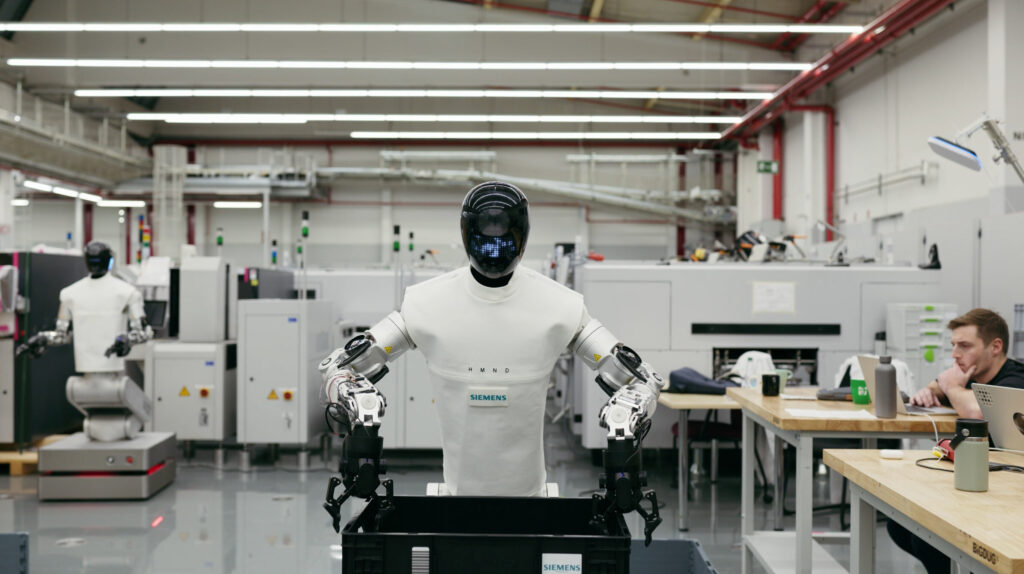
Safety is another area where Nvidia is becoming more directly involved. Agility Robotics became the first humanoid developer to work with Nvidia on Halos for Robotics, a safety architecture introduced in June. Agility plans to integrate Nvidia’s IGX Thor computing system and Halos software into Digit’s human-detection and safety systems and participate in Nvidia’s inspection program as it works toward third-party functional-safety certification.
Nvidia is also collaborating further down the robotics stack. Its work with Sharpa produced Tacmap, a tactile simulation framework for training robots on manipulation tasks, while Nvidia researchers used more than 20,000 hours of human video to train policies transferred to robots equipped with Sharpa’s five-fingered Wave hands. In May, Nvidia brought those pieces together with Unitree in an open humanoid reference design combining Unitree’s H2 Plus, Sharpa hands, Jetson Thor computing and the Isaac GR00T development stack.
Training Data Remains an Opportunity
Training data is becoming a partnership in its own right. Apptronik expanded its Robot Park network in 2026, where Apollo 2 robots collect data from industrial tasks through teleoperation, autonomous operation and simulation. The company said that data supports its research partnership with Google DeepMind and development of the Gemini Robotics models, creating a loop in which robots deployed in realistic environments generate information used to train future systems.
These arrangements point to a broader shift in humanoid robotics. Competition is no longer confined to who can build the most capable robot. It increasingly depends on who can assemble the AI, data, components, manufacturing capacity and industrial environments needed to improve and deploy those machines at scale.
That change is putting even greater emphasis on the models and training systems that determine what humanoid robots can actually do.
Challenges
Output, shipments, orders, pilots and productive deployed fleets are not interchangeable measures. The most useful measures are autonomous hours, interventions per hour, task-success rates, cycle time, uptime, repair time and the number of robots one worker can supervise. A robot must connect with warehouse software, conveyors, carts, work schedules, maintenance teams and safety procedures. It must recover from mistakes without stopping a production line. The National Institute of Standards and Technology is developing measurement methods for robot agility, manipulation, teleoperation, AI performance and workplace integration.
Humanoid robotics has made substantial progress toward those goals in 2026. The question facing the industry is no longer simply whether companies can build machines capable of impressive physical behavior. It is whether they can manufacture those machines in volume and make them intelligent, reliable and inexpensive enough that customers come back for more.